Baldwin County Schools Say Budget Is ‘On Track’ as Penny Tax Revenue Edges Up
Baldwin County's school system reported it was on pace to close fiscal 2014 with a healthy reserve as its one-cent education sales tax brought in slightly more money than the year before, officials told the board.
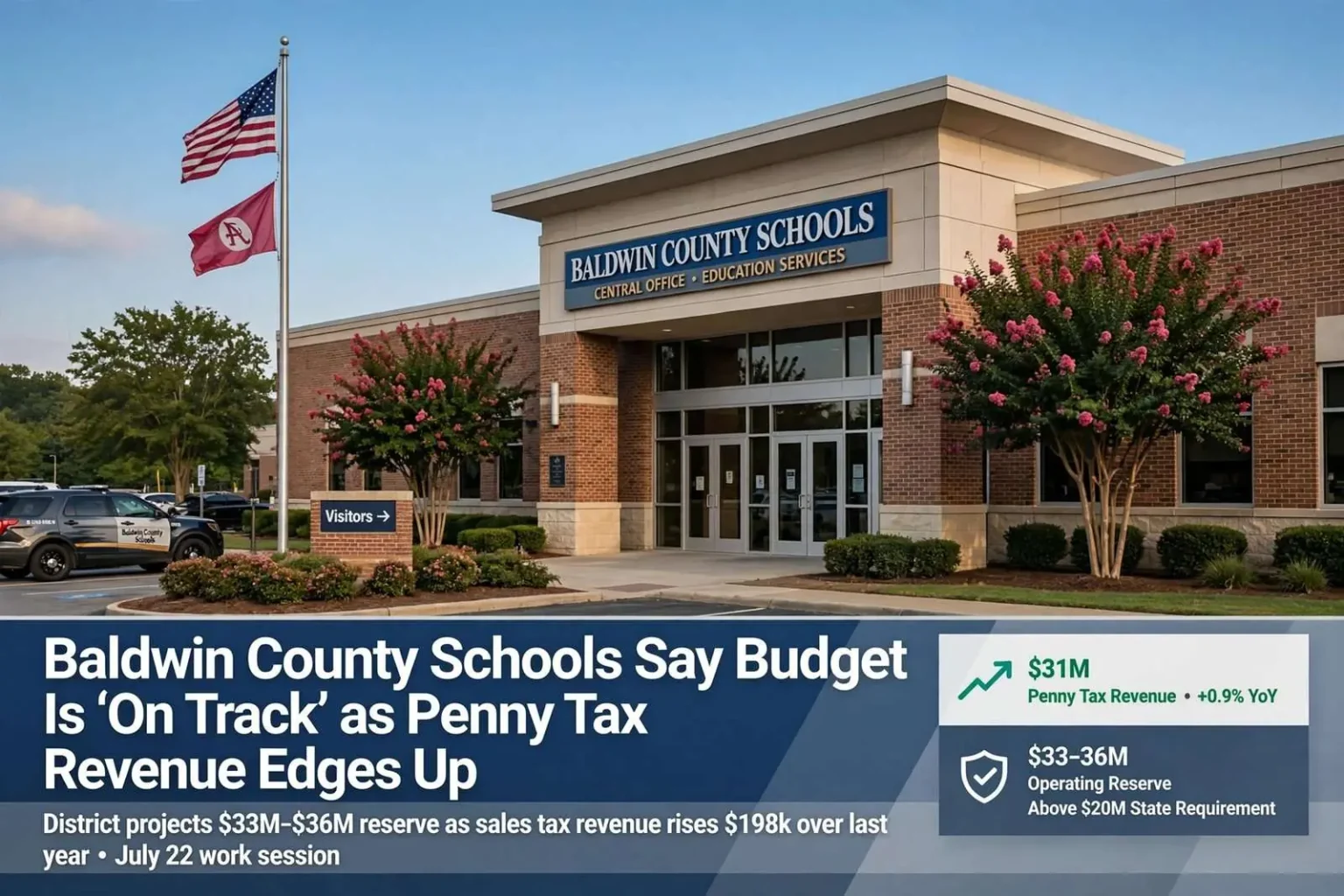
Local revenues for the Baldwin County school system came in slightly higher than the previous year, and the district was on track to finish fiscal 2014 in solid financial shape, its chief financial officer told the school board. The update, delivered as the fiscal year wound down, amounted to a mid-year bill of health for one of the state’s fastest-growing school systems—and, by implication, a contrast with the budget strain visible in other big Alabama districts.
John Wilson, the system’s chief financial officer, presented a financial update at the board’s July 22 work session. He said the district expected to close the fiscal year with an operating reserve balance of between $33 million and $36 million—a cushion that covers weeks of payroll and operations in a system the size of Baldwin County’s.
Comfortably above the required reserve
The State Department of Education requires every district to set aside enough money to cover one month of operating expenses. In Baldwin County, that threshold works out to roughly $20 million, meaning the projected reserve stood well above the state minimum. The one-month rule exists because school cash flow is lumpy—state allocations, property tax settlements and sales tax receipts arrive on different calendars than payrolls and utility bills—and a district without a buffer can be forced into short-term borrowing to make payroll.
Meeting that requirement is not automatic for every district. Wilson noted that the Mobile County system, the largest in the state, had finished fiscal 2013 about $7.6 million short of the mark, a contrast that underscored the relative stability of Baldwin County’s finances. Mobile County’s shortfall made it one of the districts statewide that have struggled to meet the reserve standard as state funding tightened and enrollment shifted, and it put neighboring Baldwin’s surplus in sharp relief across the bay.
Penny tax outpacing projections
The county’s one-cent sales tax for education had brought $21.4 million into the school system by the end of June, an increase of $198,000 over the same point in 2013. Wilson said his 2014 budget had planned for about $28 million from the penny tax, but that the total would likely come in closer to $31 million—a comfortable beat of the district’s own conservative forecast.
That figure would put the tax at roughly the same level it produced in fiscal 2013, suggesting the revenue source had stabilized after earlier fluctuations. The tax has been a central piece of the district’s funding, supporting day-to-day operations across a fast-growing county, and its fortunes track the local economy closely: retail sales in Daphne, Foley, Spanish Fort and the county’s other commercial centers rise and fall with tourism, new rooftops and consumer confidence.
Property tax collections were also tracking close to expectations. The system had collected $41.3 million in property tax revenue, about 98 percent of the budgeted $42.2 million. Property taxes, which arrive on the assessment calendar rather than the retail calendar, give the district a steadier second leg beneath the sales tax—and Baldwin’s property base has benefited from years of residential and commercial growth along the I-10 corridor and the beach.
“This means we’re on track to finish basically where we’ve expected,” Wilson said.
A $305 million spending plan
The district’s overall spending plan for 2014 totaled $305 million, reflecting the scale of a system that serves one of Alabama’s most rapidly expanding counties. Keeping revenues aligned with that plan has been a recurring theme for Baldwin County officials, who have watched enrollment climb along with the county’s population. Growth is a good problem—but it is expensive: every few hundred new students bring new teachers, portable classrooms or entire new schools, and the county has repeatedly turned to tax votes and building programs to keep pace.
The reserve balance carries particular weight for a growing district. A strong cushion gives the system flexibility to absorb unexpected costs, respond to enrollment surges and weather swings in sales tax collections, which can rise and fall with the local economy and the seasonal tourism that shapes much of the county’s commerce. A slow summer at the beach shows up in the school system’s receipts months later; a strong one does the opposite. The reserve is what smooths out those cycles so classrooms do not feel them directly.
The one-cent sales tax itself has been the subject of periodic public debate in Baldwin County, where officials have had to make the case to voters that the revenue remains essential to daily operations rather than one-time projects. Financial updates like Wilson’s serve that purpose: by showing exactly what the tax produces, what the district’s reserve requirement is and how the two relate, the numbers give the board a factual baseline for the tax conversations that inevitably return as enrollment grows.
Wilson’s report offered the board a snapshot of a system operating within its means as the fiscal year neared its close, with both of its major local revenue streams performing at or above what officials had budgeted. The update set the stage for the district’s planning heading into the following year, when Baldwin County’s continued growth would again test the balance between rising demand and available dollars.
For the board, the takeaway was twofold. The district could close fiscal 2014 with confidence—reserves well above the state floor, the penny tax stabilized and property taxes on target. And it could enter the next budget cycle knowing that the county’s demographic tide, the very thing driving enrollment and revenue upward together, would keep the financing question at the center of every school-building and staffing decision for years to come.
The July work session update also illuminated the structural difference between Baldwin County and the large urban district across the bay. Mobile County’s $7.6 million reserve shortfall, which the state had flagged in its oversight of the district, reflected years of declining enrollment, aging facilities and rising fixed costs in a system nearly three times Baldwin’s size. Baldwin’s challenge is the mirror image: growth that demands new buildings and staff faster than recurring revenue expands. Both districts must obey the same state reserve rule, but they arrive at it from opposite directions—one scrambling to build its cushion, the other defending one against the costs of its own success.
Sales tax revenue has grown into such a central pillar of Baldwin school funding that its monthly totals have become a kind of economic indicator for the county. The penny tax was originally approved by voters as a temporary measure and has been renewed repeatedly, most recently tied to school construction needs driven by the county’s population boom. When collections rose from roughly $21 million through June toward a projected $31 million for the year, the numbers confirmed not only school finance health but the strength of the retail economy from Spanish Fort’s shopping centers to the outlet malls near Foley.
The contrast between the two revenue streams matters for planning. Sales tax money moves with the economy in real time—strong holiday seasons and beach summers swell it, recessions drain it—while property tax receipts, pegged to assessments and collection schedules, change more slowly and predictably. Baldwin’s 98 percent collection rate on property taxes in fiscal 2014 meant the district could count on the stable portion of its local funding while using the sales tax as the sensitive, elastic piece. Financial officers like Wilson spend much of their year reading those two streams against each other.
State officials have pushed districts for years to treat reserve balances as a core measure of financial health, and Baldwin’s $33 million to $36 million projected cushion—roughly a month and a half of expenses beyond the required minimum—placed it among the stronger systems in Alabama. Reserves also factor into bond ratings, which affect borrowing costs when a growing district must finance new schools. In Baldwin County’s case, the healthy balance sheet in fiscal 2014 underwrote the borrowing capacity that the system’s enrollment growth would soon demand.
None of the good news in Wilson’s report removed the underlying arithmetic of growth. A $305 million budget in one of the South’s fastest-growing counties meant that every year’s stability was provisional—good while the tax base kept pace with the classrooms, strained when it did not. The July 22 work session closed with the district on track, its reserves deep, and its leadership already looking toward the next budget, the next enrollment count and the next conversation about whether Baldwin’s funding structure could keep up with Baldwin itself.
For parents and taxpayers in the district, the financial picture had a practical meaning that reached the classroom. Reserve strength and on-budget collections meant the system could avoid mid-year cuts, honor its staffing plans and maintain programs without emergency measures—a stability that districts forced into proration and reserve raids cannot promise. In a county where school quality is a major driver of the residential growth that fills the classrooms in the first place, a clean fiscal report is part of the product the community is buying.