Bond Set at $250,000 for Baldwin County Constable in Fatal Spanish Fort Shooting
A Mobile County constable charged with murder in a fatal Spanish Fort bar shooting had bond set at $250,000 after a Bay Minette hearing.
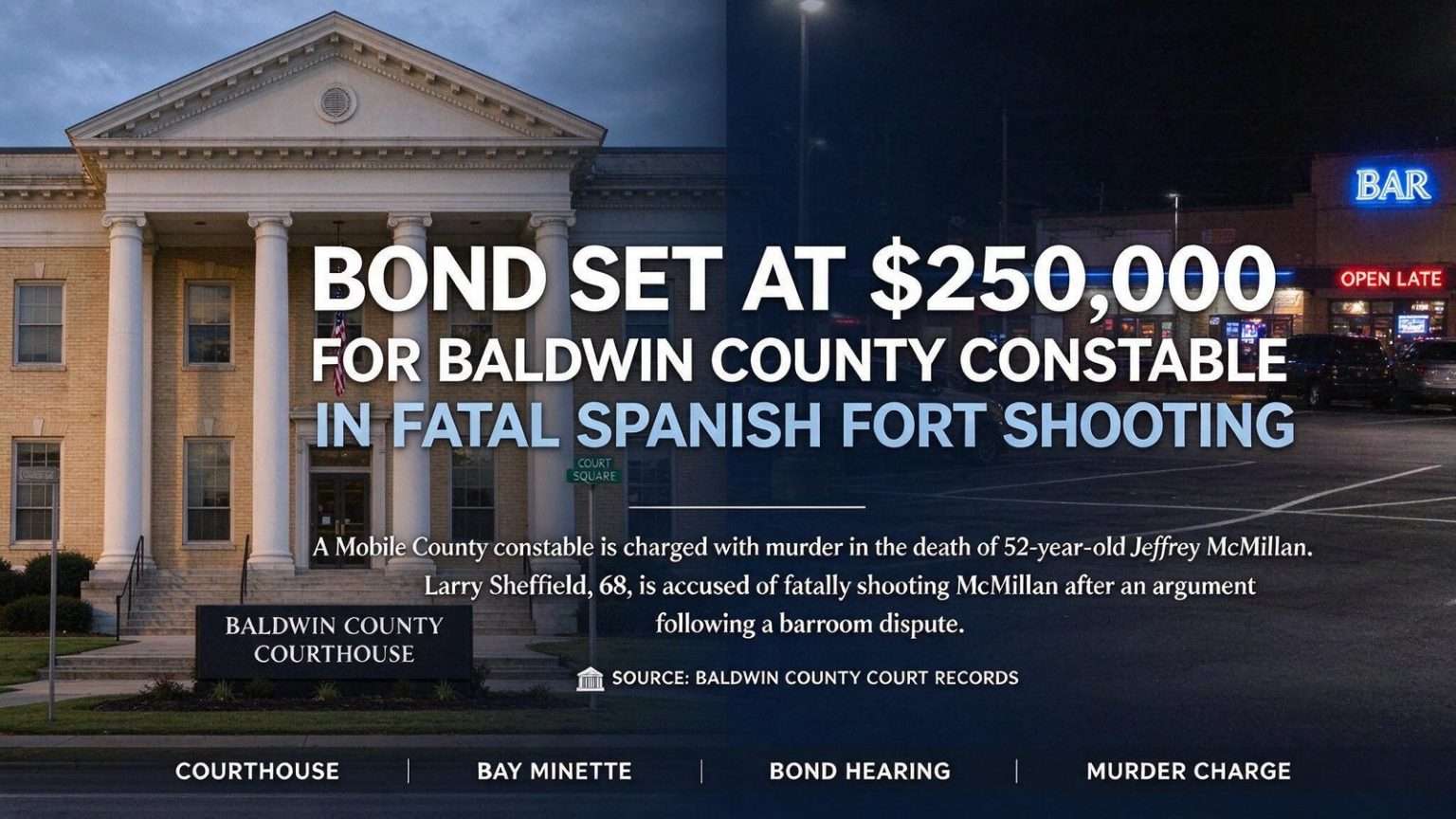
A Mobile County constable accused of fatally shooting a man outside a Spanish Fort bar had his bond set at $250,000 during a hearing this week at the Baldwin County Courthouse in Bay Minette. Larry Sheffield, 68, who has served as an elected constable since winning a write-in campaign in 2012, is charged with murder in the death of 52-year-old Jeffrey McMillan.
Authorities say McMillan was shot after midnight in the parking lot of a Spanish Fort bar following an argument that began inside the establishment. The shooting drew a heavy response from Eastern Shore law enforcement, and Sheffield was taken into custody shortly afterward. He had been held without bond since his arrest, a status that changed only when the district judge ruled on the bond request this week.
The hearing gave both sides their first public airing of sharply different accounts of what happened in the parking lot that night, and it previewed the questions a trial would likely turn on: who approached whom, and whether the shooting was an act of self-defense or an unprovoked attack.
The prosecution’s account
An assistant district attorney told the court that Sheffield started the confrontation, telling the judge the dispute began over a comment McMillan allegedly made to Sheffield’s wife while the group was inside the bar. Prosecutors asked that bond be set at $300,000, citing concerns about the danger Sheffield posed to the community if released.
The state’s version of events frames the shooting as the escalation of a barroom dispute that Sheffield could have walked away from, and prosecutors emphasized that the fatal shot was fired in a public parking lot well after midnight, in a part of Spanish Fort where businesses and their lots are shared by patrons of several nearby establishments.
Investigators are continuing to piece together exactly what happened between the two men in the moments before the shooting, and the case file remains open while detectives run down witness accounts and surveillance footage from the area. That ongoing work means the account presented at the bond hearing could still be refined as the case moves forward.
The defense’s account
Sheffield’s defense attorney pushed for a far lower bond amount, pointing to his client’s lifelong ties to Mobile County and his declining health. The defense offered a different version of events, telling the judge that Sheffield had already left the bar and was sitting in his vehicle when McMillan approached him in the parking lot — a scenario the defense described as self-defense rather than an unprovoked attack.
Under that account, Sheffield was attempting to leave when the encounter occurred, and the defense is expected to argue that he had no duty to retreat from a confrontation that came to him. The self-defense claim, if pursued at trial, would put Alabama’s stand-your-ground and justifiable-use-of-force statutes at the center of the case, and the defense signaled that those provisions will factor into its strategy as the proceedings continue.
Sheffield’s legal team also highlighted his health, telling the judge he has battled kidney cancer, has had a kidney and part of a lung removed, and is being treated for additional cancerous growths. The defense argued those conditions make Sheffield a poor candidate for a high bond and raise real questions about whether he could even post a substantial amount.
Prosecutors countered that his medical condition had not stopped him from going out to a bar and should not factor into how much bond he is required to post. The judge ultimately set bond at $250,000, a figure between what each side had requested — higher than the defense wanted but below the $300,000 the state asked for.
A bond of that size means Sheffield would remain in custody unless he or his family can secure a surety bond through a bail bondsman, which typically requires posting a non-refundable percentage of the total up front along with collateral. Given the amount, his release is far from certain, and his health will remain a point of contention as defense attorneys raise it in future motions.
The office he held
Sheffield’s status as a constable has drawn attention to a little-understood elected position that still exists on the books across Alabama. Constables in Alabama are county-level officers elected by district, and under state law they retain limited law enforcement authority, including the ability to serve civil papers such as evictions, subpoenas and other court documents. In practice, most constables today handle process serving rather than patrol duties, and their authority to make arrests or carry weapons in that capacity has been debated in the Legislature for years.
Sheffield took the office through an unusual route: a write-in campaign in 2012 in his Mobile County district. Winning as a write-in candidate is rare in Alabama elections and generally happens when no candidate qualifies for the ballot, leaving voters to write in a name. His election meant he held an elected public office even as his day-to-day duties remained limited, and the title has now placed a Mobile County elected official at the center of one of Baldwin County’s most closely watched criminal cases.
Sheffield, who has lived in Mobile County his entire life and has resided in the Semmes area for roughly a decade, remains tied to the western side of Mobile County even as his case plays out across Mobile Bay. Semmes, which incorporated as a city in 1996 after decades as a rural farming community, is one of the faster-growing corners of western Mobile County, and neighbors there have followed the case closely given Sheffield’s long tenure in local civic life.
Where the case goes from here
A murder charge in Alabama is a Class A felony, the most serious category in the state’s criminal code, punishable by 20 years to life in prison. Cases of this kind move from district court, where the bond hearing took place, through a preliminary hearing to determine whether probable cause exists, and then to a Baldwin County grand jury, which decides whether to return an indictment. Only after indictment does the case advance to circuit court for trial.
The Bay Minette courthouse, which houses Baldwin County’s district and circuit courts, handles the full docket of felony matters for a county that has grown into one of the fastest-growing in Alabama. Spanish Fort itself, perched along the Eastern Shore of Mobile Bay just east of the causeway, has expanded rapidly in recent decades with retail development around the I-10 and Highway 31 corridors, and its nightlife and restaurant scene draws patrons from across the Gulf Coast region.
Legal observers note that self-defense claims in Alabama hinge on the defendant’s reasonable belief that deadly force was necessary to prevent death or serious physical injury, and that the person claiming self-defense cannot have been the initial aggressor. The competing accounts presented at the bond hearing — one placing the confrontation’s start inside the bar with Sheffield as the aggressor, the other placing him in his vehicle when approached — map directly onto those legal standards, which is why the earliest testimony in the case has drawn so much attention.
For the McMillan family, the bond decision is only the first step in a long judicial process. Friends and relatives of the 52-year-old victim have begun organizing to follow the case through the Baldwin County court system, and prosecutors typically consult with victims’ families at each major stage, from the preliminary hearing through any trial.
The case remains open as both sides continue preparing for further proceedings. Detectives are still working to confirm the sequence of events in the parking lot, and both the prosecution and the defense have signaled they will rely heavily on witness statements collected in the days after the shooting. No trial date has been set, and further hearings are expected at the Baldwin County Courthouse in the coming months as the case works its way toward the grand jury.
Community reaction across the bay
News of the case has resonated on both sides of Mobile Bay, in part because of the unusual collision of an elected law enforcement title with a murder charge. Residents in Semmes and western Mobile County, where Sheffield has been known through civic and church circles for years, have expressed shock at the allegations, while residents of Spanish Fort have raised questions about safety in restaurant parking lots along the Highway 31 corridor, where late-night crowds on weekends can be substantial.
Baldwin County prosecutors handle a steady docket of violent felony cases each year, but cases involving current or former public officials tend to draw heightened scrutiny from the court system and the public alike. Court watchers note that the bond hearing drew more attention than a typical initial appearance, with observers from both counties present in the Bay Minette courtroom.
The timing of the shooting, just after midnight, is also likely to feature in the case. Establishments along the Eastern Shore close at varying hours, and late-night disputes that begin indoors and move outside are a recurring pattern that police departments across Baldwin County have worked to address through increased presence in commercial districts during weekend closing times.
Under Alabama law, a defendant who is out on bond must comply with standard conditions, which in murder cases often include no-contact provisions, restrictions on possessing firearms, and requirements to remain within specified counties unless the court grants permission to travel. Any violation of bond conditions can result in revocation and return to custody, a prospect the court likely made clear at the hearing.
Attorneys for both sides declined to discuss strategy in detail beyond what was said in court, and the district attorney’s office has not commented on whether additional charges or witnesses could emerge as the investigation continues. The defense, meanwhile, is expected to file motions addressing discovery and the self-defense claim in the weeks ahead.
For now, the case stands as one of the most serious criminal matters pending from the Eastern Shore, and its progress through the Baldwin County court system will be followed closely in both Mobile and Baldwin counties — by a community in Spanish Fort still processing a fatal shooting in its midst, by constituents in Mobile County who elected Sheffield to public office a decade ago, and by a family in McMillan seeking answers about how an argument inside a bar ended in a parking lot with a fatal shot.