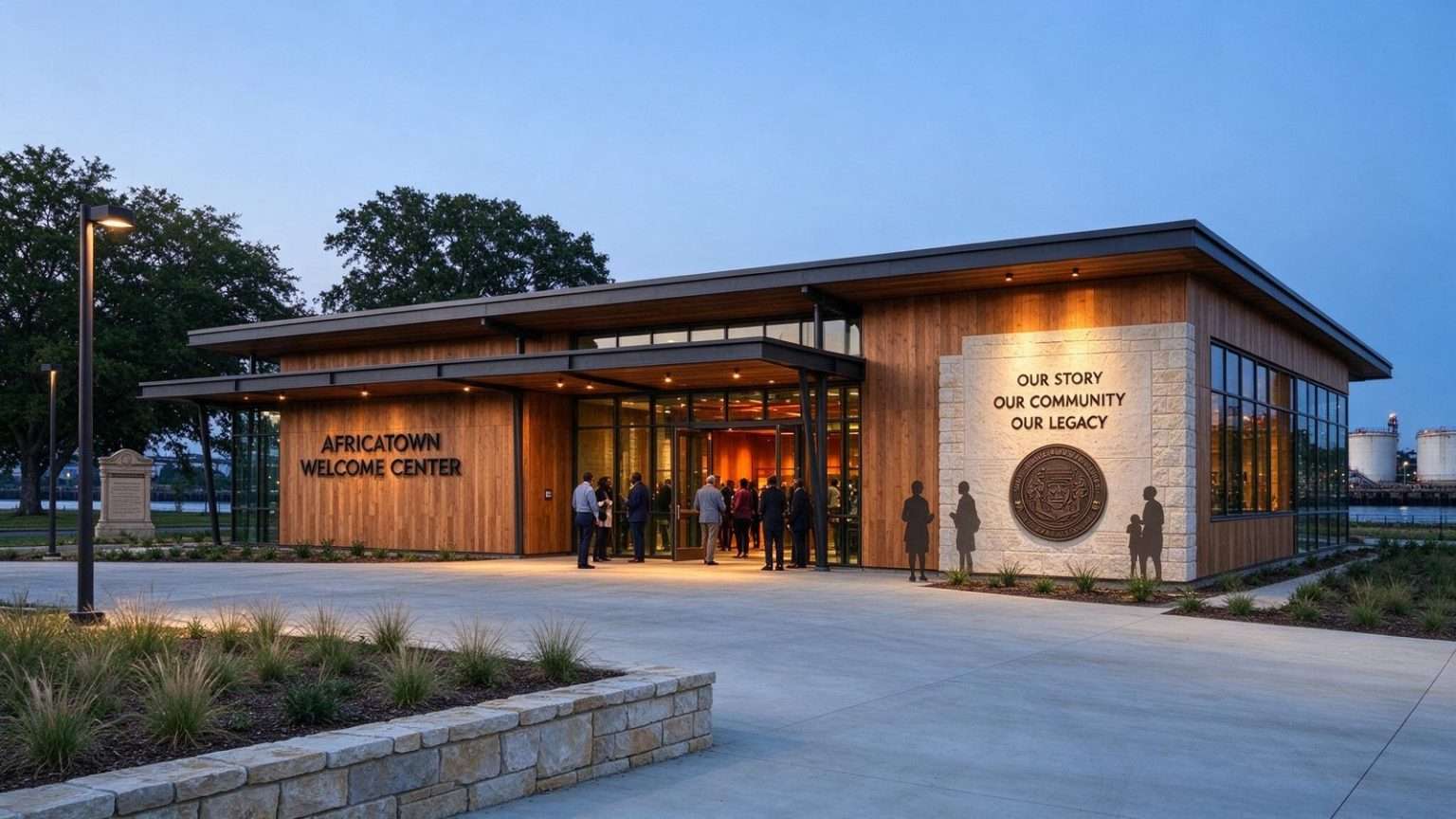
After seven months of discussions, mock-ups and community feedback sessions, architects and city staff have revealed the finished design for the new Africatown Welcome Center, presenting it to residents at a public meeting. The unveiling marked the transition from planning to execution for a project that residents have shaped at every step, and that the city has framed as a front door for one of the most historically significant communities in the United States.
Project manager Roger Washington said the team collected feedback throughout the process, asking residents to mark what they liked and disliked with dots and sticky notes so designers could refine the plans before moving into the next phase of the project. That method turned each public session into a working review rather than a presentation, with every rendering on the wall accumulating the community’s judgments in colored dots — approval in one color, objection in another — that the design team took back to the drawing board each round.
The seven-month process began with the basic questions any welcome center must answer — what it should contain, whom it should serve, and what it should say — and ended with a finished design shaped by the answers. For a project built on land with the history of Africatown’s, the community’s insistence on being heard was itself part of the design brief.
A Building Shaped by the Neighborhood
Renderings shown to the community feature a large lobby, a conference room and a theater — spaces that function both as visitor amenities and as community rooms for the neighborhood itself. A resident survey also pointed to strong demand for outdoor spaces and a place where visitors can learn the history of Africatown, the Mobile community founded by descendants of the survivors of the Clotilda, the last known slave ship to bring captive Africans to the United States.
That history is the reason the welcome center exists. The Clotilda arrived in Mobile Bay in 1860, decades after the international slave trade had been outlawed, and after emancipation the 110 survivors purchased land and founded their own community north of the city — a place where they could own property, build schools and churches, and preserve their West African identities. The neighborhood they built, known as Africatown and anchored in the Plateau and Magazine Point area, remains today a community of their descendants, and its story has drawn national and international attention since the 2019 confirmation of the Clotilda’s wreck in the Mobile River.
Longtime resident Lister C. Portis, who has lived in Africatown his entire life, said he looks forward to seeing the building that will represent his hometown. “We are rediscovering something old but looking at it with a new different perspective,” Portis said. His words captured the project’s double nature: a brand-new building whose entire purpose is to present an old and long-overlooked history to the world.
Stories on Display
Organizers plan to carry personal history into the building itself. Stories about growing up in the tight-knit community, along with memories of education and religious life, will be displayed on a monument wall on the exterior — accessible to visitors even after hours. The choice to put the community’s own words on the outside of the building, where they can be read without a ticket or an open door, reflects what residents asked for throughout the feedback process: that the center belong to the neighborhood first and to its visitors second.
The survey results reinforced that priority in other ways. Residents want the center to host after-hours events, historical celebrations and African dance classes — programming that fills the building at night and on weekends with the community it represents. A welcome center that closes at five would serve the tour buses; a welcome center that hosts dance classes and celebrations serves the descendants of the people whose story the buses come to hear. The programming plan leans deliberately toward the latter.
The conference room and theater in the design point to the same audience. Meeting space is one of the scarcest amenities in small neighborhoods, and a room that can host community meetings, school groups and presentations gives Africatown an institutional anchor it has not had. The theater allows for oral histories, documentaries and performances — the formats in which the community’s history is most naturally told.
Why Africatown’s Story Draws the World
The welcome center enters a moment of renewed attention for the community. The 2019 identification of the Clotilda’s remains in the Mobile River confirmed, with scientific certainty, the account that descendants had preserved for more than 150 years: that the ship’s owner had gambled on one final illegal voyage in 1860, that 110 young Africans survived it, and that their community on the edge of Mobile grew directly from that Landing. Since the confirmation, the community has been the subject of national media coverage, documentary films and a steady stream of visitors seeking the place where that history lives.
That attention carries both opportunity and strain. Heritage tourism can bring spending into a neighborhood that has absorbed decades of industrial encroachment — the community sits in the shadow of heavy industry on the Mobile River, a reality residents have long connected to the diminished health and prosperity of the district. But visitors need a place to be received, oriented and taught, and without one they drive through, photograph the historical markers and leave. The welcome center is designed to be that receiving point — to convert passing curiosity into a real understanding of what Africatown is.
The feedback process made clear that residents intend to control that presentation. The dots and sticky notes of the public sessions, the survey’s demand for outdoor space and history, and the monument wall of personal stories all point to a community asserting authorship over how its story is told. The building’s design is the written form of that assertion.
What Comes Next
With the design finished and presented, the next step belongs to the City of Mobile, which will begin searching for a contractor to build the facility. A timeline for construction has not been set, and the selection process will determine when shovels reach the site. City officials have described the project as a priority, and the completeness of the community process removes the planning-stage delays that often stall public buildings of this kind.
For the residents who spent seven months marking renderings with dots and notes, the unveiling was a checkpoint rather than a finish line — confirmation that the building that will represent their hometown is the one they asked for. Portis’s anticipation of seeing the building rise captures the community’s mood: something old, rediscovered and looked at with a new perspective, about to have a front door of its own.
A Community Founded by Survivors
Understanding what the welcome center means requires understanding how unusual Africatown’s founding was. The people who founded it were not settlers or migrants in any ordinary sense — they were survivors of an illegal kidnapping, trafficked across the Atlantic on the Clotilda in 1860 in defiance of federal law, smuggled into Mobile Bay and hidden by the voyage’s financiers. After emancipation came, they asked to be returned to Africa; when that proved impossible, they asked instead for land, bought it with wages earned in industry and sawmills north of Mobile, and built a community they governed and named themselves.
They deliberately preserved what they could of home. The founders kept West African names and languages among themselves, established a church and school of their own, and passed the account of the voyage down through generations with such discipline that when researchers began searching for the Clotilda’s wreck, the community’s oral history was the map. That continuity — a neighborhood that never stopped telling its own story — is precisely the story the monument wall and the center’s exhibits will carry forward.
The founders’ descendants have preserved that inheritance through a century and a half of pressures that erased similar communities across the South. Africatown was hemmed in by industrial development along the Mobile River, cut by road and rail corridors, and largely left out of the city’s growth booms. Its population declined from its early twentieth-century peak, yet the churches, the cemetery where founders including Cudjoe Lewis are buried, and the family lines in the neighborhood remain unbroken.
Planning With the Community, Not Just For It
The welcome center’s seven-month process stands out for how it was run. Public projects in historically marginalized neighborhoods have a long record of arriving as finished decisions with a ribbon-cutting attached, and residents’ skepticism of that pattern is earned. The design team’s approach — mock-ups, repeated sessions, and the dot-and-sticky-note method that made every preference visible — was built to demonstrate that input would actually change the plans, not merely be recorded beside them.
Washington’s description of the process emphasized exactly that loop: feedback collected throughout, designs refined between sessions, and a finished product presented only when the community’s marks had been worked through. The method also built something less tangible but equally important — a record of the process itself, which residents can point to when construction questions arise. A building designed this way begins its life with a constituency.
The survey instrument served a parallel purpose, converting individual preferences into data the design team could act on. The strong demand for outdoor spaces, for example, grew from residents’ understanding of how the community actually gathers — outdoors, in church yards and school grounds and along its streets — and the design’s response reflects that. So did the demand for after-hours programming, which treats the building as a living room for the neighborhood rather than a museum that goes dark at closing time.
The Wider Reckoning Around the Clotilda
The center also arrives amid a broader effort to bring Africatown’s history into public view. The Clotilda’s wreck, confirmed in 2019 by a team of archaeologists, is now a protected site, and its story has prompted new historical markers, museum exhibits in Mobile, educational programming and research into the community’s founding era. Descendant-led organizations have worked for years on community benefit plans tied to the ship’s legacy, arguing that the recognition of the history should translate into investment in the neighborhood where the survivors’ descendants still live.
The welcome center is one of the most concrete answers to that argument. It puts a permanent, purpose-built structure at the center of the visitor experience, in the community rather than across the river from it, and it commits the city to maintaining a venue for the neighborhood’s own cultural life — the dance classes, historical celebrations and after-hours events the survey called for. Construction has not begun, and a contractor has not been chosen, but the design is finished and the community has seen it.
Seven months of dots and sticky notes produced more than a set of renderings. They produced a shared plan for how Africatown will introduce itself to the world — in its own words, on its own walls, with the stories of growing up, going to school and building a church community displayed where anyone who comes looking can read them, day or night.