Trial Date Set for Eight Mile Man in Long-Running Baldwin County Sex Abuse Case
An Eight Mile man's trial is set for October at the Baldwin County Courthouse after he backed out of a plea deal.
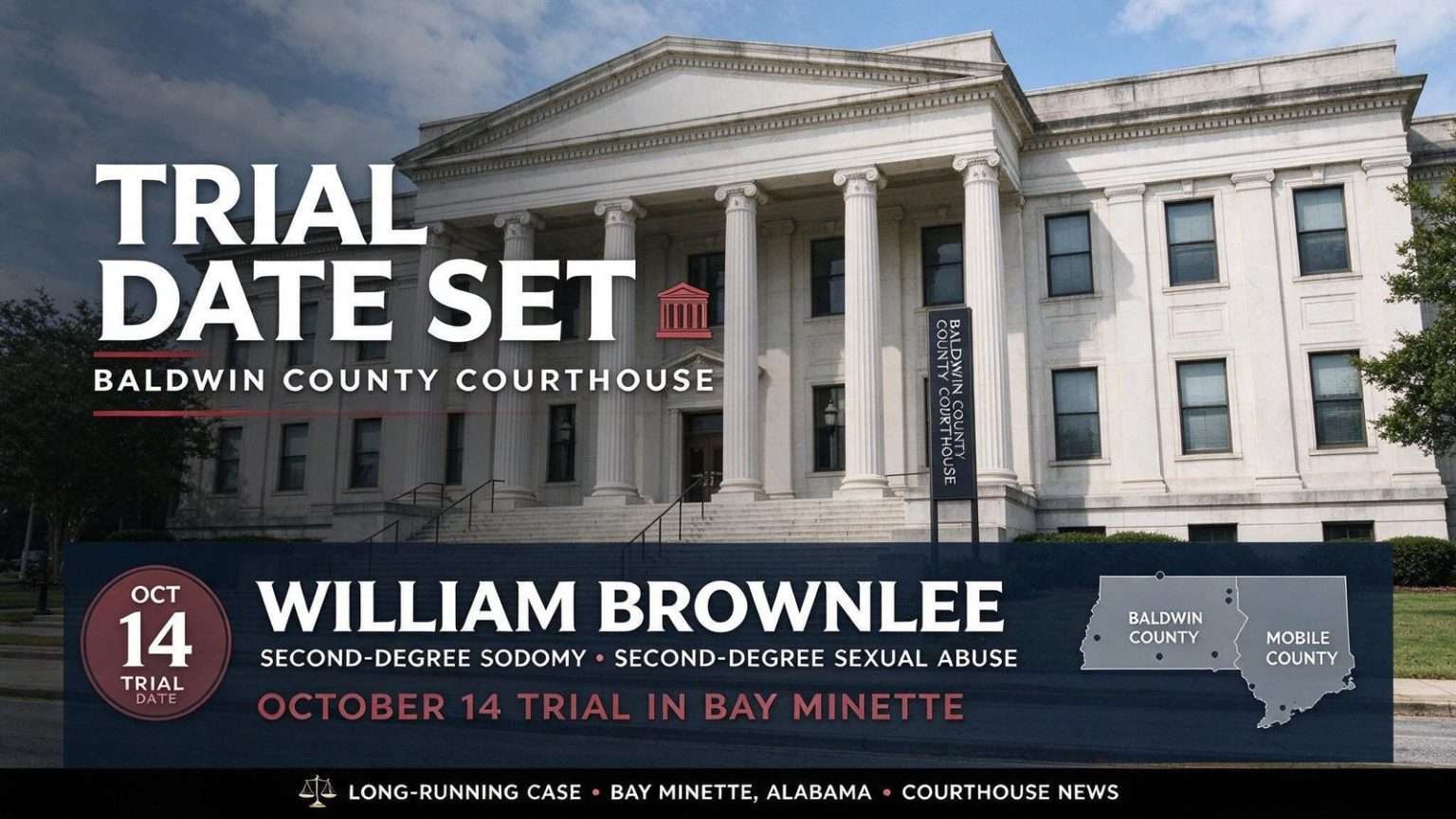
A trial date has been set for an Eight Mile man charged in a long-running child sex abuse investigation that has stretched across Baldwin and Mobile counties since 2012. William Brownlee, 50, is scheduled to stand trial October 14 at the Baldwin County Courthouse in Bay Minette on charges of second-degree sodomy and second-degree sexual abuse.
A Baldwin County grand jury indicted Brownlee in 2012, but the case has moved slowly through the court system in the years since. The delays have been typical of a complex, multi-defendant prosecution, in which the schedule of any single case is tied to the outcomes, appeals and procedural fights in the others.
Brownlee had been expected to plead guilty during a hearing in early August, but changed his mind in the courtroom before entering a plea. The reversal sent the case back onto the trial track and set up the October docket, one of the few remaining opportunities for prosecutors to bring a defendant from the sprawling investigation before a jury.
His attorney later filed a motion asking a judge to dismiss the charges outright, arguing that the indictment failed to properly spell out the allegations against his client. A judge denied that motion in late September, clearing the way for the case to proceed toward trial. The ruling left the indictment in place and narrowed Brownlee’s remaining options to trial, a late plea or further procedural delay.
A Case Tied to the Brittney Wood Investigation
Brownlee’s case is one of several stemming from a broader investigation into allegations of child sexual abuse within an extended family network in Baldwin and Mobile counties. Since 2012, at least 11 people have faced charges connected to the investigation, which became entangled with the disappearance of Brittney Wood, a Mobile County woman who has been missing since May 2012.
Wood’s disappearance gave the investigation a second, darker layer of public attention. The 19-year-old was reported missing after setting out to visit relatives, and the search for her has never produced the answer her family has sought. Investigators have said the sex abuse case and the missing person case became intertwined as interviews and evidence collection progressed across both counties.
Brownlee was reportedly a friend of Wood’s late uncle, Donald Holland, who died by suicide shortly after Wood went missing. Holland’s death came as detectives were following the trail of allegations through the family network, and it removed one of the central figures from a case that was already sprawling across jurisdictions.
The geography of the case has complicated nearly every step. Eight Mile sits along the boundary between Mobile and Baldwin counties, and the family network at the center of the investigation straddled that line, requiring coordination between two district attorney’s offices, two sheriff’s departments and two sets of grand juries, each with its own docket and its own pace.
For the young victims at the center of the allegations, the slow movement has meant years of waiting as cases were continued, negotiated and separated. Child advocacy professionals in the region have long noted that multi-defendant family abuse cases present some of the most difficult scheduling challenges in the courts, because testimony in one trial can affect the prosecution of every other case in the network.
How the Other Cases Have Resolved
Several of the other defendants tied to the investigation have already resolved their cases through plea agreements or youthful offender status. Wood’s brother was granted youthful offender status in a Baldwin County case, a designation reserved for defendants who were under 21 at the time of their alleged offenses and whose proceedings are closed to the public.
An uncle pleaded guilty to second-degree rape and sodomy charges in both Baldwin and Mobile counties and faced sentencing hearings in the following months. Because his crimes spanned both jurisdictions, he was required to answer separately in each county, a pattern repeated across the investigation as prosecutors matched charges to where offenses were alleged to have occurred.
Holland’s son was also granted youthful offender status on charges in Baldwin County, while another relative pleaded guilty to a sodomy charge in Baldwin County and continued to face separate charges in Mobile County. The mix of outcomes reflects the different ages of the defendants, the strength of the evidence in each case, and the strategic choices made by two different prosecutorial offices working in parallel.
Youthful offender status has been a recurring feature of the case’s resolution, and its use has drawn comment from residents who followed the investigation closely. Alabama’s youthful offender law is intended to give young defendants a chance at rehabilitation rather than adult prosecution, but it also closes courtrooms and seals records, which has limited what the public can learn about some of the case’s resolutions.
Baldwin County’s courthouse in Bay Minette, where Brownlee will stand trial, is the judicial center for a county that has grown rapidly along the Interstate 10 and Highway 98 corridors, and its circuit court dockets have absorbed some of the region’s most demanding criminal cases in recent memory. The Brownlee trial joins that list.
Trial Versus Plea in a Multi-Defendant Case
The scope and duration of the investigation have made it one of the more closely watched criminal cases in Baldwin County in recent years, with multiple family members facing prosecution across two counties simultaneously. Brownlee’s trial will be one of the few cases from the investigation to proceed to a full trial rather than end in a plea agreement.
A trial will put the evidence gathered by investigators from both counties before a Baldwin County jury, with testimony that is expected to revisit ground covered in the earlier cases but never tested in front of a jury of twelve. Prosecutors will need to present the allegations in a way that stands on its own, without relying on convictions that were reached through pleas or in closed youthful offender proceedings.
For the defense, the trial represents the first full opportunity to challenge the investigation’s conclusions in open court. The failed dismissal motion already previewed one line of attack, an argument about the sufficiency of the indictment, and the October docket will show whether similar challenges find a more receptive audience at trial.
Court officials have not indicated whether Brownlee’s trial date will hold or face further delays, a common occurrence in complex, multi-defendant cases moving through Baldwin County Circuit Court. Docket pressure, witness availability and the logistics of coordinating across two counties have all pushed this case back before, and experienced observers of the courthouse caution that October dates in long-running cases are rarely guaranteed.
The Baldwin County District Attorney’s Office continues to prosecute the remaining cases connected to the investigation as they move toward resolution. With most of the defendants having already resolved their charges, the office’s focus now narrows to the handful of matters still pending, Brownlee’s chief among them, and to the questions that remain open in the disappearance of Brittney Wood.
What the Case Means for the Community
The investigation has left a lasting mark on both counties. It prompted years of cooperation between law enforcement agencies that normally operate independently, tested the region’s child protection and victim services systems, and forced difficult conversations in the communities where the family lived about how such allegations could persist for so long unnoticed.
For Eight Mile and the surrounding communities along the county line, the case has been a long-running local story with deeply personal stakes, involving neighbors, relatives and classmates of those charged. The October trial will bring that story back into the open, and its outcome will be watched not only in Bay Minette but across both counties where the investigation began.
Whatever the verdict, the trial will also mark a milestone for the investigators and prosecutors who have carried the case for more than two years, and for the young survivors whose accounts led to the original charges. The October 14 date gives them, at last, a fixed point on the calendar after two years of continuances and uncertainty.
The Road From Indictment to Trial Date
The path from the 2012 indictment to the October trial date illustrates how slowly justice can move when a criminal case spans two counties. Grand juries in Baldwin and Mobile counties returned indictments as investigators worked through interviews and evidence, but scheduling the actual prosecutions proved far harder than charging them. hearings were continued as attorneys cycled onto and off of the cases, as defendants weighed pleas, and as prosecutors sequenced which matters would move first.
Brownlee’s own case traced that pattern. After his expected guilty plea collapsed in the early August hearing, the defense’s dismissal motion added another layer of delay, followed by the late September ruling and the setting of the October 14 date. Each step narrowed the possibilities, and each was closely watched by the families connected to the case, who have followed the docket through years of uncertainty.
Second-degree sodomy and second-degree sexual abuse are serious felony charges under Alabama law, each carrying potential prison sentences measured in years. The classification of the charges reflects the ages of the alleged victims in the investigation, and conviction on either count would bring permanent sex offender registration requirements along with any sentence the court imposes.
Preparation for an October trial now occupies both legal teams. The prosecution must organize the testimony of investigators, family members and expert witnesses into a coherent narrative, while the defense prepares cross-examinations and its own account of events. Jury selection alone is expected to be a significant undertaking, given how much publicity the investigation has received in the area since 2012.