Baldwin County Judge Grants Youthful Offender Status in Case Tied to Wood Family Investigation
A Mobile man linked to a long-running Baldwin County sex abuse investigation was granted youthful offender status in a closed-door hearing.
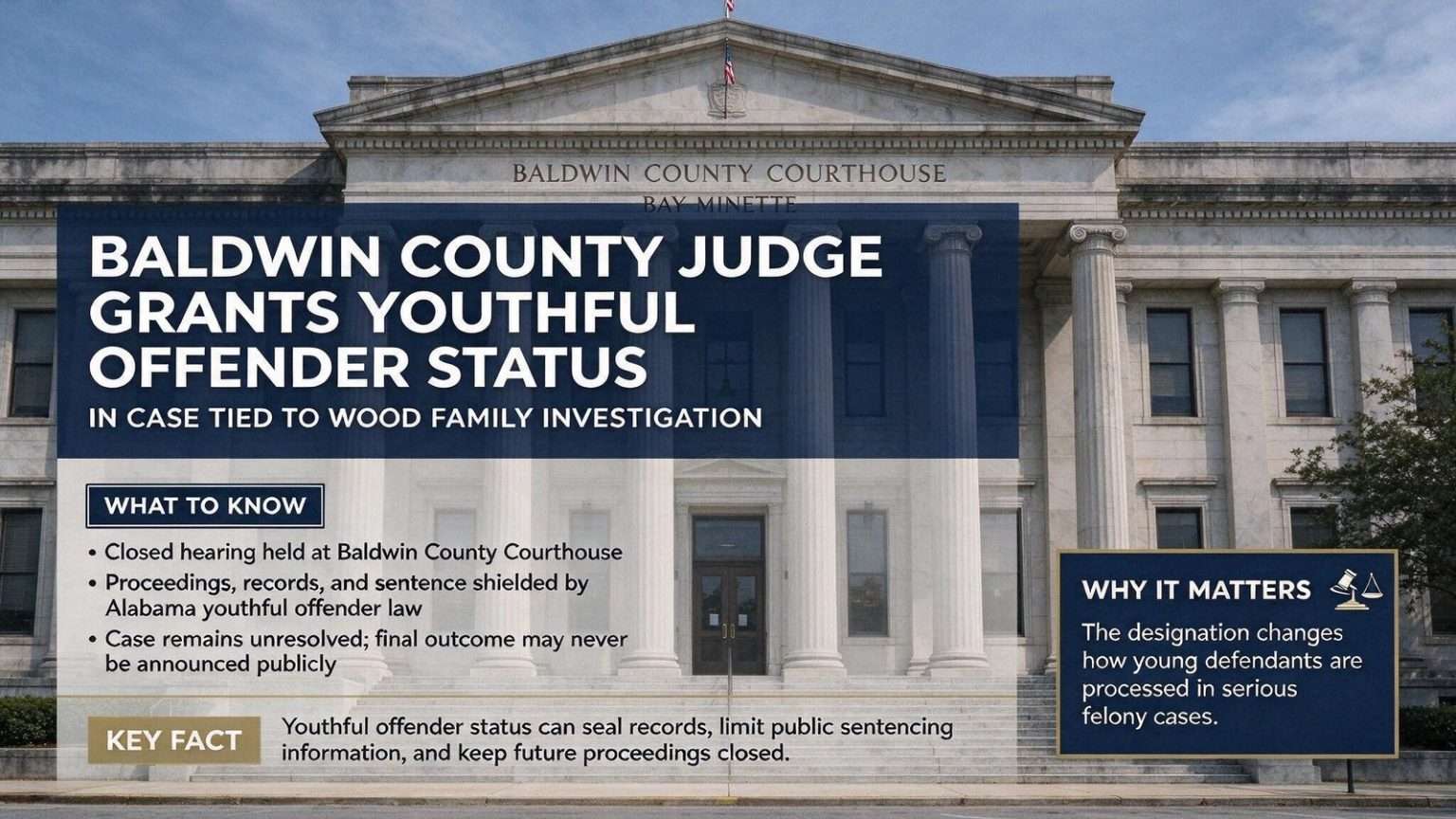
A Baldwin County judge has granted youthful offender status to a Mobile man facing rape and sodomy charges connected to a years-long sex abuse investigation that has drawn wide attention across South Alabama. The decision followed a closed-door hearing at the Baldwin County Courthouse in Bay Minette, where Circuit Judge Jody Bishop approved the request as part of an arrangement reached between defense attorneys and the Baldwin County District Attorney’s Office, according to officials familiar with the proceeding.
The hearing itself was closed to the public and the press, with only the defendant’s family permitted inside the courtroom. Because of the youthful offender designation, key details of the resolution, including any eventual sentence, are being kept out of public view under Alabama law. The unusual level of secrecy has only added to the intense community interest surrounding a case that is already among the most closely watched in the region.
An assistant district attorney handling the case acknowledged afterward that the matter had not reached a final resolution but said prosecutors hoped to bring it to a close in the near future. The defendant’s attorney declined to discuss specifics of the hearing, confirming only that his client had been granted the status. Neither statement shed light on what sentence, if any, the defendant may ultimately face, and prosecutors have not said when the case might be formally resolved.
What youthful offender status means in Alabama
Youthful offender status in Alabama is a legal designation available to defendants who were under the age of 21 when the alleged offense took place. The designation is rooted in the state’s juvenile code, and its purpose is to treat young defendants differently from adults, on the theory that they have greater capacity for rehabilitation and less culpability for mistakes made early in life. Prosecutors, defense attorneys, or the defendants themselves may seek the designation, but a judge must approve it after reviewing the circumstances of both the offense and the offender.
Once a defendant is granted the status, nearly everything about the case changes. Proceedings are closed to the public, court records are sealed from public inspection, and the defendant is tried by a judge rather than a jury. Sentencing options are also more limited than they would be in adult court, and if the defendant is later adjudicated a youthful offender, those records generally remain confidential. That is precisely what has happened here: details that would normally appear in public court files are now shielded, and the eventual outcome of the case may never be announced publicly.
For residents who have followed the wider investigation, the secrecy can be frustrating. Adult criminal dockets in Baldwin County are open to observation, and charges, plea agreements, and sentences are typically a matter of public record. A youthful offender case, by contrast, moves largely out of sight, leaving the public with little more than the fact that a hearing occurred and that the designation was granted.
The case is one of several stemming from a broader investigation into allegations that members of an extended Baldwin and Mobile County family circle passed children among themselves for sexual abuse over an extended period. The investigation has spanned years and multiple jurisdictions, and it has produced criminal cases that have moved through Baldwin County’s court system one at a time, each on its own timeline.
The defendant in this case had been indicted on charges of second-degree rape and second-degree sodomy involving a victim between the ages of 12 and 16 at the time of the alleged abuse. Under Alabama law, those offenses carry serious penalties in adult court, which is one reason the question of youthful offender eligibility carried such weight in the proceedings. The indictment itself became public when it was returned, but the resolution of the charges is now hidden behind the confidentiality that accompanies the designation.
The investigation gained heightened public attention in part because of its connection to the disappearance of a young woman from the same extended family who has been missing since 2012. That unresolved missing-person case has kept community interest in the broader investigation high, even as individual criminal cases have moved through Baldwin County’s courts on separate schedules. For many residents across the eastern shore and the greater Mobile area, the two threads — the criminal cases and the disappearance — have become intertwined in the public mind, even though investigators have treated them as distinct matters.
The reach of the alleged abuse network has made the case especially disturbing to families throughout the region. The defendants charged in the wider investigation come from the same extended family circle, and the allegations describe abuse of children over a period of years rather than isolated incidents. Such cases place heavy demands on prosecutors, who must balance the desire for accountability against the trauma experienced by young victims who may be asked to testify about events from their childhood.
Baldwin County, which includes communities such as Bay Minette, Foley, Fairhope, Daphne, and Gulf Shores, has seen the individual cases proceed at different speeds, with some defendants resolving their charges while others remain awaiting trial. The youth of the defendant in this particular case set it apart from the others and opened the door to the closed-door proceeding that took place this week in Bay Minette.
The youthful offender question also illustrates how Alabama’s courts handle young defendants in serious cases. Prosecutors in Baldwin County could have opposed the request outright and sought an adult resolution, but the arrangement reached with defense attorneys indicates a calculated judgment about how the case could best be brought to a close. Judges in the county weigh such requests by considering the defendant’s age, background, and record alongside the nature of the charges, and the decision to close the courtroom reflects the confidentiality the law attaches once the designation is granted.
Tuesday’s ruling marked the second time the defendant had sought youthful offender status in the case, after first raising the question earlier in the proceedings. The judge’s approval this week effectively resolved that issue and set the terms under which the remaining portion of the case will be handled, all away from public view.
What comes next in the case
Prosecutors have indicated they hope to reach a final resolution soon, but with the case now under the youthful offender umbrella, the public may never learn the terms of that resolution. If the defendant is adjudicated, the sentence will be determined by the judge under the limits that apply to youthful offenders rather than by a jury under the adult sentencing guidelines. Any probation, confinement, or treatment requirements would likewise remain confidential.
The Baldwin County Courthouse in Bay Minette, the county seat, has been the setting for the many related proceedings in the wider investigation. The courthouse handles the county’s circuit court docket, and cases arising from the investigation have appeared there over a period of years. Court officials have grown accustomed to attention from local media on dockets involving the case, which made Tuesday’s closed hearing all the more striking, since reporters were kept outside the courtroom entirely.
Legal observers note that the arrangement between the defense and the District Attorney’s Office suggests both sides saw value in resolving the eligibility question early. For the defense, youthful offender status offers the possibility of a more lenient outcome and a sealed record. For prosecutors, agreement on the designation may have simplified the path to a resolution in a case involving a young defendant and a victim who was a minor at the time of the alleged offenses.
A community still watching
For South Alabama residents, the case remains a source of unease. The allegations that children were passed among adults for abuse within a family circle struck many as almost impossible to comprehend, and the connection to a young woman missing since 2012 has kept attention focused on every development, however small. Community members have followed each court date, and the closed nature of this week’s hearing has done little to satisfy the questions many still carry.
Advocates for child welfare in Baldwin and Mobile counties point out that cases of this kind highlight the importance of reporting suspected abuse early, so that investigators can intervene before patterns of harm become entrenched. Schools, churches, and medical providers across the region are often the first to notice signs that a child is in trouble, and both counties maintain channels for reporting suspected abuse to law enforcement and the state Department of Human Resources.
For now, the defendant remains under the court’s supervision as the case moves toward what prosecutors hope will be a final resolution. Whether the public will ever learn the outcome is another matter. Under Alabama law, that decision now rests behind closed doors, where it is likely to stay.