Baldwin County’s Longest-Serving Prosecutor Weighs His Options
Baldwin County District Attorney David Whetstone, three months into a new six-year term, acknowledged in April 2005 that retirement rumors were circulating and that some of them were true.
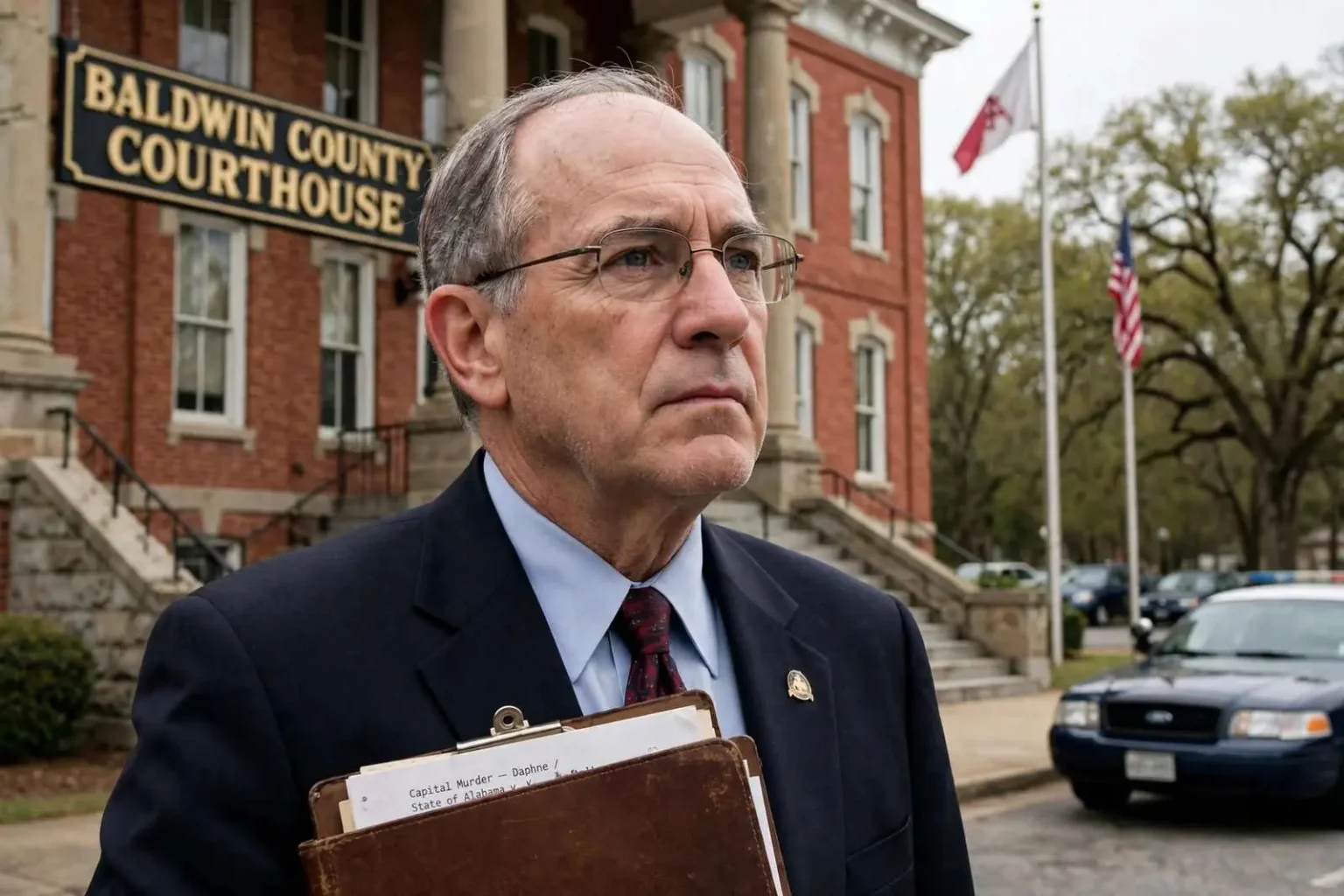
BAY MINETTE — David Whetstone, the longest-serving elected Republican prosecutor in Alabama, was three months into a fresh six-year term as Baldwin County district attorney in April 2005 when he sat down for a wide-ranging interview and declined, at considerable length, to say whether he intended to serve it. “Yes, I will say there are rumors circulating,” Whetstone acknowledged. “Some of ’em are true and some of ’em are not true.” He was 60. His state retirement was fully vested. He had maxed out on salary five years earlier and described himself, only half joking, as working for a small fraction of what he was worth. Offers had arrived from the private sector. Other opportunities beckoned in public life. And, as he put it more than once, “It’s nice to have options.”
Whetstone’s tenure as district attorney began in 1984, when he won his first election in a county that was then transitioning from Democratic to Republican dominance. He had served as an assistant district attorney under his predecessor, learning the office’s rhythms and the county’s criminal landscape. Over twenty-one years, he had prosecuted capital murder cases, overseen the office’s expansion from a handful of lawyers to a staff of twenty, and navigated the shift from paper files to digital case management. His reputation was built on a blend of courtroom aggression and administrative competence — he tried major cases himself rather than delegating them all, and he maintained a conviction rate that commanded respect from defense attorneys and judges alike.
Why the Timing Mattered
The calculation was not purely personal. Under Alabama law, a vacancy in a district attorney’s office is filled by gubernatorial appointment, and in 2005 the governor was Republican Bob Riley — whose own political future beyond the 2006 election was, at that moment, widely regarded as uncertain. A prosecutor who wanted a say in choosing his own successor had a narrow and closing window in which to exercise it. Whetstone did not put it quite so bluntly, but he did not have to. If a Republican administration left Montgomery, so would his influence over who inherited the office he had run since 1984.
The gubernatorial appointment power for district attorney vacancies is a distinctive feature of Alabama’s judicial system. Unlike judges, who face retention elections, a DA appointed to fill a vacancy serves until the next general election — potentially years. This gives the governor significant indirect influence over local prosecution priorities. In 2005, Riley was in his first term, facing potential primary challenges and a general election against a Democratic opponent who could be competitive in a state where the Democratic brand still held sway in many local races. Whetstone’s calculation was that a Democratic governor would appoint a Democrat to lead the Baldwin County DA’s office, fundamentally changing its orientation on issues from death penalty pursuit to drug prosecution to public corruption.
Still, He Insisted No Departure Was Imminent
Still, he insisted no departure was imminent. If he were easing toward the door, he said, he would not be preparing to try a capital murder case himself in May; he would be handing that kind of draining, months-long assignment to an assistant. The case involved a double homicide in the Daphne area, the kind of high-profile prosecution that Whetstone had always taken personally. His willingness to lead the trial team suggested either genuine commitment to seeing the term through or a desire to exit on a high note — a final courtroom victory before whatever came next.
Whetstone’s courtroom presence was a known quantity in Baldwin County. He had tried more than thirty capital cases in his career, a number that dwarfed most prosecutors’ experience. He knew the rhythm of a death penalty trial — the jury selection choreography, the guilt phase strategy, the penalty phase mitigation — and he believed that the DA’s personal involvement in the most serious cases set a standard for the office. His assistants watched him work, learned his methods, and carried them into their own cases. The institutional memory of the office was, in many ways, embodied in Whetstone’s courtroom practice.
Who Might Follow Him
Pressed on succession — and repeatedly noting that “the job ain’t open” — Whetstone allowed that if he retired that day, his personal choice would be his veteran chief assistant district attorney, Judy Newcomb. “What I would ask, if I were to decide to leave, would be that whomever is appointed be a person obviously qualified, who has the experience to step in and run the office from day one.” Newcomb, who had worked alongside Whetstone for more than fifteen years, handled the office’s most complex white-collar and special victims cases. She was widely respected by the local bar for her preparation and professionalism. Whetstone’s endorsement, while unofficial, carried weight with the governor’s office — a fact both men understood.
The succession question in a district attorney’s office is not merely administrative. The DA sets prosecution priorities — which cases get resources, which plea offers are authorized, which diversion programs are funded. A new DA can reshape the office’s culture overnight. Whetstone’s tenure had been marked by a tough-on-crime posture: aggressive use of habitual offender statutes, resistance to early parole recommendations, and a willingness to seek the death penalty in cases where other prosecutors might settle for life without parole. His successor, whether appointed or elected, would decide whether to continue, modify, or reverse those policies. For the Baldwin County law enforcement community — sheriff’s deputies, municipal police, state troopers — the DA’s charging decisions directly affected their work on the street.
Baldwin County’s Growth and Changing Caseload
Baldwin County’s explosive growth during Whetstone’s tenure had transformed the office’s caseload. When he took office in 1984, the county’s population was roughly 80,000. By 2005, it had surpassed 150,000, driven by Gulf Coast tourism, retiree migration, and spillover from Mobile’s housing market. The criminal docket had expanded accordingly — more domestic violence, more drug cases, more property crime, more traffic fatalities. The office had added prosecutors, investigators, and victim advocates, but the per-capita resources had not kept pace. Whetstone had lobbied the county commission and the legislature for additional funding, with mixed success. The tension between a growing caseload and static resources was a constant backdrop to his tenure.
The county’s demographic shift also changed the jury pool. The influx of retirees from the Midwest and Northeast brought different attitudes toward crime and punishment — some more punitive, some more skeptical of law enforcement. The growing African American population in north Baldwin County, concentrated around Bay Minette and Stapleton, meant that jury selection in serious cases required more nuance. Whetstone had adapted, hiring prosecutors who reflected the county’s diversity and investing in jury research for capital cases. But he acknowledged that the office’s relationship with the community it served was an ongoing negotiation.
The Private Sector and Public Life Options
The private sector offers that Whetstone referenced were not hypothetical. Defense firms in Mobile and Birmingham had made inquiries about his availability, knowing that a former DA with his trial experience and local connections could command a premium in white-collar defense and civil litigation. The financial difference was substantial — a senior partner at a major Alabama firm could earn three to four times a district attorney’s salary, which was capped by state law at roughly $130,000. Whetstone had maxed out on that salary scale years earlier, meaning his only raises came from cost-of-living adjustments approved by the legislature.
Public life options were equally real. Speculation in Montgomery political circles had long linked Whetstone to a potential run for attorney general, a circuit judgeship, or even a congressional seat if the district lines shifted favorably. His name recognition in Baldwin County — the state’s fastest-growing county — was near-universal. His Republican credentials were unimpeachable: he had been elected as a Republican in 1984, before the party’s statewide dominance, and had never faced a serious general election challenger. The Alabama Republican Party’s leadership viewed him as a reliable ally and a potential standard-bearer.
A Career Defined by the Courtroom
For all the speculation about his next move, Whetstone’s identity remained rooted in the courtroom. He described his greatest professional satisfaction not in election victories or administrative achievements but in the moments when a jury returned a guilty verdict in a case he had tried. “That’s why I do this,” he said. “Not for the office. For the verdict.” The capital murder case he was preparing for May was, in that sense, the purest expression of his career — a test of evidence, advocacy, and the community’s judgment.
Whether he served the full six-year term or stepped aside for a successor, Whetstone’s legacy in Baldwin County was already fixed. He had built an office that prosecuted the toughest cases, trained generations of prosecutors, and maintained a consistency of purpose across political cycles. The county had grown from a rural outpost to a suburban powerhouse during his watch, and its criminal justice system had grown with it — not perfectly, not without criticism, but with a recognizable shape that bore his imprint. As he put it, “I’ve done the work. The rest is just noise.”