Foley Man Facing Child Sexual Abuse Charge Set for a Blind Plea in Baldwin County Court
A Foley man accused of sexually abusing a young girl in 2010 was scheduled to enter a blind plea at a mid-September 2014 hearing in Baldwin County court, records showed.
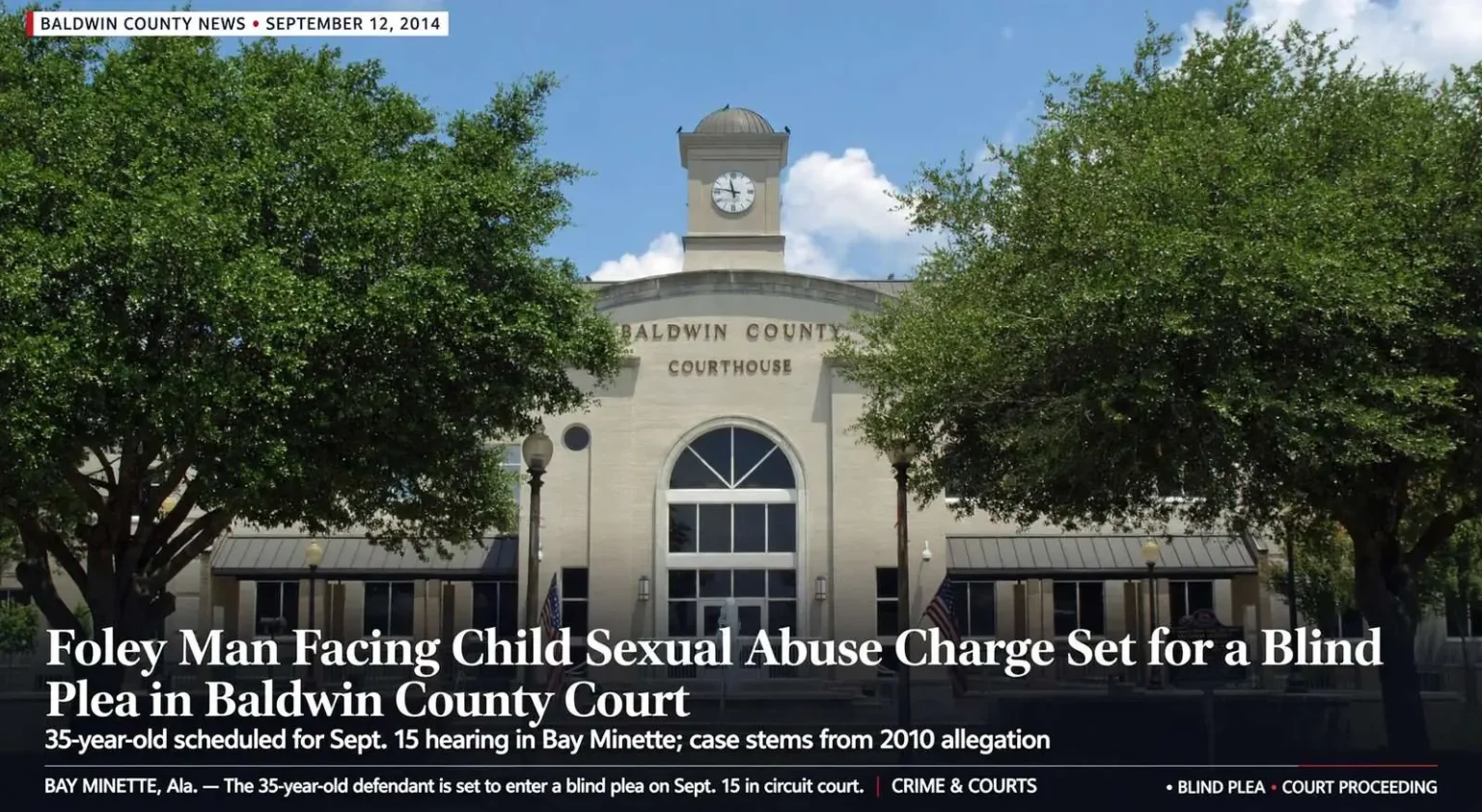
A Foley man accused of sexually abusing a 7-year-old girl was scheduled to appear at a mid-September 2014 plea hearing in Baldwin County court, according to records reviewed at the time. The 35-year-old defendant, whose home was listed in the 13200 block of Thomas Trail, was expected to enter what is known as a blind plea during the Sept. 15 hearing in Bay Minette, court records indicated. He faced a charge of sexual abuse of a child younger than 12 years old, stemming from an allegation dating to 2010.
The filing quietly set the stage for one of the most consequential decisions a criminal defendant can make: to place his fate entirely in the hands of a judge rather than take his chances with a jury or a negotiated agreement.
What a blind plea means
A blind plea is a plea entered in court without a sentencing recommendation from the prosecution. Rather than agreeing to a negotiated outcome, the defendant leaves the sentence entirely to the discretion of the judge. It is a route defendants sometimes take when no plea bargain has been reached but they nonetheless choose not to proceed to trial.
Because the prosecution offers no recommendation, the approach carries real uncertainty for the defendant, whose punishment rests wholly with the court. A judge weighing a blind plea considers the full range of punishment allowed by statute, the facts of the offense, the defendant’s history and the arguments of both sides at sentencing. There is no floor promised in advance and no ceiling agreed in advance — the outcome can be more lenient than the state might have offered, or harsher.
Defense attorneys generally treat the blind plea as a calculated risk, reserving it for cases where trial exposure is severe and negotiations have stalled. Prosecutors, for their part, gain a conviction without the strain of trial, but they surrender control over the sentencing recommendation that a negotiated plea would include. Judges accept blind pleas with care, ensuring on the record that a defendant understands exactly what he is giving up before the plea is accepted.
The charge and the arrest
Authorities arrested the man in December 2012 on the charge of sexual abuse of a child less than 12 years old. According to the affidavit filed in the case, the allegations described conduct against the young girl that formed the basis of the felony count.
Given the sensitive nature of the case and the age of the child involved, court proceedings were handled with the discretion typical of such matters in the Baldwin County system. Records in cases involving child victims are closely guarded, hearings are often closed or conducted with special protections, and prosecutors generally avoid details that could identify a young victim. That discretion is built into Alabama law, which provides protections for child witnesses that do not apply in ordinary felony cases.
The scheduled September hearing represented a pivotal moment in a case that had moved through the court process for nearly two years since the arrest. Delays of that length are not unusual in serious felony matters. Defense counsel need time to review evidence, and cases involving children often proceed slowly by design, so that young witnesses are prepared and protected. Along the way, the docket records hearings for motions, evaluations and negotiation sessions that never appear in public view.
In Baldwin County, cases of this kind move through a circuit court system that has grown with the county itself. The county’s population has expanded rapidly over the past two decades, feeding growth along the U.S. 98 and Alabama 59 corridors from Daphne and Fairhope down through Foley and the beach communities, and the courts have absorbed the caseload that comes with it.
A case in the Baldwin County system
The hearing was set to take place in Bay Minette, the seat of Baldwin County government and home to the circuit court where felony matters from across the county — including Foley and the rapidly growing communities of south Baldwin — are resolved. Defendants from the coast can face a drive of more than 40 miles north to the historic county seat, where the courthouse complex anchors a downtown of brick storefronts that has served as the county’s legal center for generations.
Cases involving allegations of child sexual abuse are among the most serious that prosecutors handle, and Alabama law provides for significant penalties upon conviction. A conviction for sexual abuse of a child under 12 carries a felony sentence that can extend to decades in prison, and judges in such cases must also consider supervised release requirements and sex offender registration that follow a defendant long after any prison term ends. Those stakes explain why the path to resolution in such matters is often long and carefully litigated.
The blind plea scheduled for that September hearing signaled that the case was approaching a resolution, with the outcome to be determined by the judge should the defendant proceed as court records anticipated. Had the plea gone forward, the hearing would have unfolded in two parts: the defendant’s formal admission of guilt on the record, followed by a sentencing proceeding in which the state and the defense would present evidence and argument before the judge imposed the sentence.
How felony cases reach that point
The road to a plea hearing begins long before the parties assemble in the courtroom. After an arrest, prosecutors in the district attorney’s office review the file — incident reports, witness statements, forensic interviews and physical evidence — and decide what charge, if any, the evidence will support. Grand jury indictment follows in felony matters, and then a period of discovery and motion practice in which the defense tests the state’s case.
In cases involving child victims, forensic interviewers and child advocacy professionals play an early and central role. The Gulf Coast’s network of child advocacy centers exists precisely to give children a single, controlled setting for interviews that might otherwise be repeated across multiple agencies, reducing trauma while preserving the quality of the evidence. That interview record frequently becomes the backbone of the prosecution’s case.
Negotiations run in parallel with that preparation. Most felony cases nationally are resolved by plea rather than trial, and Baldwin County is no exception. When the two sides cannot agree on a recommended sentence, the options narrow: go to trial, or enter a blind plea and let the judge decide. The September docket call in this case reflected the second path.
For victims’ families, the slow pace of the process can be difficult, even when it serves the case. Advocates for child witnesses note that each continuance extends the period during which a family lives with uncertainty, but they also acknowledge that careful case-building is often what makes a conviction possible without putting a young child through the ordeal of testifying at trial.
What the community can expect
As with any pending criminal matter at that stage, the defendant remained entitled to the presumption of innocence unless and until a plea was entered or a conviction obtained. A docket entry scheduling a plea hearing is not a finding of guilt; defendants sometimes appear expecting to plead and instead ask for a continuance, change course, or reach an agreement with the prosecution at the last minute.
If the plea had gone forward as scheduled, the judge’s sentencing decision would have ended the uncertainty that hung over the case since the 2012 arrest. Sentencing in Alabama felony cases generally follows soon after the plea, though courts may order pre-sentence investigations that add weeks while a probation officer compiles the defendant’s history for the court’s review.
For a community the size of Foley, court dockets in Bay Minette were a regular reminder that the machinery of the justice system continued its work well out of public view, moving cases toward conclusion months and sometimes years after the events that first brought them to the attention of law enforcement. The Sept. 15 hearing was one entry on a crowded calendar, but for the people connected to the case it represented the moment the long process since December 2012 would finally turn toward an ending.
Court observers note that blind pleas also shift some of the public accounting of a case. Because no negotiated sentence is announced alongside the plea, the community learns the outcome only when the judge speaks, and the reasoning behind that sentence becomes part of the court record rather than part of a bargain struck in advance.
The case also illustrated the quiet coordination that serious felony prosecutions require — police investigators who build the initial file, child advocacy professionals who document the youngest witnesses’ accounts, prosecutors who weigh the evidence, defense counsel who test it, and a court that must ultimately decide the outcome. None of that work is visible from the outside, and most of it happens years after the community has stopped paying attention. In the Baldwin County courthouse in Bay Minette, that was the work underway as the September hearing approached.