University of South Alabama Mobile
USA President Tony Waldrop Reflects on First Five Months Ahead of Historic Inauguration
University of South Alabama President Tony Waldrop discusses his first months in office ahead of the university's first-ever formal inauguration.
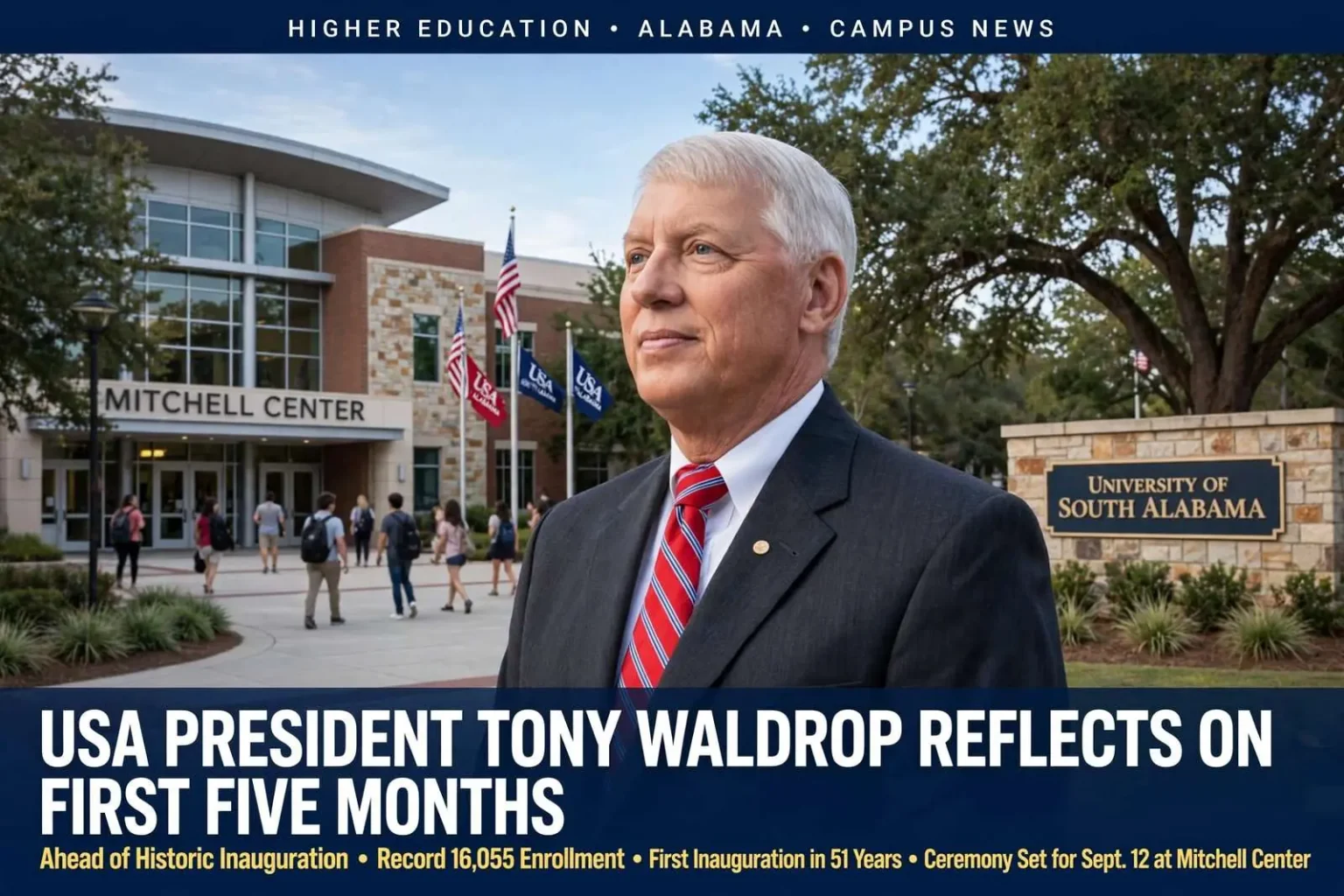
Five months into the job, University of South Alabama President Tony G. Waldrop has already overseen a record enrollment figure, made a string of high-profile public appearances, and fielded persistent questions about a possible on-campus football stadium. Now he is preparing for a milestone moment: the university’s first formal presidential inauguration in its 51-year history.
The university announced enrollment of 16,055 students this fall, a record for the institution. For a public university that began as an extension center in the early 1960s and grew into a comprehensive institution with a major medical enterprise, the number matters in concrete ways: state funding formulas, housing demand, faculty hiring and the scale of everything from parking to advising all track against enrollment. Landing a record figure in a new president’s first semester sets the tone for the tenure that follows.
Waldrop marked the early months of his tenure with a mix of ceremonial and hands-on appearances, including the grand opening of a newly renovated lobby and courtyard at USA Children’s and Women’s Hospital and a turn taking the ALS Ice Bucket Challenge that was popular nationwide that year. The combination was telling. Children’s and Women’s is the anchor of the university’s health system and one of the Gulf Coast’s most specialized medical facilities, while the Ice Bucket Challenge connected the campus to a national moment of fundraising for neurological research — a cause that resonates in a state where ALS touches families in every community.
A first in 51 years
Waldrop’s formal inauguration ceremony was scheduled for 2 p.m. on Friday, September 12, at the USA Mitchell Center. Neither of his two predecessors, Fred Whiddon or Gordon Moulton, had a formal inauguration ceremony during their tenures, making the event a first for the university.
That history says something about South Alabama itself. Whiddon led the institution from its founding era, and Moulton guided much of its modern growth; between them they shaped the campus for decades without ever standing for the formal academic ritual that older universities treat as routine. For a young institution still defining its traditions, an inauguration is less a pageant than a declaration — a way of saying that the university has arrived at a stage where its rituals are worth establishing.
Classes were canceled for the day so that students, faculty and staff across campus could attend. The decision transformed the ceremony from an event for dignitaries into a campus-wide occasion, and it reflected the emphasis Waldrop has placed since arriving on the university as a single community rather than a collection of departments.
Who will be there
Guest speakers at the ceremony were expected to include Mobile Mayor Sandy Stimpson, Mobile County Commissioner Connie Hudson, and U.S. Rep. Bradley Byrne, along with members of the University of South Alabama Board of Trustees. Dr. Steve Furr, the board’s chair pro tempore, was set to serve as master of ceremonies.
The guest list mapped the university’s political geography. South Alabama sits on land that binds it to the city of Mobile, the county commission that helps fund it, and the congressional delegation that advocates for it in Washington. A first inauguration that draws all three — the mayor’s office, the county commission and the U.S. House — amounts to a public reading of the relationships a new president will need to keep healthy.
University officials described the event as a chance for Waldrop to lay out his long-term vision for the school, building on months of conversations he has had with faculty, staff and students about the university’s direction. Inaugural addresses, at their best, convert a transition into a program; officials here framed the speech as the summary of a listening tour rather than the start of one.
Retention on the rise
In an interview ahead of the ceremony, Waldrop discussed the university’s continued progress on student retention, noting that the first-year retention rate for the fall 2013 freshman class climbed to 71 percent, marking the third consecutive year of improvement. Retention — the share of freshmen who return for their second year — is one of the most closely watched numbers in higher education, because it measures whether a university keeps the students it admits, and it feeds directly into the graduation rates families use to judge a school.
He credited expanded academic advising, more data-driven efforts to flag financial obstacles early, and a push to get students involved in campus organizations, arguing that engaged students are more likely to persist and succeed. The three levers he named reflect national research: advising catches academic trouble before it becomes academic failure, early warning on money problems prevents the mid-year departures that pile up in campus financial aid offices, and involvement in clubs and organizations gives students a reason to stay beyond the classroom.
For South Alabama, the improving streak also carries a financial dimension. Retained students are tuition revenue that returns automatically, and every point of improvement in first-year retention compounds across the years that follow. A record enrollment on top of rising retention is the combination university business officers like best: growth that is built to last rather than borrowed from the next admissions cycle.
Money, scholarships and the Mitchell gift
Waldrop also spoke about fundraising, highlighting the Mitchell-Moulton Scholarship program created through Abraham Mitchell’s $50 million commitment to the university, with all gifts matched dollar-for-dollar. Matching programs of that scale do more than add money; they recruit other donors, since every gift a donor considers is effectively doubled by the match, and they give fundraisers a deadline-driven story to tell across the Gulf Coast’s business community.
Waldrop and his wife, Julee Briscoe Waldrop, endowed their own scholarship in memory of his parents to benefit academically strong students from lower-income families, a group Waldrop said he identifies with personally. A president endowing a scholarship in his first months is a gesture aimed at setting priorities as much as providing aid: the gift points the university’s attention toward high-ability students for whom finances, not talent, are the barrier.
He also emphasized the value of employer-provided internships in preparing students for the workforce and said he has sought input from industry leaders, including positive feedback on the university’s engineering programs, to help align coursework with employer needs. The emphasis fits the regional economy — shipbuilding, aerospace, healthcare and chemical manufacturing all hire heavily along the central Gulf Coast — and it signals that Waldrop sees the university’s job as extending through graduation into employment.
The stadium question and what comes next
Woven through his first five months has been a question Waldrop has not been able to escape: whether South Alabama should build an on-campus football stadium. The university’s football program, a young addition by college standards, currently plays its home games away from the academic heart of the campus, and fans, students and donors have debated for years whether bringing the games home would change the feel of fall Saturdays in Mobile. Waldrop has fielded those questions persistently without committing himself publicly, and the inauguration is unlikely to settle the matter — but the vision he lays out will frame how the university weighs it.
As Waldrop settles into the role, university officials say his inauguration will formally mark the start of an era focused on shared goals among the campus community, with an emphasis on collaboration between administration, faculty, staff and students as the university works to define its future direction. The language of collaboration is standard for such occasions; the substance behind it, in Waldrop’s case, is the record of his first five months — record enrollment, rising retention, a landmark scholarship program and a hospital investment delivered before the ceremony even arrived.
For Mobile, the inaugural week is also a civic moment. The Mitchell Center crowd will include the region’s political leadership, the university’s trustees and thousands of students getting a first look at the president whose decisions will shape the campus for years. Fifty-one years after the university was chartered, it will hold its first presidential inauguration — a small ritual by the standards of older institutions, and a notable one for a university that has never needed one until now.
Why the record enrollment matters
Behind the headline number, a record fall enrollment reshapes campus life in ways students and parents notice directly. Residence halls and off-campus rentals tighten; class sections multiply; parking and dining plans strain and get revised. Universities that grow quickly have to decide whether growth is an opportunity or a problem, and the difference usually comes down to whether student services — advising, tutoring, financial aid counseling — grow with the student body.
That is why Waldrop’s pairing of enrollment news with retention news is significant. A university can post record numbers one year and watch them evaporate the next if freshmen do not return. By pointing to advising expansion, early financial warnings and campus involvement as the drivers of the retention climb, Waldrop effectively answered the question of whether the record class is being taken care of — and gave the faculty and staff at the ceremony a metric to hold the administration to.
The enrollment milestone also lands at a moment of stability for the institution. South Alabama had been led by only two presidents in its first half-century, and transitions at the top are when universities either consolidate their momentum or lose it. A record class arriving during a leadership handover is the kind of gift a new president cannot manufacture — and Waldrop’s first months suggest he intends to spend it on the fundamentals of teaching, graduating and employing students.