Oil Spill Upends Politics: Byrne Endorsement Rollout in Mobile Postponed
A press conference at which area legislators and council members were to endorse gubernatorial candidate Bradley Byrne was called off as the Gulf oil spill scrambled schedules along the coast.
A press conference scheduled for this afternoon in downtown Mobile, at which a slate of area elected officials was to announce their endorsement of Republican gubernatorial candidate Bradley Byrne, has been postponed.
The event was set for 4 p.m. at the Arthur R. Outlaw Convention Center. It would have been one of the more substantial displays of establishment support assembled in the Mobile area for any candidate in this year’s race for governor.
The Byrne campaign did not state a reason for the postponement. But the timing points in an obvious direction: the oil spill in the Gulf of Mexico, which began with the explosion of the Deepwater Horizon drilling rig on April 20, has scrambled the schedules of elected officials up and down the Gulf Coast this week as the slick moved toward Alabama waters.
Legislators, county officials and municipal leaders across Mobile and Baldwin counties have been pulled into briefings, coordination meetings and shoreline assessments. For a candidate seeking to project seriousness about a coastal economy suddenly under threat, holding a campaign event in the middle of it carried an obvious risk.
Who Was Set to Appear
Among those planning to publicly endorse Byrne were: former U.S. Rep. Jack Edwards, who represented southwest Alabama in Congress for two decades; state Sen. Ben Brooks; state Reps. Jamie Ison, Chad Fincher, Victor Gaston and Jim Barton; Mobile City Councilman John Williams; and Mobile City Councilwoman Connie Hudson.
The lineup is notable for reaching across the region’s Republican bench, from a retired congressman with deep name recognition to sitting legislators and two council members who have been at the center of Mobile’s contentious budget fight.
Edwards’ involvement carried particular weight in the region. Representing the First District for two decades in Washington, he built a reputation as an advocate for the Gulf Coast’s military installations and port interests, and his endorsement signaled the kind of institutional continuity that matters in a race where party elders are sorting among several contenders. The state legislators on the list — spanning districts in Mobile and Baldwin counties — brought the connections that matter in a campaign that will be decided in a statewide primary.
Hudson and Williams, meanwhile, represented the city government perspective at a moment when Mobile’s budget debate had dominated local headlines. Their planned appearance alongside state officials underscored how broadly Byrne’s support ran across the levels of government in his home region.
Why It Was Called Off
The Deepwater Horizon disaster transformed the political calendar across the Gulf Coast within days. The rig exploded on April 20 and sank, and in the weeks since, oil began moving toward the Louisiana, Mississippi and Alabama coastlines, threatening the beaches, fisheries and seafood industries that anchor the coastal economy of both Mobile and Baldwin counties.
For elected officials, the emergency absorbed the working day. Briefings with state and federal responders, sessions with fishermen and tourism operators, and coordination on boom deployments and contingency planning replaced the routine of public appearances. A 4 p.m. endorsement rally at the convention center — with the coast’s attention fixed on the water — risked looking tone-deaf at best.
The postponement also spared the campaign a difficult visual: a celebratory political event staged steps from a waterfront whose future had just become uncertain. In a crisis, candidates are judged less by what they say than by whether they seem to grasp the moment, and the campaign’s decision suggested it understood the optics.
The Race for Governor
Byrne, the former chancellor of Alabama’s two-year college system and a former state senator from Baldwin County, is among the leading contenders for the Republican nomination in the June 1 primary. He faces a crowded field in a contest that has become the state’s marquee political battle, with the winner advancing to face the Democratic nominee in the fall.
Byrne’s profile has been shaped by his tenure atop the two-year college system, where he took on an overhaul of an institution shaken by scandal — a record he presents as evidence of his willingness to confront entrenched interests. His time in the state Senate representing Baldwin County gave him roots in the fast-growing suburban belt south of Mobile, and his base along the coast is among the strongest any candidate brings to the race.
The Republican primary field is crowded and expensive, with multiple candidates competing for the same conservative electorate and a runoff likely if no one clears a majority on June 1. In that landscape, endorsements function as currency — each one signals to donors, activists and voters that a candidate has consolidated support in a key region. Mobile and Baldwin counties, with their large and reliably Republican electorates, are territory every contender must win, and the postponed event would have marked a significant claim on it.
How the Spill Reshapes the Campaign
The oil spill is already rewriting the issues frame of the campaign. Candidates who had been running on jobs, education and state budgets now find every forum pulled toward the coast’s emergency: who is responsible for the response, whether the state’s claims against the responsible party will be pursued aggressively, and how fishing, seafood and tourism families will be made whole.
For a coastal candidate like Byrne, the moment is double-edged. His familiarity with the region and its industries positions him to speak credibly about the spill’s consequences, and the crisis gives the coast’s concerns a prominence in statewide politics they rarely enjoy. But it also means his campaign events compete with the emergency itself, and any appearance of proceeding with politics as usual could cost him with the very voters who know him best.
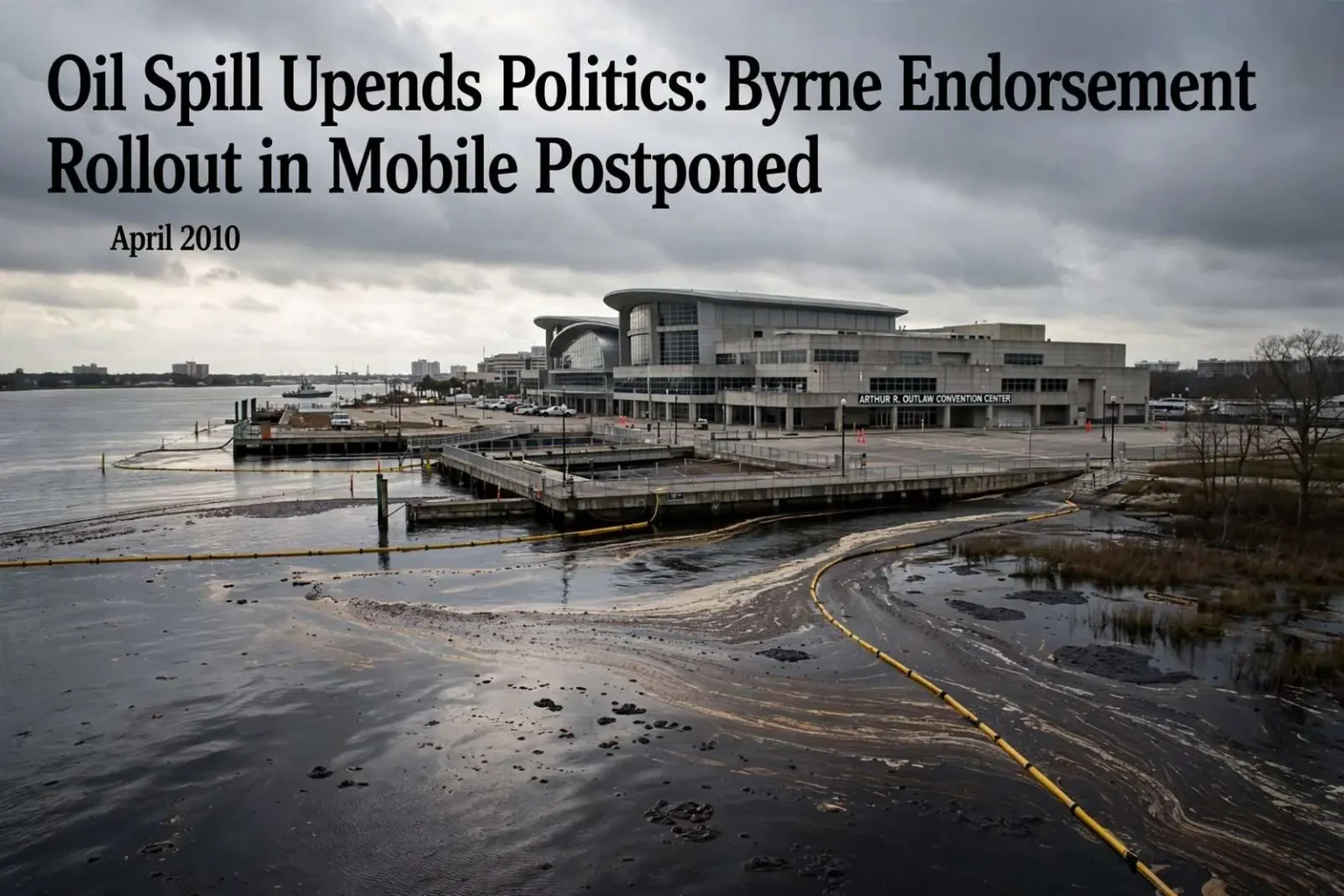
The convention center that was to host the event sits on Mobile’s waterfront, a reminder of how much the city’s economy and identity are tied to the Gulf. Whatever day the endorsement event is rescheduled for, it will unfold against a backdrop no campaign planned for — and every Gulf Coast candidate will be measured by how they respond to it.
What Comes Next
The Byrne campaign has not announced a new date for the endorsement announcement, and observers expect the event to be rescheduled once the immediate pressure of the spill response eases. The roster of officials who committed to appear signals that the support itself remains intact; only the timing moved.
In the meantime, the campaign joins the rest of the Gulf Coast in watching the water. For coastal Alabama, the weeks ahead will determine the extent of the spill’s damage to beaches, marshes and fisheries — and for the candidates who would govern the state through the recovery, the crisis has become the first great test of the 2010 campaign.
The endorsements in context
Political observers in the region noted that the breadth of the postponed lineup said as much as its individual names. A former congressman, four state representatives, a state senator and two city council members spanning the bay in a single announcement is the kind of consolidation candidates usually assemble in stages — a Baldwin legislator here, a Mobile council member there — rather than all at once.
For Byrne, the value went beyond headcount. Endorsements from sitting officials come with working networks: the legislators’ campaign volunteers, the council members’ neighborhood organizations, the donor lists that follow each endorser. In a primary fought largely on organization and name recognition across 67 counties, those assets compound, and locking down the Mobile area’s establishment early would have freed the campaign’s resources for the contested ground elsewhere in the state.
The announcement’s venue — the Arthur R. Outlaw Convention Center, the city’s flagship public facility on the waterfront — would have added its own symbolism, placing the endorsement in the building that hosts the region’s largest civic and commercial gatherings, in view of the port and the bay that define Mobile’s relationship with the Gulf.
A coast already on edge
Even before the slick arrived, the spill’s approach had changed daily life along the Alabama coast. Fishing boats that would normally be working were being contracted for response duty. Tourism operators watched reservation books as the national coverage of the spill played nightly. Local officials fielded questions about everything from beach closures to seafood safety, most of which no one could yet answer.
That uncertainty is precisely what made a political rally untenable this week. Constituents whose livelihoods hung on the response did not want to watch endorsement politics; they wanted information, preparation and advocacy. Every coastal elected official on the postponed list faced the same calculation, and the postponement reflected it.
Looking down the calendar
The June 1 primary remains weeks away, giving the campaign time to reschedule the Mobile announcement and regain its rhythm. Whether the spill’s political weight grows or fades will depend on how the response unfolds — and on whether the slick reaches the beaches of Baldwin County, where the tourism economy is most exposed and where Byrne’s political home lies.
For now, one of the state’s leading gubernatorial candidates has made the same choice as the region’s mayors, legislators and council members: the coast’s emergency comes first, and the campaign waits.