University of South Alabama Mobile
Ribbon-Cutting Caps $72.6 Million Expansion at Mobile Children’s Hospital
University leaders and hospital staff gathered in Mobile for a ribbon-cutting closing out a $72.6 million expansion at USA Children's & Women's Hospital.
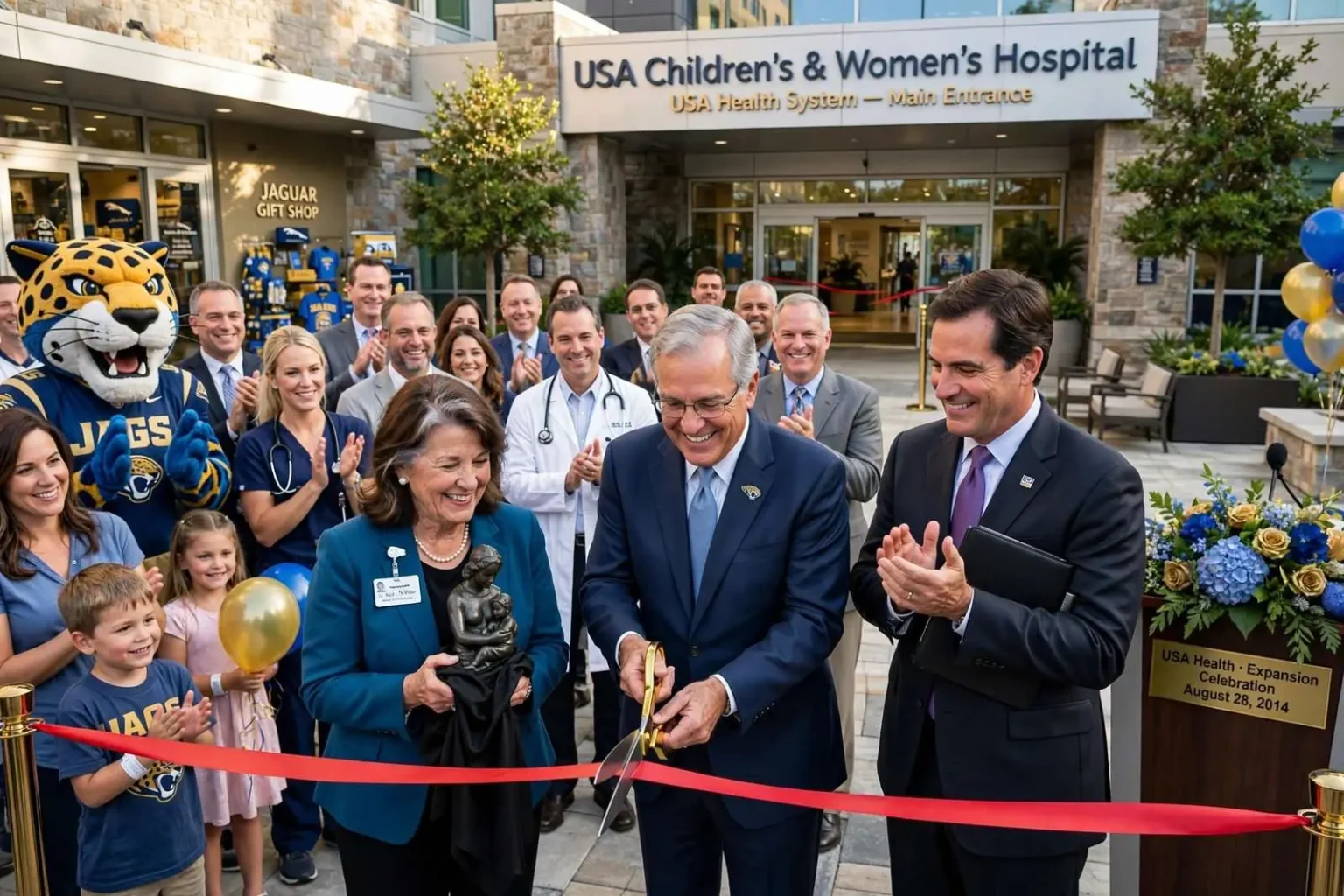
University of South Alabama leaders gathered with hospital staff and families in Mobile to mark the formal close of a $72.6 million expansion at USA Children’s & Women’s Hospital, capping nearly four years of construction with a ribbon-cutting and open house.
The event, held on a Thursday in late August, brought together administrators, donors and community members to celebrate the finished courtyard and lobby, the last visible piece of a project that broke ground on Nov. 17, 2010.
For the hospital’s staff, the day closed a chapter that had reshaped nearly every corner of the campus. Construction zones, temporary entrances and rerouted hallways had been part of daily life for years, and the finished lobby and courtyard restored — and greatly improved — the front door through which thousands of families pass each year, many of them arriving at the hardest moments of their lives.
USA President Tony Waldrop and hospital administrator Owen Bailey addressed the crowd during the opening ceremony, reflecting on the years of planning and fundraising that went into transforming the campus. During the program, Bailey presented a sculpture to Dr. Becky DeVillier, the hospital’s former administrator, in recognition of her years of service leading the facility.
The gesture highlighted how much of the project’s momentum predated the construction itself. Hospital expansions of this scale are years in the making before the first shovel of dirt turns — in master planning, in philanthropic campaigns, in the quiet work of administrators who build the case for investment and shepherd it through university and state approvals.
The USA Foundation’s role in funding the work placed the project squarely in the tradition of Gulf Coast philanthropy. Hospital foundations raise money across years of galas, named-gift campaigns and community drives, and major medical expansions in Mobile have historically depended on that giving alongside hospital operating revenue. Donors who gave to the children’s and women’s hospital knew they were funding a facility whose reach extends across state lines — the region’s high-risk deliveries and pediatric referrals funnel there from a multi-state area.
Waldrop, who led the university during the expansion’s defining years, and Bailey, the longtime administrator of the health system’s hospitals, used the occasion to thank the staff who carried the institution through the construction era. Nurses, physicians and support personnel worked for years around cranes, temporary walls and shifting entrances without interrupting the hospital’s core work — delivering babies and treating children every single day, in all weather and at all hours, while the campus was torn apart and rebuilt around them.
Phase One: A New Clinical Backbone
The first phase of the broader expansion, funded jointly by the USA Health System and the USA Foundation, added critical space for the hospital’s neonatal and pediatric intensive care units along with new operating rooms. That 195,000-square-foot wing very nearly doubled the hospital’s overall footprint and was dedicated back in September 2013.
The clinical spaces in that first wing carry the heaviest load in the hospital’s mission. The neonatal intensive care unit cares for the region’s smallest and sickest newborns, including the premature deliveries that arrive at USA Children’s & Women’s from across south Alabama, southern Mississippi and the Florida Panhandle. Additional capacity in the NICU and pediatric ICU translated directly into the number of critically ill children the hospital could accept on any given night.
USA Children’s & Women’s holds a distinctive place in the region’s health care landscape. As the only children’s and women’s specialty hospital in the area, it functions as the referral center for high-risk obstetrics, neonatal care and pediatric specialties across a broad stretch of the central Gulf Coast. Families from Mobile, Baldwin and Washington counties — and far beyond — rely on it for care unavailable at community hospitals, and its academic ties to the University of South Alabama’s College of Medicine mean that physician training and leading-edge treatment happen side by side.
New operating rooms in the first phase similarly expanded the hospital’s surgical capacity, from routine pediatric procedures to complex cases that previously faced scheduling bottlenecks. In children’s hospitals, operating room time is a scarce resource with a direct effect on how quickly young patients can be treated, and added suites ripple through the whole surgical calendar.
Phase Two: Built Around the Families
The second phase, celebrated at Thursday’s gala, focused on the patient and visitor experience rather than clinical space. Crews renovated and enlarged the hospital’s main lobby and gift shop and built a covered courtyard connector joining the newer wing to the original building, creating a more welcoming entrance for families arriving at the hospital.
The connector did more than look inviting — it solved a practical problem created by the first phase’s growth. With the hospital’s footprint nearly doubled, moving between the original building and the new wing had meant crossing between structures in the weather; the covered link folded the expanded campus into a single continuous interior path, an everyday improvement for staff moving between units and for parents shuttling between a child’s bedside and the cafeteria or pharmacy.
Children’s hospital administrators have increasingly embraced the idea that the building itself is part of the care. Long stays in a pediatric or neonatal unit are among the most stressful experiences a family can have, and design choices — natural light, open courtyards, calm public spaces — are treated as therapeutic tools rather than amenities. The finished courtyard gives families a place to step outside and breathe without leaving the hospital grounds.
The renovated gift shop, meanwhile, is more than a retail operation in a children’s hospital. Gift shops provide families enduring long stays with the small necessities — toiletries, snacks, reading material, a birthday present grabbed at midnight — that keep life functioning during a crisis, and proceeds typically flow back into hospital programs. The decision to stock Jaguar-branded merchandise alongside the usual offerings ties the shop into the university identity that runs through the whole health system, giving families a way to bring a piece of south Alabama spirit into a patient room.
The open house that followed the ribbon-cutting had a distinctly family-friendly feel, with USA’s Jaguar mascots and cheerleading squad mingling with guests. The newly finished gift shop, tucked into the renovated lobby, now stocks a wide selection of Jaguar and university-branded merchandise alongside its usual offerings.
The presence of the university’s mascots and cheerleaders underscored the institution’s relationship with the hospital. USA Children’s & Women’s is part of the USA Health System, and the athletes, students and alumni who fill Mitchell Center stands on basketball nights share the university with the tiny patients down the road. For children who may be long-term or repeat patients, a visit from a costumed mascot is a small, familiar piece of the world outside the hospital walls.
Celebrations carried into the next day, when a traveling juggling troupe called “Playing By Air” brought performances to the hospital for patients and families who could not attend the ceremony.
That follow-up mattered to the hospital’s philosophy of the week: the ribbon-cutting was, in a sense, for the donors and dignitaries, but the entertainment was for the children — the patients the expansion ultimately exists to serve. Hospital child-life staff routinely organize performances, visits and activities precisely because normal childhood experiences are part of healing.
For the staff who watched the courtyard and lobby open to the public, the celebration was a long-awaited exhale at the end of nearly four years of work.
What the Expansion Means for the Region
The completion of the $72.6 million project left USA Children’s & Women’s with a campus far larger, more modern and more capable than the one that broke ground in November 2010. The near-doubling of the hospital’s footprint gave the region’s only dedicated children’s and women’s hospital room to grow its neonatal and pediatric intensive care, its surgical program and its subspecialty clinics in the years ahead.
The investment also reflected confidence in the region’s trajectory. Mobile’s health care sector — anchored by the USA Health System, Providence Hospital and the area’s growing specialty practices — has expanded along with the Gulf Coast’s population and economy, and academic medical centers that invest in facilities tend to draw the physicians, nurses and researchers who keep care local. Every family that can receive complex pediatric care in Mobile rather than traveling to Birmingham, New Orleans or Pensacola saves hours of driving during the most stressful days of their lives.
Nearly four years after the groundbreaking, the ribbon-cutting marked the end of construction — but for the hospital, it was really a beginning. The expanded campus is now the backdrop for tens of thousands of births, surgeries and stays each year, and the renovated lobby through which those families pass was designed, down to the courtyard outside, to make the hardest days a little less hard.