University of South Alabama Mobile
USA President Tony Waldrop Takes ALS Ice Bucket Challenge in Mobile
University of South Alabama President Tony Waldrop joined the viral ALS ice bucket challenge outside the campus Jaguar monument in Mobile, Alabama.
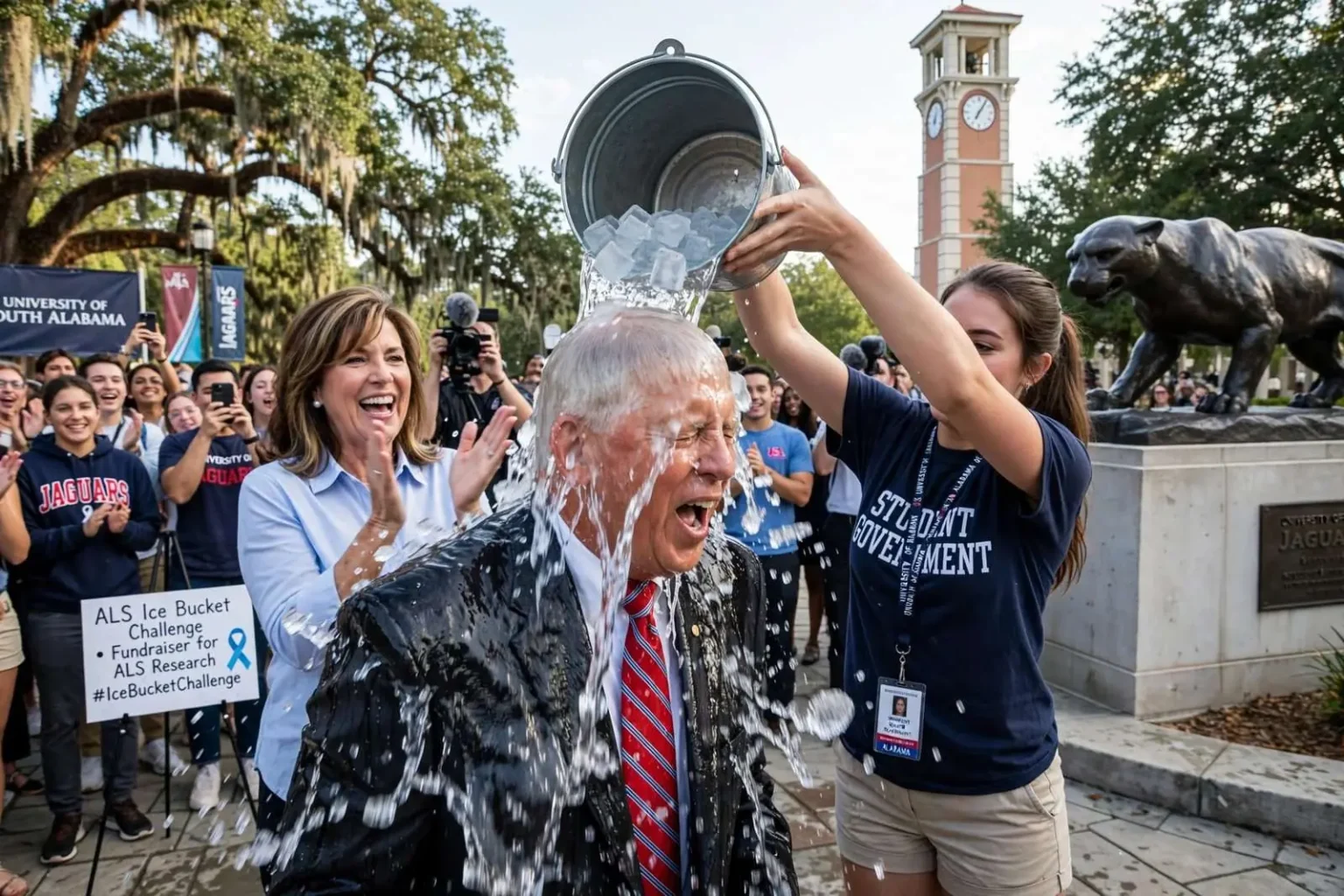
University of South Alabama President Tony Waldrop added his name to the growing list of Mobile-area figures taking part in the viral fundraising campaign for ALS research, standing outside the campus Jaguar monument as a bucket of ice water was dumped over his head. The moment capped weeks of the ice bucket challenge sweeping across social media nationwide, a campaign meant to raise awareness and donations for research into amyotrophic lateral sclerosis, a progressive disease that attacks the nerve cells that control muscle movement. Students and staff gathered around the monument to watch the university’s top administrator take the drenching, cheering as the water came down.
Waldrop, relatively new to the university’s top post, had been challenged by USA’s Student Government Association president, Danielle Watson, who showed up in person to empty the bucket herself. The handoff gave the campus event a personal touch that separated it from the countless challenge videos filmed in private backyards, putting student government leadership face to face with the president in a public display of support for the cause. Waldrop’s wife, Julee, joined in on the fun as well, taking part alongside her husband as the crowd looked on.
The Jaguar monument, a familiar landmark on the Mobile campus, provided a backdrop that made clear the event was a university-wide undertaking rather than a private stunt. Videos and photographs of similar challenge moments had been circulating for weeks by the time Waldrop took his turn, and the South Alabama campus community had watched athletes, entertainers, politicians and neighbors across the Gulf Coast accept the same dare.
A Challenge That Spread From Social Media to Campus
The ice bucket challenge followed a simple format that helped it spread at remarkable speed. A person who was challenged had 24 hours to either dump a bucket of ice water over their head or donate to ALS research, and many participants did both. After completing the challenge, the participant would call out others by name, creating a chain of tag-you’re-it moments that leapt from friend group to friend group and from city to city. By the time the campaign reached the University of South Alabama’s campus, it had already become one of the most successful grassroots fundraising efforts in memory, pulling in contributions from millions of donors large and small.
Amyotrophic lateral sclerosis, often called Lou Gehrig’s disease, is a progressive neurodegenerative condition that attacks the nerve cells responsible for voluntary muscle movement. Patients gradually lose the ability to speak, move and eventually breathe, and there is no cure. The disease’s brutality is part of what made the challenge resonate: the campaign’s visibility brought a little-known illness into everyday conversation, and the donations that followed gave researchers new resources for the search for treatments.
The viral format also suited the rhythms of campus life. Student organizations, athletic teams and academic departments across the country had been challenging one another all summer, and South Alabama’s student government made sure the university’s newest president did not sit the trend out. Watson’s decision to issue the challenge personally, and then to wield the bucket herself, tied the moment directly to student leadership on campus.
The Stunt Was More Than Spectacle
For all the laughter that accompanied the dousing, university organizers were careful to frame the event as a fundraising effort rather than mere entertainment. Participants across the campus community were pairing their ice bucket moments with actual donations to ALS research, turning a viral social media trend into tangible support for a disease that has no cure. That pairing of spectacle and substance was the hallmark of the campaign everywhere it appeared, and South Alabama’s version was no different.
The challenge also gave the university a chance to show a lighter side of its leadership at a moment of transition. Waldrop was still settling into the presidency, and a public, good-natured turn in front of students offered a different image than the ribbon cuttings and policy announcements that usually fill an administrator’s calendar. Campus events of this kind tend to travel far on social media, reaching alumni and prospective students along with the intended audience of donors.
Rather than let the moment end there, Waldrop turned around and issued challenges of his own, calling out members of the university’s leadership team, several academic deans and the president of the faculty senate to take their turn within the customary 24-hour window or make a donation instead. The strategy mirrored the way the campaign worked everywhere else: each newly drenched participant became the gateway to another round of participants, and each round carried the fundraising total higher.
At least one dean wasted no time answering the call. The dean of the college of engineering announced he would complete his own ice-water dousing within days of being challenged, a response that signaled the campaign would keep rolling through the university’s leadership ranks rather than stopping at the president’s office. Engineering students, with their well-earned reputation for creative contraptions, had been among the more inventive participants at campuses nationwide, and the college’s dean joining in gave that spirit an official stamp at South Alabama.
Meanwhile, Waldrop’s wife extended a separate invitation to Mobile County’s public health officer, pulling local government into the campus-driven wave of participation. The invitation underscored how the challenge had moved beyond celebrity circles and into the fabric of civic life, connecting the university’s campaign to the public health apparatus that serves the wider Mobile community. A dousing accepted by the county’s top health official would carry its own message about the seriousness of the cause.
How the Money Gets to Work
The funds raised through the challenge flow toward research into amyotrophic lateral sclerosis, a disease that has historically received far less research funding than its devastation would suggest. Because ALS progresses quickly and affects a comparatively small patient population, it has long struggled to attract the large-scale philanthropic attention that more common diseases draw. The challenge changed that equation almost overnight, giving organizations fighting the disease a level of visibility and financial support they had never enjoyed.
For patients and their families along the Gulf Coast, the influx of money and awareness carried real meaning. Care for ALS patients is intensive, involving equipment, therapy and round-the-clock assistance as the disease advances, and research into treatments depends on sustained funding that comes in waves when public attention spikes. Campaigns like the ice bucket challenge bridge the gap between a disease that most people never think about and the urgent need to understand it better.
University organizers noted that participants across the campus community were making good on the campaign’s dual promise, donating as well as dousing. The pattern reflected a broader truth about the challenge: while some critics dismissed it as slacktivism, the sheer volume of participants meant that even modest per-person gifts added up to substantial sums. The South Alabama campus, by organizing its participation around the Jaguar monument and involving student government, faculty leadership and administrators alike, converted a national meme into a coordinated campus effort.
The event also fit into a tradition of university communities rallying around health-related causes. From relay-style fundraisers to benefit walks, campuses have long served as engines for charitable participation, and the ice bucket challenge simply gave that instinct a new, faster-moving format. What once required months of organizing could now spread across a campus in a matter of days, with each participant recruiting the next.
A President Finding His Footing in Public
For Waldrop personally, the drenching offered an early lesson in the public side of a university presidency. New chief executives at public universities spend their first years introducing themselves to students, faculty, donors and the surrounding city, and few introductions travel as quickly as a video of the president soaked at a campus landmark. The event put a human face on an administration that most students knew only through formal announcements, and it did so in service of a cause that few would criticize.
The Jaguar monument setting reinforced the point. The jaguar serves as the university’s athletic identity, and the South Alabama Jaguars’ rise through the ranks of collegiate athletics has been one of the campus’s defining stories in recent years. Holding the challenge there tied the fundraising effort to the school spirit that animates game days, borrowing some of that energy for the benefit of ALS research.
The participation of Julee Waldrop added a family dimension that resonated with observers. University presidencies are demanding jobs that put spouses in the public eye as well, and her willingness to join the drenching signaled that the incoming first family intended to be visible and engaged with campus life. It also doubled the fundraising moment, since two participants accepting the challenge in a single event meant two more donors added to the rolls.
Mobile’s Broader Response to the Campaign
South Alabama was hardly alone along the Gulf Coast in embracing the campaign. Schools, businesses, fire departments, newsrooms and families across Mobile and Baldwin County had been accepting challenges throughout the summer, making the region part of a truly national phenomenon. The speed with which the trend moved from coast to coast surprised even seasoned fundraisers, and it demonstrated the organizing power of social media when a cause is simple enough to explain in a single sentence.
The campaign’s reach into institutional leadership mattered as much as its numbers. When a university president, a dean or a county health officer takes the challenge, the act signals institutional endorsement of the cause and encourages others in similar positions to follow. Waldrop’s decision to challenge his leadership team, his deans and the faculty senate president created a map of exactly that kind of institutional participation, and the engineering dean’s quick acceptance suggested the map would be filled in promptly.
Whether the 24-hour deadline was met by every person named or answered with a donation instead, each response advanced the campaign’s twin goals of awareness and funding. The format’s genius lies in that choice: even declining the dare costs the declined participant a donation, meaning the challenge loses nothing when someone begs off. It is a fundraising machine with no losing outcome, which is precisely why it spread so far and so fast.
By the time Waldrop wrung out the last of the ice water at the Jaguar monument, the University of South Alabama had joined an effort that millions of Americans had already made their own. For a campus still getting to know its new president, the afternoon delivered a memorable image, a few good laughs, and, most importantly, another stream of donations toward a disease that has waited far too long for a cure.