Paleo Meal Delivery Business Moves Into Former Little House Midtown Space
A Paleo and vegetarian meal delivery business called Balance has taken over the cottage on Airport Boulevard once home to Little House Midtown.
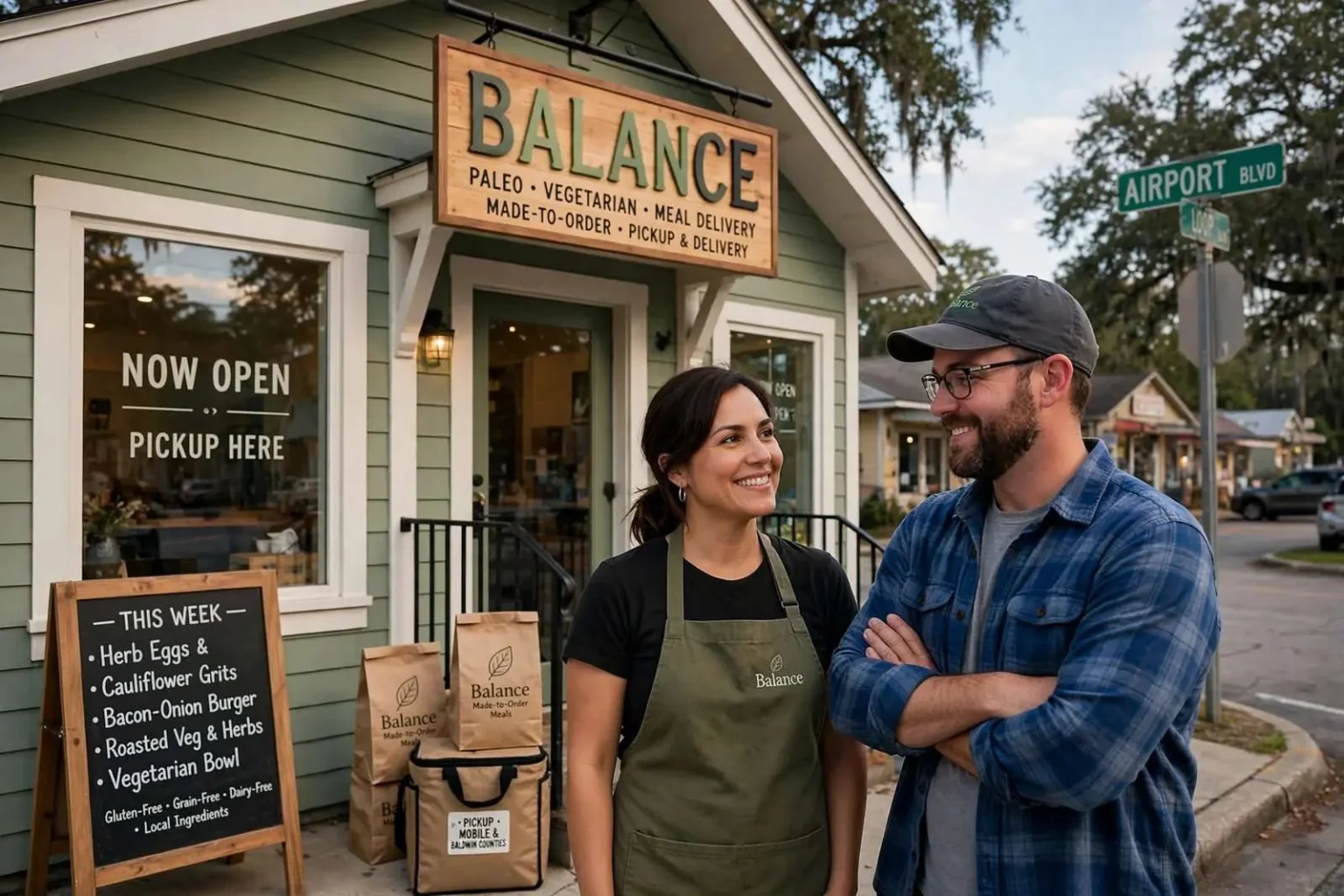
A cottage on Airport Boulevard near the Loop in Mobile has a new occupant after sitting empty since Little House Midtown closed earlier this year, and the small storefront’s second act centers on what might be the city’s most personal corner of the food business.
The space now belongs to Balance, a made-to-order meal delivery business built around Paleo and vegetarian gourmet cooking. Balance isn’t a restaurant, at least not yet. Instead, it operates as a meal planning and delivery service that has quietly been serving customers for roughly five months, starting out of a small kitchen on Government Street before settling into its new permanent home at the corner storefront.
The move from a rented kitchen to a dedicated storefront marks a milestone for a young business. The Government Street kitchen was a means to an end — a licensed space to cook from while the company found its footing — while the Airport Boulevard cottage gives Balance a street-facing identity, a pickup point customers can find, and room to grow.
The husband-and-wife team behind the business, Liz Garza and John Smith, had been searching for the right location for months, checking out spaces up and down Airport Boulevard without finding anything that fit their budget. When the Little House space came open and a for-rent sign appeared, they moved fast, touring the building with its owners and signing a lease the very next day. For a small company, the speed reflected both necessity and fit: a cottage-style storefront on one of Mobile’s busiest corridors, at a price a startup could absorb, was a combination unlikely to wait.
From the Loop to the Dinner Table
The stretch of Airport Boulevard near the Loop has long been a home for small businesses in modest buildings, and the cottage that housed Little House Midtown fit the pattern — a residential-scale structure converted to retail use, where a boutique once welcomed shoppers the way it now welcomes meal customers. Those buildings carry a charm that new construction cannot replicate, and their modest rents are often the only entry point for food entrepreneurs who cannot afford a restaurant build-out.
Smith, who also runs a separate business operating assisted living facilities, and Garza split the workload of planning menus and managing orders, while two full-time chefs handle food preparation alongside a dedicated delivery driver. That division of labor is the architecture of a company still small enough to be personal: the owners know the menu, the customers and the delivery routes, and the chefs cook to order rather than to a production schedule.
Customers can have meals brought straight to their homes or offices for an extra fee, or pick them up at no charge from several fitness studios and gyms scattered across Mobile and Baldwin counties, including locations in Daphne and Spanish Fort, in addition to the storefront itself. The pickup network is a shrewd piece of distribution for a young company: gyms concentrate exactly the customers most likely to buy Paleo meals, the studios gain a perk for their members, and Balance avoids the cost of home delivery for customers who can grab a week’s meals after a workout.
The Paleo Philosophy
The Paleo approach at the center of Balance’s menu emphasizes whole, minimally processed ingredients: locally sourced proteins, organic produce, and dishes free of gluten, grains, dairy and legumes. The diet’s core idea — eating the way humans are said to have eaten before agriculture reshaped the food supply — has moved from crossfit gyms and cookbooks into the mainstream of American eating, and South Alabama has proven no exception.
Garza has said the philosophy grew out of her own family’s history with obesity-related illness, and that she views real food as something closer to medicine than simply fuel. That origin story shapes the business in practical ways. The menu is built around what the ingredients do for the person eating them, not around novelty or indulgence, and the vegetarian offerings extend the same care to customers whose path to health runs through plants rather than protein.
For customers with dietary restrictions — celiac disease, gluten sensitivity, lactose intolerance — a menu that is grain-free and dairy-free by design removes the improvisation that eating out usually requires. There is no need to interrogate a menu or hope a kitchen understands cross-contamination.
Recent menu offerings have included dishes like herb-seasoned eggs with cauliflower grits for breakfast, a bacon-and-onion burger served with sides that stand in for the starch a traditional plate would hold, and hearty dinners that swap spiralized vegetables and roasted produce for pasta and potatoes. The cooking is built to prove a point: that a diet defined by what it excludes does not have to taste like deprivation.
The Meal Delivery Business Model
Balance sits inside one of the fastest-growing corners of the food economy. Meal preparation and delivery services have grown nationwide as busy households look for ways to eat well without cooking from scratch every night, and the model offers customers something neither restaurants nor grocery stores provide: a week of complete, diet-specific meals designed and cooked by professionals, scaled to their goals.
For customers, the economics often make sense when compared with the alternative of eating out. Restaurant meals cost more per serving, and drive-through convenience comes at a nutritional price that customers like Balance’s are actively trying to avoid. A subscription-style order of prepared meals — breakfasts, lunches and dinners portioned and ready to reheat — turns healthy eating from a daily decision into a standing arrangement, which is precisely why the model retains customers once it wins them.
The made-to-order element distinguishes Balance from the national meal-kit companies that ship vacuum-packed ingredients in cardboard boxes. Cooking to order in a local kitchen and delivering within days — not weeks — means fresher food, menus that can respond to what local farms have in season, and a customer relationship built face to face at pickup locations rather than through an app store. It is a slower way to build a food business, and for a company whose brand rests on personal attention, arguably the only way.
Little House Leaves a Legacy
Balance inherits its storefront from Little House Midtown, the boutique that gave the cottage its identity among Mobile shoppers before closing earlier this year. Small independent retailers like Little House lent Airport Boulevard’s cottage row its personality — destinations that drew customers looking for something the malls and chains could not offer — and their closures leave gaps that new businesses must decide whether to fill.
That the space did not stay empty long says something about the corridor. Airport Boulevard remains one of Mobile’s most active commercial arteries, running from downtown through midtown and west toward the city’s newer growth, and its older buildings near the Loop offer exactly the low-cost, high-visibility space that young businesses need. A food company with a steady stream of pickup customers makes a natural successor to a boutique, bringing repeat daily traffic to a building that once depended on destination shopping.
What Success Looks Like
For Garza and Smith, the next chapter is about scale without dilution. Adding customers to a made-to-order operation means longer chef hours, more delivery routes and more pickup partnerships, and each addition tests whether the personal quality that defines the brand survives the growth. The five months before the storefront opening established that the food finds buyers; the new cottage will test whether Mobile will make a habit of it.
The broader story is one Mobile sees more often now: local food entrepreneurs building businesses that could only exist here — rooted in local farms, local gyms and a customer base that knows the owners by name. Balance’s cottage on Airport Boulevard, like the Government Street kitchen before it, is one more sign that the city’s appetite for real food has grown into an economy of its own.
A Week in the Life of the Business
The rhythm of a made-to-order meal company follows its customers’ calendars. Orders build through the week, chefs shop and prep in cycles keyed to the menu plan, and cooking days compress into long production sessions before delivery and pickup windows open. The dedicated delivery driver then works a route that can stretch from the Loop across the bay to Daphne and Spanish Fort, while the storefront handles walk-up pickups and the questions that come with them.
Menu planning is where Garza’s philosophy does its daily work. Building a week of breakfasts, lunches and dinners that stay compliant — no grains, no dairy, no legumes — while rotating enough variety to keep subscribers interested is a design exercise most kitchens never face. Cauliflower must become grits, vegetables must carry the textures that pasta and potatoes normally provide, and every dish has to survive a reheat at the customer’s office.
The vegetarian line adds a second discipline. Paleo cooking leans on meat as its anchor, so meatless dishes must draw protein and heartiness from vegetables, eggs, nuts and seeds — cooking that demands more technique, not less. Offering both lines under one roof lets the company serve households with mixed diets, where one member eats Paleo and another prefers meatless meals, without doubling the shopping.
Why the Location Fits the Mission
The cottage’s curb appeal works in the company’s favor. A friendly residential-scale building with parking nearby makes pickups feel effortless, and passersby on Airport Boulevard see a business that looks like a home — an apt image for food cooked the way a careful home cook would make it. The corner location also sits among the neighborhoods where many of the company’s customers live and work, shortening the trip that turns a trial order into a routine.
There is symbolism, too, in the building’s history. Little House Midtown built its following on the appeal of things made carefully and sold personally, and Balance makes its case in the same vocabulary — small batches, real ingredients, owners behind the counter. South Alabama’s food culture has room for both, and a cottage on Airport Boulevard has now hosted two chapters of it.
For customers curious about the Paleo and vegetarian approach, the storefront offers the lowest-stakes entry point: pick up a week’s meals at no delivery charge, talk to the people who cooked them, and see whether eating this way fits. That accessibility — a table in a cottage near the Loop instead of an app and a shipping box — is the quiet advantage a hometown company will always hold.