Figures Holds Wide Money Lead Over Thomas in Senate District 33 Primary
Campaign disclosures showed state Sen. Vivian Figures raising more than four times what challenger Herman Thomas collected as the two headed into the final weeks of their Democratic primary contest.
Incumbent state Sen. Vivian Figures entered the closing weeks of her Democratic primary campaign with a commanding financial advantage over challenger Herman Thomas in the contest to represent Senate District 33, according to campaign finance disclosures filed for the most recent reporting period. The filings, reviewed against the calendar, show a race in which one campaign is preparing for a television-scale finish while the other is counting on organization and name recognition to close the gap.
The numbers
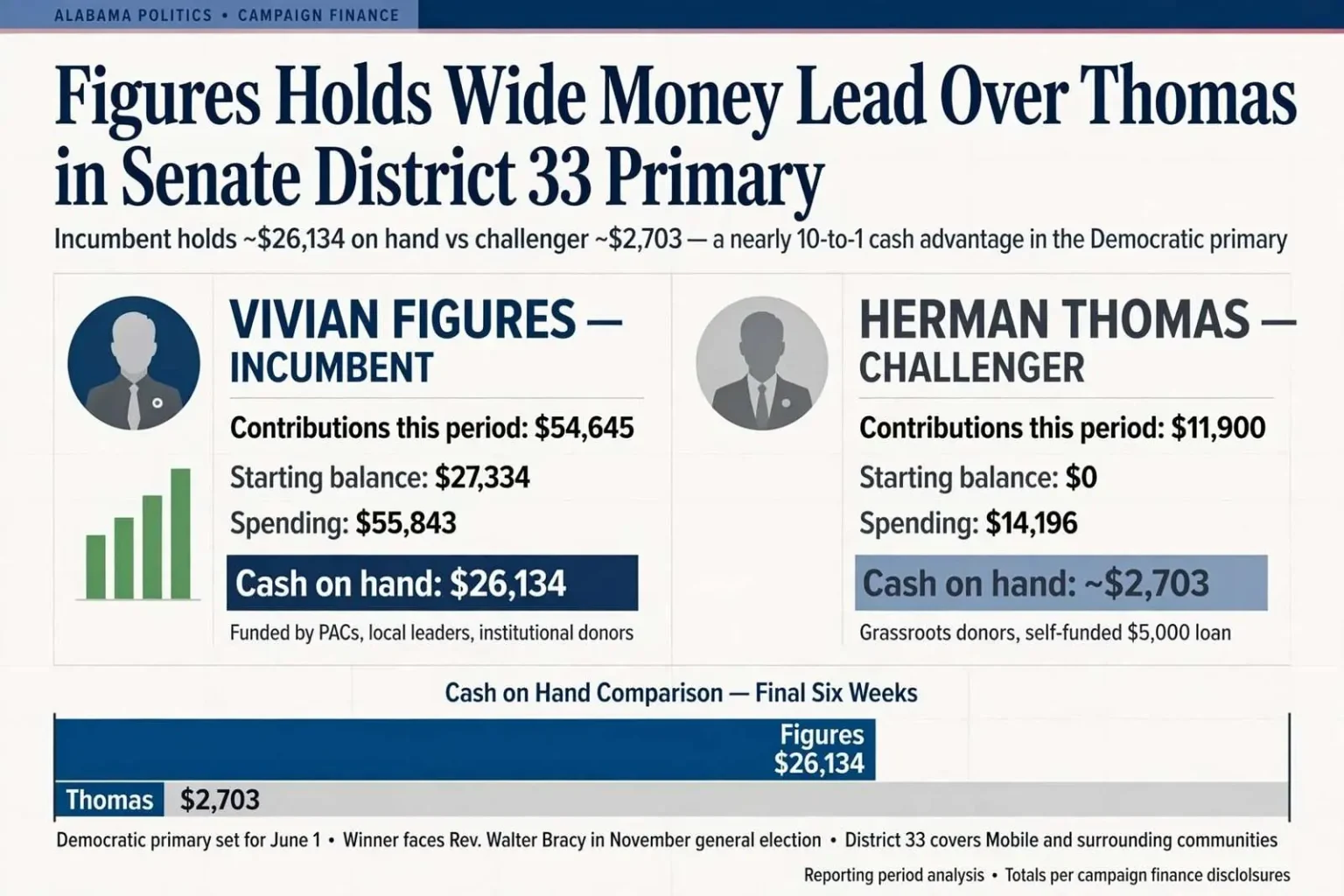
Figures reported contributions totaling $54,645 during the period. Thomas reported $11,900. The gap widens when starting balances are taken into account. Figures opened the disclosure period with $27,334.16 already in the bank. Thomas opened at zero.
Both campaigns spent aggressively. Figures reported outlays of $55,843; Thomas reported $14,196. That left the incumbent with roughly $26,134 on hand heading into the final six weeks, against about $2,703 for the challenger — close to a ten-to-one advantage at the moment when television time, mailers and get-out-the-vote operations are typically purchased.
Thomas loaned his own campaign $5,000, a contribution that accounted for nearly half of everything he reported raising during the period. Self-funding of that kind is common among challengers who cannot tap institutional money, but it also underscores the structural reality of the race: every dollar Thomas spends from his own pocket is a dollar he cannot replenish, while Figures’ committee can continue drawing on a deep roster of political action committees as the primary approaches.
In practical terms, the cash balance shapes what the final stretch looks like on the ground. A committee with roughly $26,000 in the last six weeks can fund direct mail to likely voters, paid staff for get-out-the-vote shifts and radio or digital advertising targeted to Mobile households. A challenger with $2,700 must rely on volunteers, yard signs, church announcements and free media — tools that can matter in a low-turnout primary but that leave little room for error or response.
Where the money came from
The two donor lists tell very different stories about the shape of each campaign. Figures drew heavily on organized political money: a $10,000 contribution from Wall of Separation; $7,500 from FGA PAC; $5,000 each from LEG PAC, Future PAC and Trial PAC; $2,500 each from Eagle PAC, FAX PAC, Union Street PAC and the Alabama Power Co. Employee State PAC; $2,000 from TABS, Inc.; and $1,500 each from the Alabama Dental PAC and Retailers of Alabama PAC.
She also reported $1,000 each from the Alabama Circuit Clerks Association, the Regions Financial Corp. PAC and Tom Coker & Associates, along with $500 from the Pharmaceutical Research and Manufacturers of America and $500 from Lamar Companies. The list reads like a directory of the interest groups that follow the Statehouse: trial lawyers, retailers, utilities, lenders, broadcasters and the professional associations whose bills rise and fall in Montgomery each session.
Individual donors included former state Rep. Mary Zoghby, former Mobile Mayor Mike Dow, Riley Boykin Smith and Edward A. Hosp II — a mix of Mobile figures and Montgomery-connected names that reflects two decades of relationship-building around the State House.
Thomas’s list, by contrast, was built almost entirely from individual contributors in Mobile, most giving $100 to $300. His largest reported gifts were $1,000 each from Percival Ethridge and David Thomas, with $500 contributions from the Jerome Carter Law Firm, E.L. Boatman and Northside Check. The rest was a long roll of small local donations — a pattern that reflects both a grassroots base and the difficulty a challenger faces in attracting institutional support against a sitting senator.
The distinction matters beyond bookkeeping. Incumbents who collect from organized PACs owe their attention to a wide circle of interest groups; challengers who collect from neighbors are betting that personal loyalty will outperform institutional money. In District 33, where a single Senate seat represents a large share of the City of Mobile and its surrounding communities, both campaigns are counting on the same small universe of likely Democratic primary voters to notice them.
The backdrop
The race carries a history that neither candidate can entirely set aside. Thomas is a former circuit judge who surrendered his judgeship amid allegations that he paddled inmates under his authority. He was ultimately acquitted of the criminal charges arising from that controversy, but the case dominated courthouse conversation in Mobile for years and remains the first thing many voters associate with his name.
The case also touched Figures directly: her son, Akil, who has a long history of drug-related criminal charges, was involved in the matter. The entanglement of the incumbent’s family in the controversy that ended her challenger’s judicial career has given the primary a personal edge that campaign finance reports only hint at.
Figures has held the District 33 seat for more than a decade, succeeding her late husband, state Sen. Michael Figures, and building a legislative profile that extends well beyond Mobile. She has carried forward a family legacy in Alabama politics — Michael Figures was one of the most prominent Black legislators of his generation — while developing her own record in the Senate, where seniority and committee assignments accrue to those who hold a seat long enough. Challenger campaigns in such districts must overcome not only the incumbent’s money but the network of favors, constituent services and institutional relationships a long tenure builds.
The seat covers much of the city and surrounding areas of Mobile County, taking in some of the state’s most historically significant Black neighborhoods along with established middle-class districts. Senate District 33’s voters have consistently sent Figures or her husband to Montgomery since the 1980s, making this primary one of the few occasions in which the seat has been seriously contested in a generation.
What comes next
The Democratic primary is set for June 1. The winner will face the Rev. Walter Bracy in the November general election, a matchup that in a heavily Democratic district would ordinarily favor the primary’s survivor. Mobile’s Senate delegation has long been dominated by the party, and the June contest is widely viewed as the real decision point for the seat.
For Figures, the final six weeks are about converting money into turnout. Her committee’s balance allows her to fund the traditional instruments of a Mobile primary: mail pieces to likely voters, advertising on radio stations that reach the district’s neighborhoods, and the Election Day machinery of rides to the polls and poll watchers that has decided close local contests in the past. For Thomas, the same stretch is about persuasion on a shoestring — forums, churches, neighborhood associations and the one-on-one conversations that a former judge with high name recognition can still hold across the district.
Money is not destiny in a legislative primary, particularly in a district where a challenger enjoys high name recognition. Thomas’s years on the bench mean that tens of thousands of District 33 voters already know who he is — favorably or otherwise — without his spending a dollar to remind them. Name recognition of that kind cannot be purchased by a well-funded newcomer, and it cannot be erased by an incumbent’s mail program either.
But a ten-to-one cash advantage in the final stretch buys options — and the ability to answer an attack the same week it is made. In campaigns where the personal history between the candidates is this entangled, the ability to respond quickly matters. A challenger who cannot afford a mailing cannot correct a misstatement about his record; an incumbent who can, controls the final frame of the argument. That arithmetic, as much as any single filing line, is what the closing weeks of the District 33 primary will test.
The reporting period itself explains some of the gap. Campaign finance disclosures in Alabama are filed on a fixed schedule, and the numbers released in the closing weeks of a race capture campaigns at very different stages. An incumbent who has been raising steadily since the previous cycle begins the period with a bank balance; a challenger who entered the race late starts from zero and must build a donor list from scratch in a compressed calendar. Thomas’s $11,900 — roughly a quarter of what Figures collected — is a respectable total for a first-time legislative challenger, but it arrived over weeks rather than years.
The shape of the Senate District 33 electorate also colors the spending. Primaries in Mobile’s legislative districts are often decided by a few thousand voters, concentrated in precincts where a generation of family ties, church memberships and civic relationships determine who shows up on June 1. Paid media can move those numbers at the margins, but the campaigns’ real work is identical regardless of budget: identifying supportive voters, then making sure each of them casts a ballot in a low-turnout election that most residents will not notice until the final week.
Both campaigns will spend the final days on that groundwork. Figures’ balance sheet gives her the luxury of staffing those efforts; Thomas’s budget means the work falls to volunteers. Whether the money gap proves decisive will be answered June 1, when the district’s voters — not its donor lists — settle a contest that has already given Mobile one of its most personal legislative primaries in years.