Mobile Councilwoman, Developer Spar Over Westwood Plaza ‘User Fee’
Mobile Councilwoman Bess Rich and a shopping center developer are at odds over a proposed 1 percent shopper fee tied to the Westwood Plaza redevelopment plan.
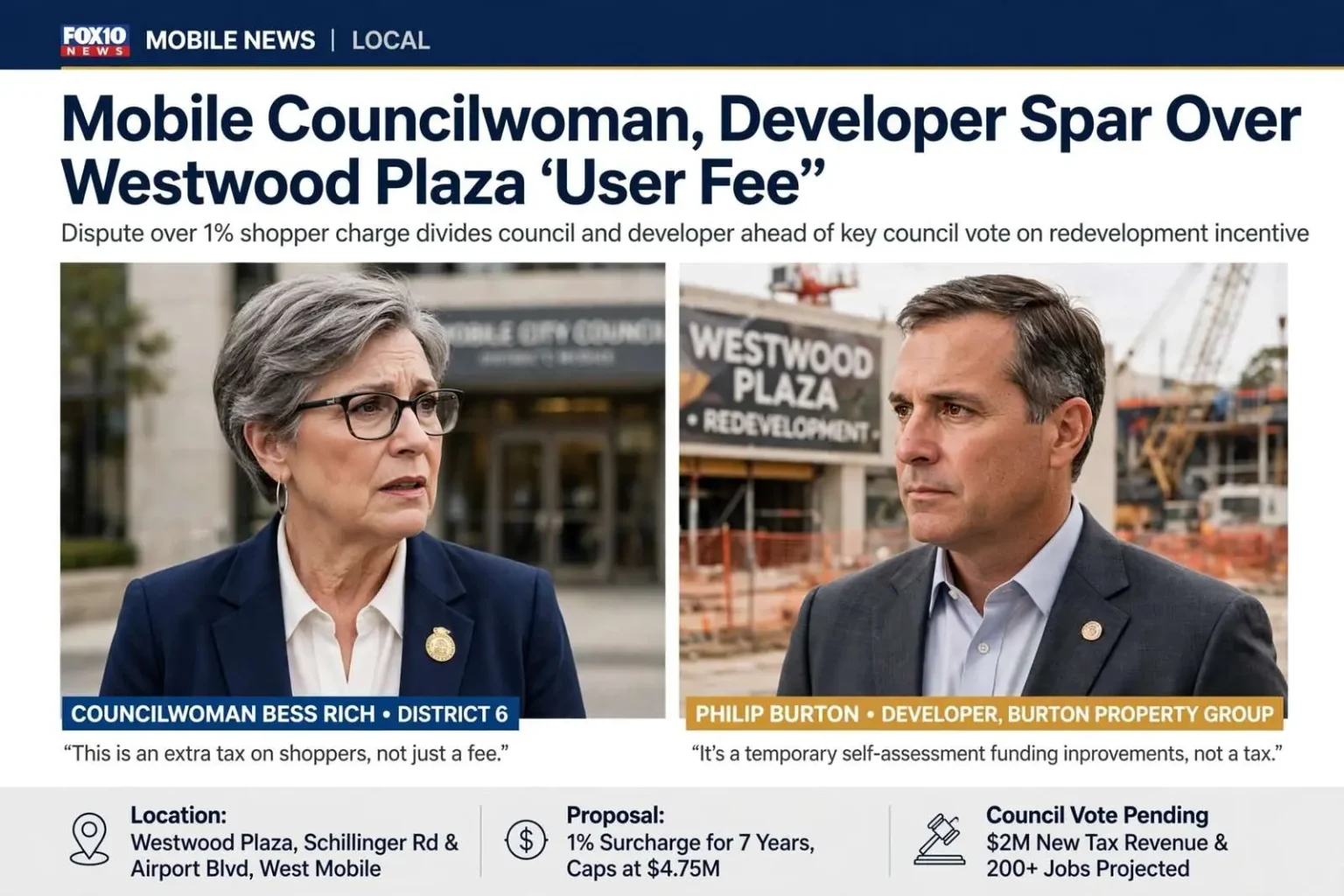
A disagreement over how to pay for the redevelopment of Westwood Plaza has put a Mobile City Council member and the shopping center’s developer on opposite sides of an incentive package headed for a council vote. The dispute centers on a proposed 1 percent charge on shoppers at the redeveloped center, a mechanism that has become the flashpoint in a broader debate over how the city subsidizes private retail projects. Councilwoman Bess Rich, whose district includes the plaza near Schillinger Road and Airport Boulevard, has argued publicly that the charge amounts to an extra tax rather than a simple fee. Developer Philip Burton disputes that characterization, and the two positions now frame a vote that could shape retail development incentives in Mobile for years to come.
Rich has made her case in written comments shared with constituents, laying out concerns that go beyond the single project at hand. She said uneven sales tax rates across the city create confusion for shoppers, who may pay one total rate at a store inside a special district and a different rate at a competing business just down the road. In her view, that patchwork puts businesses outside the districts at a competitive disadvantage, since they must compete without the marketing money the surcharge generates while also charging customers more at the register. The plaza she represents sits in a busy west Mobile retail corridor where shoppers routinely cross between centers, making the rate differences easy to notice.
A Fee, or a Tax?
Burton rejects the idea that the charge is a tax in any meaningful sense. He said it applies only within the redeveloped center and phases down once the early infrastructure costs of the project are recovered, after which the additional collections end. He has pointed to a similar arrangement used roughly five years earlier at an outlet center in Foley as precedent, arguing that shoppers retain the choice of whether to patronize stores inside the district at all. In that framing, the charge functions less like a government levy and more like a self-assessment that property owners and their customers accept in exchange for a rebuilt, modernized shopping destination.
The arrangement Burton proposes is structured as a cooperative district, a tool that Alabama municipalities have used to channel money raised inside a defined commercial area back into that area’s own improvements. Under the proposal, the site would be organized as such a district, charging an extra 1 percent for the first seven years on top of the roughly 10 percent combined city, county and state sales tax already collected there. The rate would then fall to a half percent either after seven years or sooner if the district collects more than $4.75 million from the surcharge, a built-in sunset designed to limit how long shoppers pay the premium. Supporters of the structure say that sunset clause is what separates it from a permanent tax increase.
Benchmarks and Road Money
The agreement reportedly includes a performance benchmark that gives the city a measure of protection if the redevelopment underperforms. Under that benchmark, the project is required to boost tax revenue by 40 percent, and if it fails to do so the city could withhold the incentive. Such conditions have become a point of emphasis in incentive discussions because they tie public participation to measurable results rather than to promises made before construction begins. Whether the 40 percent threshold is achievable depends on how quickly new tenants lease space and how strongly the rebuilt center performs once it opens.
City officials have also committed to up to $250,000 in nearby roadway work tied to the project, a commitment that has drawn its own scrutiny. The money would fund improvements to the roads around the plaza, where traffic generated by a larger shopping center is expected to increase. Rich has questioned why a developer would receive public money for infrastructure that developers typically fund themselves. In support of that point, she cited a nearby grocery store development where the builder covered the cost of added turn lanes without any city assistance, an example she has used to argue that the Westwood package asks taxpayers to shoulder expenses the private market routinely absorbs.
The Administration’s Position
Mayor Sandy Stimpson’s administration has voiced support for the deal, putting the weight of the executive branch behind the incentive package. A spokesperson for the mayor’s office said the investment would improve retail options in the area, upgrade infrastructure near the intersection and generate substantial new tax revenue for the city. The administration has urged the council to act quickly, framing the project as an opportunity to modernize a aging commercial property before it slips further behind newer centers elsewhere in the region. That urgency has not moved Rich, who has continued to press her concerns in public and in writing as the vote approaches.
The debate comes at a time when Mobile’s established shopping centers are competing for tenants against newer developments across the Gulf Coast, making redevelopment incentives a recurring topic at City Hall. Westwood Plaza has served the west Mobile community for decades, and city leaders on both sides of the dispute agree that the property needs reinvestment. The disagreement is not over whether the plaza should be redeveloped but over who pays for it, and whether the cooperative district structure is the right vehicle.
A Contrast With McGowin Park
Rich has drawn a contrast with the incentive package approved for the McGowin Park shopping center near Hank Aaron Stadium, a comparison she has raised repeatedly in the Westwood debate. Under the McGowin Park arrangement, that developer receives a share of city and county sales tax collections over a period of 20 years, without any added fee charged to shoppers at the register. In Rich’s view, that structure directed public money to the project without creating a two-tier sales tax system across the city. The comparison has become a shorthand in the debate for the kind of incentive she would prefer to see used again.
Burton has pushed back on the comparison, noting that his project is a renovation of an existing center rather than new construction, unlike McGowin Park. From his perspective, that distinction matters because redeveloping an aging property carries costs and risks that differ from building on open land, and the cooperative district structure is designed to fit that reality. He has argued that the shopper fee is what makes the renovation financially workable, since the district’s collections help retire the early infrastructure costs that a purely public incentive would otherwise have to cover.
Scope of the Redevelopment
The Westwood Plaza project carries a reported price tag in the tens of millions of dollars, a scale that explains why the financing structure has drawn such attention. Plans call for adding roughly 168,000 square feet of retail space to the existing shopping center, which currently totals about 140,000 square feet. The expansion would more than double the footprint of the center, reshaping a property that has anchored its corner of west Mobile for a generation. Updated lighting is part of the plan as well, matching a theme already used at Mobile Regional Airport and along the downtown skyline, a design choice intended to tie the rebuilt center to the city’s broader visual identity.
The developer has said the completed project could generate roughly $2 million in additional tax revenue and create more than 200 jobs, figures that form the core of the economic case for the incentive package. New tenants are expected to join the existing anchors at the site, broadening the center’s mix of stores and services. Construction would proceed in phases, with an outdoor retailer targeting an opening by the end of the year and no firm timeline yet announced for the remainder of the buildout. A phased approach limits disruption for existing tenants but means the full benefit of the redevelopment would arrive gradually rather than all at once.
The council is expected to take up the incentive proposal at an upcoming meeting, and the outcome will determine whether the cooperative district moves forward as designed. Until then, the exchange between Rich and Burton has laid out the competing arguments clearly: a councilwoman who sees an added tax on shoppers and a subsidy for costs developers should bear, and a developer who sees a temporary, self-limiting tool to rebuild a tired shopping center. However the vote goes, the discussion has put Mobile’s approach to retail incentives under a level of public scrutiny that future projects are likely to feel.
For residents of the district, the practical effect of the proposal would show up at the register. A shopper spending $100 inside the redeveloped center would pay the extra dollar during the initial seven-year period, while a shopper buying identical goods at a store outside the district would not. That is the distinction Rich has focused on, and the one Burton has defended as voluntary. Both sides acknowledge that the roughly 10 percent combined rate already collected at the site is among the higher totals shoppers encounter in the region, which is why even a one-point addition has generated debate.
The cooperative district mechanism has been used elsewhere along the Gulf Coast precisely because it lets private development finance its own improvements without a direct appropriation from the city’s general fund. Money collected inside the district stays tied to the district, funding the infrastructure and upkeep that the redevelopment requires during its early years. The sunset in the Westwood proposal, whether triggered by the passage of seven years or by the $4.75 million collection threshold, is intended to ensure the charge ends once those costs are recovered.
What happens next rests with the council. Members will weigh the administration’s endorsement and the project’s projected 200 jobs and $2 million in new tax revenue against Rich’s objections about rate equity, competitive fairness and the principle of public money for private infrastructure. The upcoming vote will show whether the city is prepared to extend the cooperative district model to west Mobile, or whether the concerns raised about shopper fees will push future redevelopment deals toward structures like the one used at McGowin Park.