Bracket-Style Contest Aims to Crown a Name for New Mobile River Bridge
A bracket-style online poll is letting the public weigh in on names for the proposed new bridge over the Mobile River carrying Interstate 10.
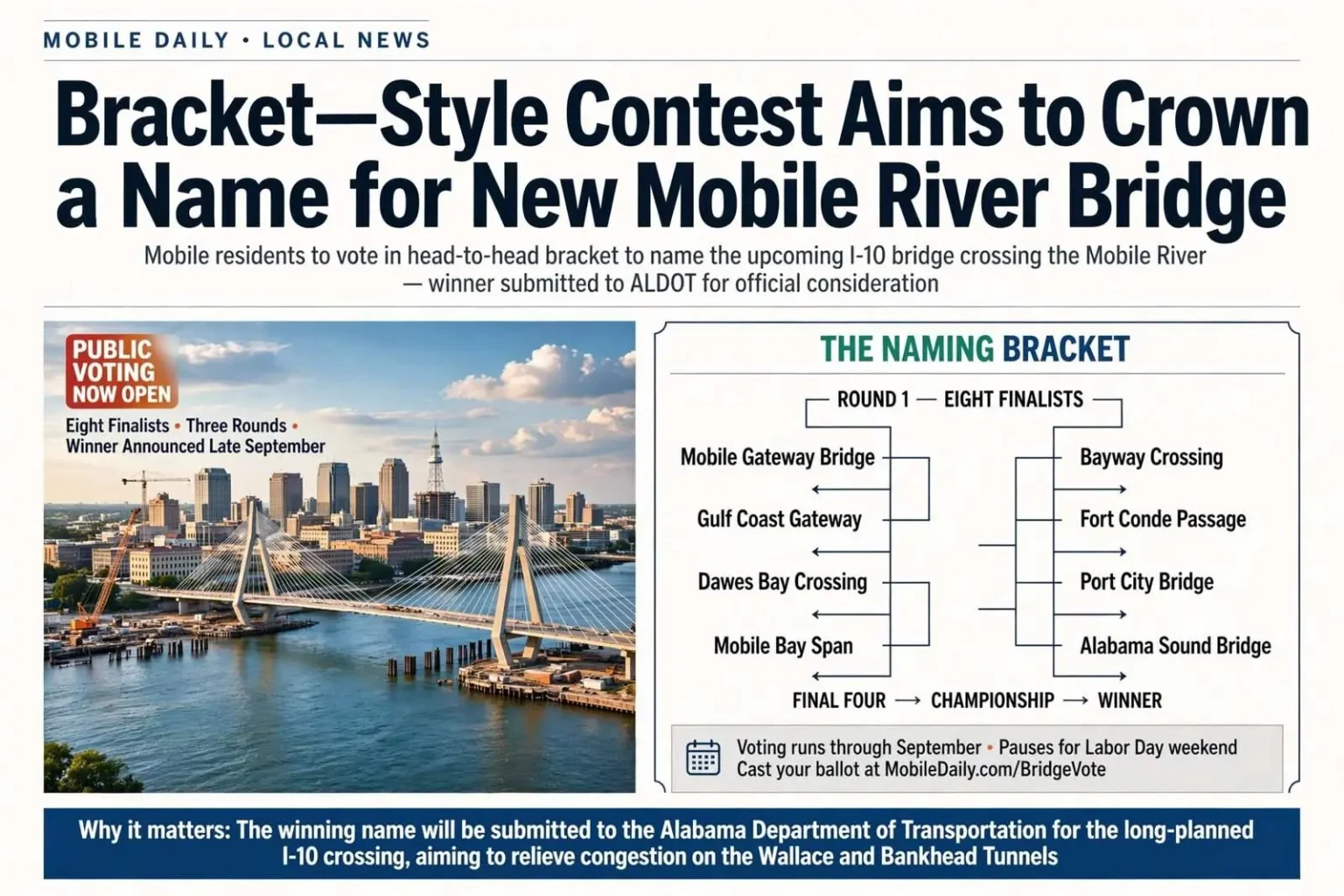
Mobile residents will soon get a say in what the region’s next major piece of infrastructure will be called, as a bracket-style public voting contest kicks off to help settle on a name for the long-discussed bridge planned to carry Interstate 10 across the Mobile River. The naming contest gives the public a direct voice in a project that has been debated, studied and delayed for years, and one that will reshape both the skyline and the traffic patterns of downtown Mobile for decades to come.
The tournament-style format, modeled loosely on postseason sports brackets, pits eight finalist names against one another in head-to-head rounds. Voters choose their favorite in each matchup, with winners advancing until a single name is crowned as the public’s top pick. The approach borrows the familiar excitement of a playoff bracket and applies it to civic decision-making, an attempt to turn what is normally a dry public-input exercise into something engaging enough to draw broad participation from across the Mobile area.
Organizers said the field of finalists was built from two main sources: suggestions submitted by the public in response to an earlier call for name ideas, and additional options that had already been circulating locally, including variations on a “Gateway” theme tied to the bridge’s role as an entry point into Mobile. That dual approach was designed to balance fresh community creativity with names that have already gained traction in years of casual conversation about the project at coffee shops, council meetings and civic club gatherings across the city.
The bridge at the center of the contest is the long-planned Interstate 10 crossing of the Mobile River, a project intended to relieve chronic congestion on the Wallace Tunnel and the Bankhead Tunnel, the two aging underwater passages that currently funnel interstate traffic through downtown. A new bridge would give through travelers a direct route across the river while easing pressure on streets that were never designed to carry the volume of an interstate highway.
Rules shaped which names made the cut
Certain rules shaped which names made the cut. Organizers said they wanted every finalist to carry a genuine connection to Mobile, Mobile Bay or the Gulf of Mexico, a standard meant to ensure the winning name reflects the place the bridge actually serves rather than a generic label that could hang over any span in any American city.
That standard ruled out names honoring sports figures after feedback from the public suggested keeping athletes out of the running. Names tied to politicians were also kept to a minimum, reflecting a deliberate effort to keep the contest from becoming a referendum on any officeholder or administration. Naming public works after elected officials has often proved contentious, and organizers appear to have wanted the bridge’s identity to belong to the community rather than to any individual career.
More whimsical suggestions, such as naming the span after a beloved regional treat long associated with Mobile’s Mardi Gras celebrations, were set aside as unrealistic despite genuine public affection for the idea. The playful submissions demonstrated how much enthusiasm the contest generated, even if the names themselves were unlikely to survive a formal review process. In the end, the eight finalists all passed the test of having a real, defensible link to the city, the bay or the Gulf.
The “Gateway” theme that surfaced among the finalists reflects how many residents view the project. A tall bridge spanning the Mobile River would become the first dramatic glimpse of the city for travelers approaching from the east, framing the skyline of downtown Mobile the way other cities’ signature spans frame theirs. A name that captures that welcoming role has obvious appeal, and multiple variations on the Gateway idea earned spots in the bracket, meaning voters will have to choose between several takes on the same concept.
A schedule built around Labor Day
The voting will unfold over several weeks rather than in a single push. An initial round narrows the eight finalists down through head-to-head matchups, followed by a “Final Four” stage, then a two-name championship round before a winner is announced in late September. The staggered format keeps attention on the contest for an extended period and gives organizers repeated opportunities to remind residents to cast ballots as the field shrinks.
The schedule builds in a break around the Labor Day holiday, acknowledging that late summer weekends on the Gulf Coast are a time for travel to the beaches and family gatherings rather than civic voting. The pause also gives organizers a chance to assess participation in the early rounds and promote the championship matchup once the field has been cut in half.
Each round of voting is expected to be promoted through local channels, and organizers have encouraged residents to make their voices heard at every stage, not just the final. Because the early matchups determine which themes survive, a name that starts with a modest following can build momentum round by round, while a favorite that draws lukewarm support can be eliminated before the championship.
What happens with the winning name carries real weight beyond bragging rights. Organizers said the top vote-getter will be formally submitted as the public’s preferred choice during upcoming Alabama Department of Transportation public hearings on the bridge project. That means the bracket is not merely an entertainment exercise; it channels public sentiment directly into the official process that will shape decisions about the span.
The first of those hearings is scheduled for the evening, with additional sessions to follow as the project moves through its review and design phases. Public hearings are a standard step for major transportation projects of this scale, giving residents, business owners and commuters an opportunity to comment on everything from alignment and design to tolling questions before construction plans are finalized.
Why the name matters to Mobile
For a city that takes pride in its history as the oldest settlement on the Gulf Coast, the identity of a signature bridge is no small matter. The span will carry Interstate 10 traffic across the Mobile River between downtown Mobile and the growing communities of Baldwin County, becoming part of the daily routine for tens of thousands of commuters and a landmark visible to every traveler passing through the region.
Names drawn from the bay and the Gulf carry particular resonance locally. Mobile’s economy and culture are inseparable from the water that surrounds it, from the port that made the city an industrial center to the beaches and bayous that draw visitors across the region. A name connected to that geography ties the bridge to the community’s deepest shared identity rather than to a momentary trend.
Bracket contests of this kind have grown popular with civic organizations across the country precisely because they lower the barrier to participation. Instead of asking residents to attend a meeting or submit written comments, a head-to-head vote takes seconds on a phone and produces a clear, quantifiable result. The competitive format also tends to generate conversation on social media, extending the reach of the effort well beyond the people who vote.
For organizers, the hope is that the energy generated by the naming contest carries into the formal hearing process. Public involvement in major infrastructure projects often peaks too late, after key decisions have effectively been made. By attaching a fun, accessible contest to the front end of the ALDOT hearing schedule, the contest’s designers have created a pipeline that funnels casual interest into official participation.
The contest also serves as a reminder of how long the bridge conversation has run in Mobile. The idea of a new interstate crossing east of downtown has circulated for years, debated in city halls, newspaper editorials and neighborhood association meetings throughout the region. Rising traffic volumes on Interstate 10, and the strain placed on the tunnel system that threads beneath downtown, have only strengthened the argument that a new crossing is needed.
What residents can expect next
Once the championship round concludes in late September, attention will shift to the ALDOT hearings, where the public’s preferred name will be presented alongside other input on the project. The transportation department will weigh that feedback as it advances the bridge through its planning milestones, with the name eventually appearing on design documents, signage and, ultimately, the structure itself.
For now, the immediate task belongs to voters. Eight names, three rounds, one winner — and a community that will live with the result every time it drives across the Mobile River. Residents who want a say in how their city greets the future have a simple opportunity to do exactly that, one matchup at a time.
Whatever name emerges victorious, the contest has already accomplished something tangible: it has put a major infrastructure project at the center of public conversation in a way that a traditional hearing notice never could. The bridge will take years to plan and build, but its name — chosen by the people of Mobile themselves — is now only a few rounds of voting away.