Gambling Raids at Mount Vernon and Citronelle Nightclubs Net Six Arrests
U.S. Marshals and Mobile County sheriff's deputies swept two northern Mobile County nightclubs, seizing 21 gambling machines and $20,000 in cash and jailing six suspects in a coordinated raid.
Law enforcement officers descended on two nightclubs in the rural northern reaches of Mobile County, hauling away illegal gambling machines and stacks of cash in a coordinated raid that ended with six people behind bars.
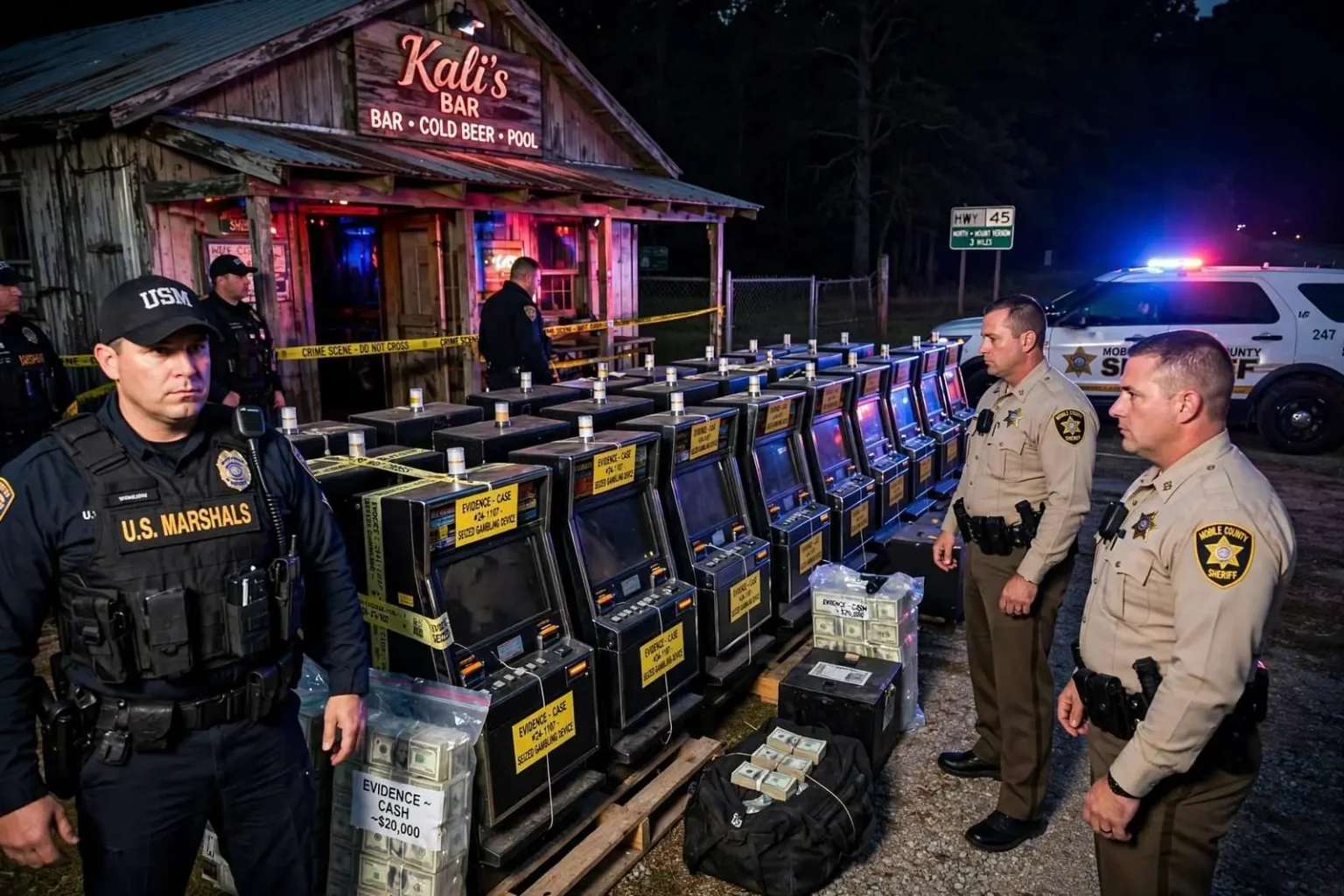
The operation, carried out by U.S. Marshals and Mobile County sheriff’s deputies, targeted establishments near Mount Vernon and Citronelle on a Friday. Acting on a warrant, officers seized roughly $20,000 in cash proceeds and 21 gambling machines from the two locations, according to the Mobile County Sheriff’s Office.
The machines were pulled from Kali’s Bar on Highway 45 and from Club Boo Joe’s on West Coy Smith Road.
A crackdown on illegal machines
Gambling machines of the kind seized in the raid are illegal under Alabama law, and authorities said such devices are normally destroyed once confiscated. The seizure of 21 machines and a five-figure sum of cash pointed to an operation that had been generating steady revenue in the two nightspots.
The raid reflected a continuing effort by state and federal authorities to root out illegal gambling in Alabama, where the legality of electronic gaming devices has long been contested and where periodic sweeps have targeted bars, clubs and storefronts accused of running unlicensed machines.
Alabama’s gambling law draws a line that electronic machines routinely cross. The state permits certain forms of gambling — bingo operations at specific constitutional amendments, dog tracks in a handful of counties and a state lottery debate that has run for decades — but slot-machine-style devices outside those sanctioned settings are prohibited. Machines pitched as “skill” games or sweepstakes terminals have been repeatedly found to be gambling devices in disguise, and the distinction between legal and illegal hardware is one prosecutors and sheriffs’ offices across the state litigate seizure by seizure.
Six taken into custody
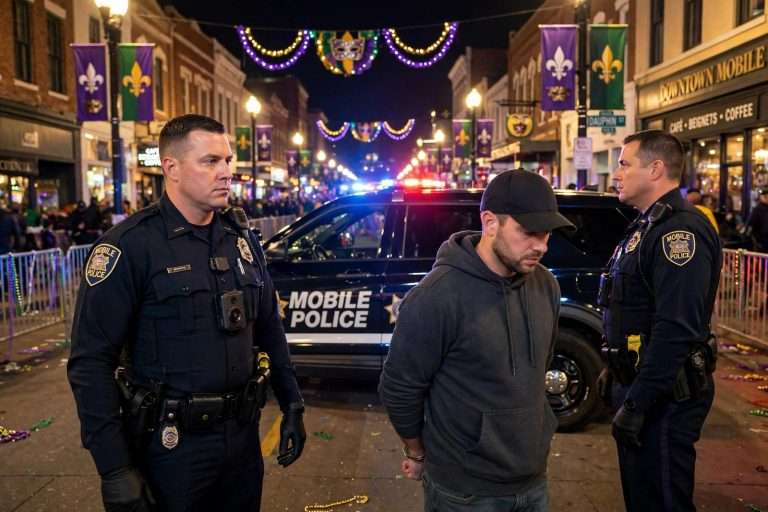
Six suspects were jailed as a result of the operation. According to the sheriff’s office, those arrested were taken into custody on a mix of outstanding warrants, drug charges and weapons charges rather than solely for the gambling machines themselves.
Each of the people jailed had been at the establishment on Coy Smith Road at the time of the raid. The involvement of U.S. Marshals alongside local deputies suggested the operation had a federal dimension, whether through the underlying warrant or the presence of individuals wanted on federal matters.
The sheriff’s office did not immediately release the names of those arrested or detail the specific charges each faced, which is standard practice in the hours after a multi-agency operation while warrants are confirmed and charges are formally filed. The mix of allegations — old warrants, controlled substances and weapons — illustrated how a gambling enforcement action often becomes the occasion for clearing other matters that had been waiting on a moment of contact.
Rural clubs draw scrutiny
The two locations sit in the rural northern tier of Mobile County, a landscape of small communities, crossroads stores and clubs that operate well outside the scrutiny that falls on businesses inside city limits. Mount Vernon rests in the county’s northeast corner near the Washington County line, while Citronelle anchors the far northwest — both an hour’s drive from downtown Mobile and the agencies that patrol it.
That distance is part of the business model for establishments accused of running illegal machines. A club off Highway 45 or down a county road draws its clientele from a wide radius, operates late into the night and counts on the simple fact that unincorporated Mobile County has few deputies per square mile. Enforcement, when it comes, tends to come all at once — a planned operation with a warrant, multiple agencies and transport for the evidence.
The cash seized in Friday’s raid — roughly $20,000 spread across two small rural nightspots — suggested volume as well as distance. Illegal machines in Alabama typically pay out in store credit or vouchers rather than cash, with settlements handled off the floor, but the proceeds accumulate quickly when the machines run around the clock. Twenty-one machines between two clubs implies a steady rotation of players and a daily take worth protecting — which is, in the end, what the warrant was aimed at.
The Highway 45 corridor
U.S. Highway 45 runs north out of Mobile through Prichard, across the Chickasaw line and into the county’s rural stretches, climbing toward Mount Vernon and eventually the Mississippi state line. Along its length, service stations, convenience stores and roadside bars serve the communities scattered through Whistler, Kushla and the county’s northern bends — the same corridor the seized machines at Kali’s Bar called home.
West Coy Smith Road, where Club Boo Joe’s stood, branches into the country around Citronelle, a town of a few thousand residents that serves as the commercial hub for the county’s northwest corner. The road network up there is spare: two-lane highways, farm roads and club driveways, with little in between.
For the sheriff’s office, that geography shapes enforcement. Complaints about illegal machines in the county’s rural reaches take time to build — deputies have to document the activity, establish the pattern and secure a warrant before moving. The result is the kind of single-morning operation seen Friday: two clubs hit simultaneously, before word of the first raid could empty the second.
Why the marshals were in the room
The presence of U.S. Marshals in a Mobile County gambling raid is a detail worth unpacking. The Marshals Service is a federal agency whose core duties include locating and arresting fugitives wanted on federal warrants — a function that frequently pairs them with local deputies serving local warrants. When a planned raid targets a location where wanted individuals may be present, the partnership lets both sets of warrants be served in one controlled encounter.
That is consistent with how the sheriff’s office described the arrests: the six people jailed faced outstanding warrants, drug charges and weapons charges, not gambling counts alone. The machines and the cash were the evidence of the establishment’s operation; the arrests were the mechanism by which wanted people were taken off the street. Neither function required the other, but combining them saved manpower and risk.
Multi-agency operations of this kind are a recurring pattern in Alabama gambling enforcement, where illegal machines are a county-by-county patchwork and where the state’s attorney general has periodically joined or encouraged local crackdowns. A sheriff’s office with a warrant and a federal partner with fugitive authority makes a formidable combination in a rural nightclub at closing time.
What happens to seized machines
Under Alabama practice, gambling machines seized in raids like Friday’s are normally destroyed once their evidentiary value is spent. The machines are photographed, catalogued and held as evidence while any prosecution proceeds; afterward, their destruction is the point — a device that cannot be resold or re-purposed cannot quietly return to service in another club down the road.
The cash follows a different path. Money seized as proceeds of illegal activity is held pending the outcome of the case and can ultimately be forfeited, often flowing back into law enforcement purposes under state forfeiture law. The roughly $20,000 taken Friday represents both evidence of the operation’s scale and, eventually, a measure of its profitability.
For the communities around Mount Vernon and Citronelle, the raid’s message was less about the machinery than about the pattern: illegal gambling operations in rural Mobile County, however far from the city they sit, remain within reach of a coordinated enforcement response — and the clubs that host them can expect the warrant, the seizure and the arrests to arrive together.
Enforcement in context
Friday’s operation fits into a long-running tension in Alabama between the state’s gambling laws and the machines that operators keep placing just outside them. Counties have voted on constitutional amendments allowing bingo; cities have hosted electronic bingo halls that later became court battles; and successive attorneys general have taken different postures toward enforcement. Through it all, the state’s position on unlicensed slot-style machines in ordinary bars and clubs has remained clear: they are illegal gambling devices, wherever they operate.
Sheriffs’ offices across the state have absorbed the practical burden of that policy. Illegal machines are cheap to install and profitable to run, which means enforcement resembles lawn care — a periodic sweep knocks the problem back, and the equipment eventually reappears somewhere else. Each seizure and destruction removes hardware from circulation, but the economic incentive that drew it into a rural nightclub remains until the enforcement risk outweighs the revenue.
Raids that combine gambling enforcement with warrant service and drug and weapons arrests change that calculus. For the operators of the two clubs, the loss of 21 machines and $20,000 in cash was substantial; for the six people jailed, the consequences extended well beyond gambling; and for the county at large, the operation demonstrated that the sheriff’s office will spend the planning time required to reach the rural ends of its jurisdiction.
The names of those arrested and the specific charges they face were expected to be released as the cases moved through the court system. Until then, the documented facts of the raid stand on the official record: a warrant, two clubs on the county’s northern roads, 21 machines, roughly $20,000 in cash, six arrests and a joint operation between the U.S. Marshals Service and the Mobile County Sheriff’s Office that began and ended on a single Friday.