Citronelle Teen Recounts Terrifying Shooting on Prine Road; Police Seek Tips
A 17-year-old describes gunfire that struck the car he was riding in Monday night on Prine Road in Citronelle. No one was hurt, and police are following leads.
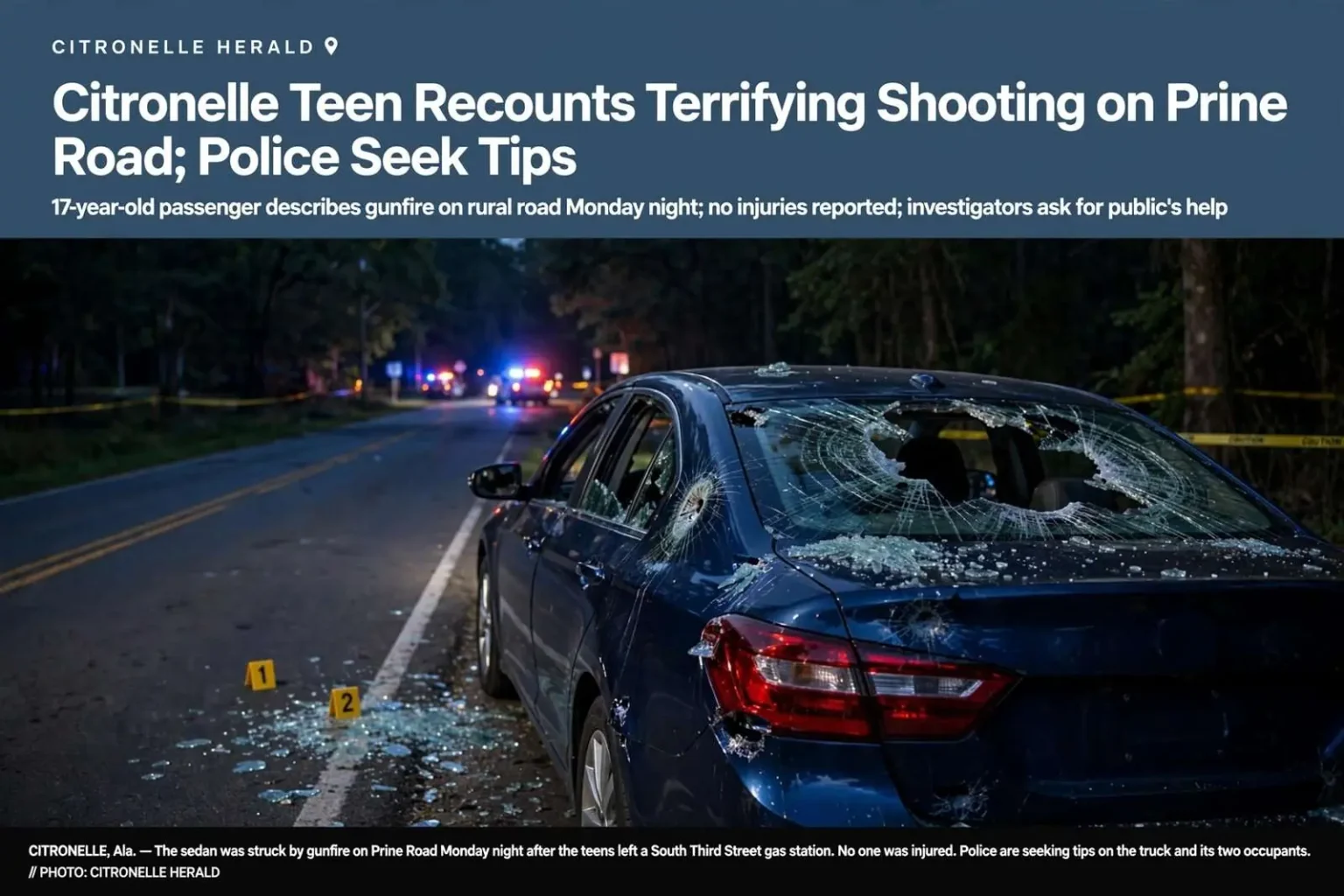
CITRONELLE, Ala. — A 17-year-old is describing the moment someone opened fire on the car he was riding in Monday night on Prine Road. No one was hurt. Investigators are searching for the person who shot into the car, which had two teens inside.
Tim Mcoemore said he was riding in the passenger seat of his friend’s car when gunfire erupted behind them.
“The moment I heard the bullet come through the glass, we just got down,” Mcoemore said.
Mcoemore’s father, Draper Weaver, said Tim and his friend had just left a gas station and were heading home when the shooting started.
“The shot went through the back glass, which is crazy to me. It went through, hit the rearview mirror. That’s the glass on the ground, and hit the windshield,” Weaver said.
How it started
Tim said it began at a gas station on South Third Street across from Lott Middle School, a few miles from his home. After filling up the gas tank, Tim said he and his friend noticed a truck pull out behind them and, after making the turn onto Prine Road, quickly start speeding up.
“They started speeding up, and all of a sudden bullets started hitting the car,” Mcoemore said.
Tim said he heard about 10 to 12 shots.
“We ducked our heads. And it was like, my friend he thought he had just got shot so he was looking down and I had to help him grab the wheel cause we were about to go off the road,” Mcoemore said.
The sequence the teenager describes — a casual stop, a truck following, then a fusillade on a dark two-lane road — is the kind of encounter that turns an ordinary evening drive into a survivable miracle. Ten to twelve rounds fired at a moving car from behind is not a warning; it is an attempt to kill, and the only reasons two teenagers were not struck were the speed of the car, the darkness of the road and the split-second instinct to get below the line of the glass.
Tim said he and his friend never spoke to the two people they saw in the truck at the gas station. He said he recognized the truck’s passenger but had no idea why anyone would start shooting at them.
That detail — a familiar face in a truck they had not spoken to — is the thread investigators now pull. A shooter who knows his victims, even distantly, narrows the universe of motive: a dispute, a misunderstanding, an old grudge carried into a chance encounter at a gas station. The teens, by their own account, exchanged no words, gave no insult and had no conflict at the station. Whatever drove the gunfire was carried by the people in the truck, not created by anything the two 17-year-olds did.
“I knew we were close to home, so when he started getting back up and driving, I looked for my phone, and I called my dad,” Mcoemore said.
A father’s response
“I answer the phone, and he was on the phone screaming like, hey hey hey they got a gun! They’re shooting at us! Can you please help? Come outside! So I jump up, put on my clothes, shoes, grab my gun and run out the door, and by that time they’re…” Weaver said.
The phone call from the passenger seat — placed while the car was still moving, while glass was still falling out of the frame — is the image that stays with a family. A father who hears his son screaming that someone is shooting at them does not process the next hour; he moves. By the time Weaver reached the road, the boys were coming home to a house that became, in the space of a few minutes, the scene of a family’s worst night and the first stop of an investigation.
What the father found when his son’s car arrived told its own story: a rear window shot through, a rearview mirror shattered, a windshield struck — the physical transcript of 10 to 12 rounds that somehow missed two young men. Every one of those impacts was a bullet that entered the cabin of a moving car. Investigators would later walk the same path, photographing the glass on the roadway and the holes in the car, counting casings and reconstructing the angles from which the shots came.
The setting: Citronelle and Prine Road
Citronelle sits in the far northern reaches of Mobile County, a city of a few thousand residents surrounded by forest, farmland and the wide, dark roads that connect its neighborhoods to one another. South Third Street is one of its main thoroughfares, and the gas station where the teens stopped sits across from Lott Middle School — a landmark that places the incident at the center of a community where nearly everyone knows someone involved. Prine Road runs off the main corridors into residential stretches, the kind of road where a car at night is usually alone.
Violence of this kind is rare in Citronelle, and that rarity is part of what the case demands from investigators and residents alike. In a small city, the pool of people who drive pickup trucks, who were at the gas station Monday night, and who might have reason to fire on two local teenagers is not large — and the community’s willingness to talk to police is often the difference between a case that closes and one that grows cold. Major-city investigations rely on cameras and databases; small-city investigations rely on neighbors.
The investigation
Police are asking anyone with information about the shooting, or who can identify the people in the truck, to come forward. The evidence they start from is specific: a truck that followed a car out of a gas station parking lot on South Third Street, a passenger the victims recognized, a rapid burst of gunfire on Prine Road, and a vehicle damaged at the rear, the mirror and the windshield. Each detail eliminates possibilities. Ten to twelve shots fired from behind means the shooter expected to overtake the car; a recognized passenger means a connection the victims themselves cannot explain; a gas station encounter means the possibility of witnesses who do not yet know they saw something important.
Investigators will work the obvious ground first — the gas station’s activity that evening, any surveillance cameras covering the pumps and the road, the car itself, and the accounts of the two teenagers. They will also canvass the houses along Prine Road, where a fusillade of gunfire on a summer night is not the kind of thing residents sleep through, and where a stranger’s truck may have passed more than once before Monday.
The Mobile County District Attorney’s Office would ultimately weigh charges in a case like this, and the charges available depend on the outcome: attempted murder is on the table in any shooting into an occupied vehicle, and the fact that no one was hurt changes the sentencing exposure but not the gravity of the act. Alabama law treats firing into an occupied vehicle as a serious felony in its own right, precisely because the act — not the result — defines the crime.
What the family and the city are left with
For the Weaver and Mcoemore family, the shooting converts an ordinary routine — filling the tank, driving home — into something that requires reassessment. Two teenagers survived a close-range ambush with their wits and each other’s help: a passenger who ducked and called his father, a driver who kept the car on the road while bleeding glass into the cabin. Both behaviors are, in their way, the training that driver’s education and family conversations about danger are supposed to produce, executed under fire.
For Citronelle, the case is a test of the community relationships that small-city policing depends on. The shooter is, by every account available, someone local enough to be recognized by a 17-year-old at a gas station — which means someone else in Citronelle knows who was in that truck Monday night. Tips from neighbors, classmates and passersby are what turn that knowledge into an arrest, and police have made clear that they need exactly that help.
Anyone with information about the shooting on Prine Road, or about the truck and its two occupants at the South Third Street gas station, is asked to contact the Citronelle Police Department or Mobile County investigators. Callers can pass along what they saw; the smallest detail — a name, a truck’s description, a time — is the piece that fits.
Monday night could have ended far worse than shattered glass in a driveway. It ended instead with a father running out his front door, a car full of bullet holes and two teenagers alive — and with a community now holding the answer to who pulled the trigger and why.