Prichard Crime Sweep Nets Dozens of Arrests With Help From U.S. Marshals
State troopers, U.S. Marshals and Mobile County deputies teamed up for a two-day sweep in Prichard that led to 36 arrests on outstanding warrants.
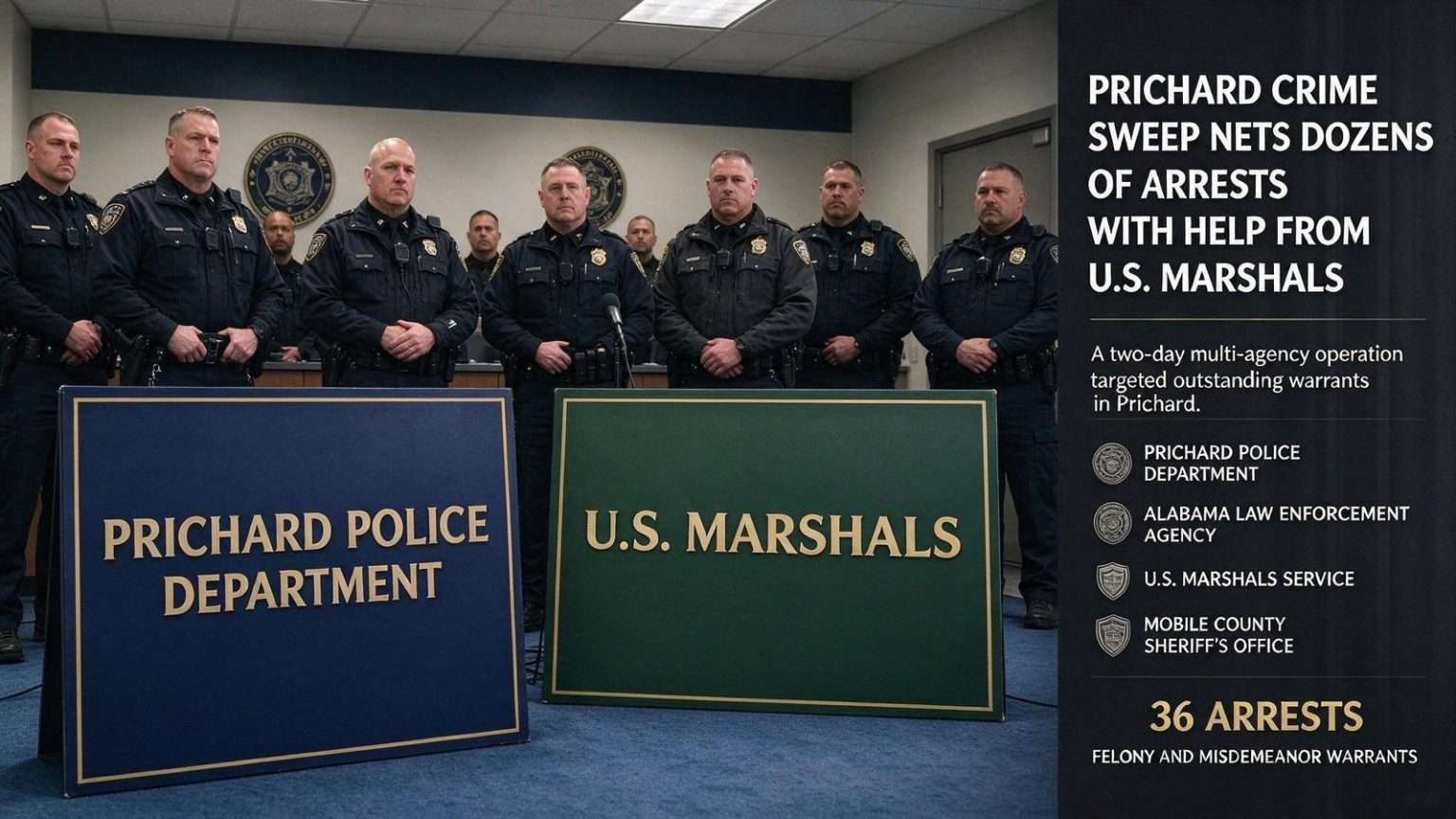
Several law enforcement agencies joined forces for a two-day operation in Prichard aimed at clearing outstanding warrants and sending a message that the city, long challenged by high crime rates, is not a safe haven for offenders. The sweep brought state, federal and county resources onto Prichard’s streets in a coordinated push that officials describe as the latest installment of a partnership rather than a one-time raid.
The Prichard Police Department partnered with the Alabama Law Enforcement Agency, the U.S. Marshals Service and the Mobile County Sheriff’s Office for the sweep, which resulted in 36 arrests tied to seven felony warrants and 113 misdemeanor warrants. The arithmetic of the operation tells its own story — a handful of serious felony cases surrounded by a long tail of unresolved misdemeanor warrants, the kind of backlog that accumulates in any city where the volume of cases has historically outrun the capacity of a small department to serve them.
Representatives from each agency met at Prichard Police headquarters afterward to discuss the operation’s results. The debriefing itself was part of the message: for a city that has spent years trying to rebuild the credibility of its police force, a room full of state troopers, deputy U.S. marshals and sheriff’s deputies standing with Prichard’s own officers is a demonstration aimed as much at residents and partners as at the people taken into custody.
Spencer Collier, secretary of the Alabama Law Enforcement Agency, said his agency has served as a strategic partner to Prichard for roughly two years, including pulling state troopers from other parts of Alabama to increase patrol presence in the city. That commitment — redistributing troopers toward one municipality — is an unusual level of state attention for a city of Prichard’s size, and it reflects the administration’s judgment that the city’s crime problem is worth a sustained investment rather than episodic attention.
Collier, who began his law enforcement career as a Prichard police officer, said the city holds personal significance for him. “Teamwork works better,” Collier said, adding that state resources would remain available to Prichard leaders as needed going forward. The ALEA secretary’s history with the department gives the partnership a personal dimension, and his framing of the sweep — teamwork rather than takeover — is aimed at a city that has seen outside intervention viewed with skepticism before.
Arrests as a Last Resort
Prichard Police Chief Bernard Parrish, who has led the department since November 2014, said arrests were treated as a last resort rather than a first response. He said many of those taken into custody during the sweep had previously been given opportunities to participate in an amnesty program aimed at resolving outstanding warrants without jail time. The city’s amnesty efforts allowed residents with minor warrants to appear, settle their cases and walk out without arrest — and those who took that route were not among the sweep’s totals.
That framing matters in a city like Prichard, where the population living with old misdemeanor warrants overlaps heavily with the working families the city depends on. Parrish’s insistence that amnesty came first is an argument about fairness — that the sweep targeted those who had refused every voluntary path to clearing their records, not residents surprised by a case they never knew had moved. It is also an argument aimed at keeping the community’s cooperation, which a department short on officers cannot afford to lose.
The amnesty programs that preceded the sweep were advertised through city channels, giving residents with outstanding warrants a defined window to resolve their cases on their own terms. That sequencing is deliberate policy rather than public relations: departments that run sweeps without offering amnesty first risk sweeping up residents who would have settled their cases willingly, and they burn the community goodwill that future investigations depend on. In Prichard’s case, the amnesty option also served as a sorting mechanism, separating residents who needed a path from offenders who needed a reminder.
U.S. Marshals Supervisory Inspector Scott Malkowski said the sweep was part of a broader, long-term commitment by federal authorities to support local crime-fighting efforts in Prichard. “We want people to know there is no safe haven for crime in Prichard,” Malkowski said. The Marshals Service brings to such operations the fugitive-tracking apparatus the agency is built for — database networks, investigative capacity and the experience of task forces that operate across jurisdictional lines, which is precisely what a warrant backlog requires.
Officials estimated the combined law enforcement effort in Prichard has cost roughly $400,000 over the past 18 months, a figure that includes resources devoted to specific high-profile cases in the city. The number is a measure of how unusual the partnership is: a half-million-dollar-scale federal, state and county investment in a city of Prichard’s size represents the kind of sustained multi-agency attention that most small municipalities never receive, whatever their crime rates.
The two-year arc of the partnership has already reshaped what enforcement looks like in the city. State troopers running radar and answering calls have freed Prichard’s own officers to concentrate on investigations and neighborhood work, and the visible presence of marked state vehicles on the city’s main corridors has been one of the most noticed changes by residents. Officials credit the combination with supporting the department through the period when it was rebuilding its own ranks, a transition that required training time the city’s call volume did not naturally allow.
Prichard, home to more than 20,000 residents, has struggled for decades with crime rates that rank among the highest in Alabama, alongside the fiscal problems that pushed the city into bankruptcy and a population that has fallen by more than half since its mid-century peak. The city sits immediately north of Mobile along the Interstate 65 and U.S. 45 corridors, and its crime statistics have made it a recurring focus of regional headlines — a dynamic city officials say obscures the neighborhoods where ordinary life proceeds without incident.
The city’s decline and its crime problem are intertwined in ways residents know well. Prichard incorporated as a manufacturing-era suburb whose shipyard and industrial payrolls sustained thriving neighborhoods through the mid-twentieth century, then absorbed the region’s deindustrialization and white and middle-class flight in waves. What remained was a city with an aging housing stock, a shrinking tax base and a police department that, at its low points, struggled to staff patrols at all. Parrish’s department has been rebuilding from that low point since he took over in late 2014.
Against that history, the multi-agency partnership represents the city’s most significant external support in a generation. The state troopers Collier has redirected to Prichard patrol alongside city officers, the Sheriff’s Office contributes countywide capacity, and the Marshals Service supplies the fugitive apparatus that turns outstanding warrants into custody. Each agency covers a gap the small city department cannot fill alone, and the two-day sweep was designed to show all of that machinery operating at once.
For the people arrested, the consequences will run through the courts rather than the streets — felony defendants into the circuit court system, misdemeanor cases resolved as their warrants allowed. Officials have emphasized that the point of the operation was never volume for its own sake but the resolution of cases that had been sitting unresolved, some for years, waiting for capacity that the department alone could not produce.
Warrant sweeps of this kind follow a well-established model across Alabama and the Gulf Coast. Multi-agency fugitive operations typically target a jurisdiction after a review of its outstanding warrant file, coordinate arrests over a compressed window to maximize custody before word spreads, and close with a public accounting designed to reach two audiences at once — offenders still on the list, and the residents weighing whether their local police can protect them if they cooperate. Prichard’s sweep followed that script deliberately, down to the headquarters briefing where each agency’s role was detailed for the record.
The partnership’s continuation is the part residents will watch. A two-day sweep produces headlines; a second year of trooper patrols produces habit. Collier’s pledge that state resources will remain available as needed, and the Marshals Service’s description of a long-term commitment, both suggest the operation is a scheduled installment in an ongoing arrangement rather than a response to a single bad season. City officials have consistently argued that visible, sustained enforcement is what changes a city’s trajectory — and what convinces residents that reporting crime is worth the trouble.
What the sweep cannot resolve, by itself, are the conditions underneath Prichard’s crime statistics — the vacant properties, the lost industries and the thin municipal budget that come up in every conversation about the city’s future. But for two days, at least, the city’s warrant backlog shrank by more than a hundred names, and the agencies that showed up said plainly that they intend to keep showing up. For a police department still rebuilding two years into a new chief’s tenure, that combination of results and reinforcement is the point of the exercise.