Citronelle Memorial Library Continues Legacy Rooted in 500 Donated Books
Citronelle Memorial Library, founded in 1893 with 500 donated books, is now a fully accredited Mobile County library offering computers, Wi-Fi and printing services under Head Librarian Tina Bender.
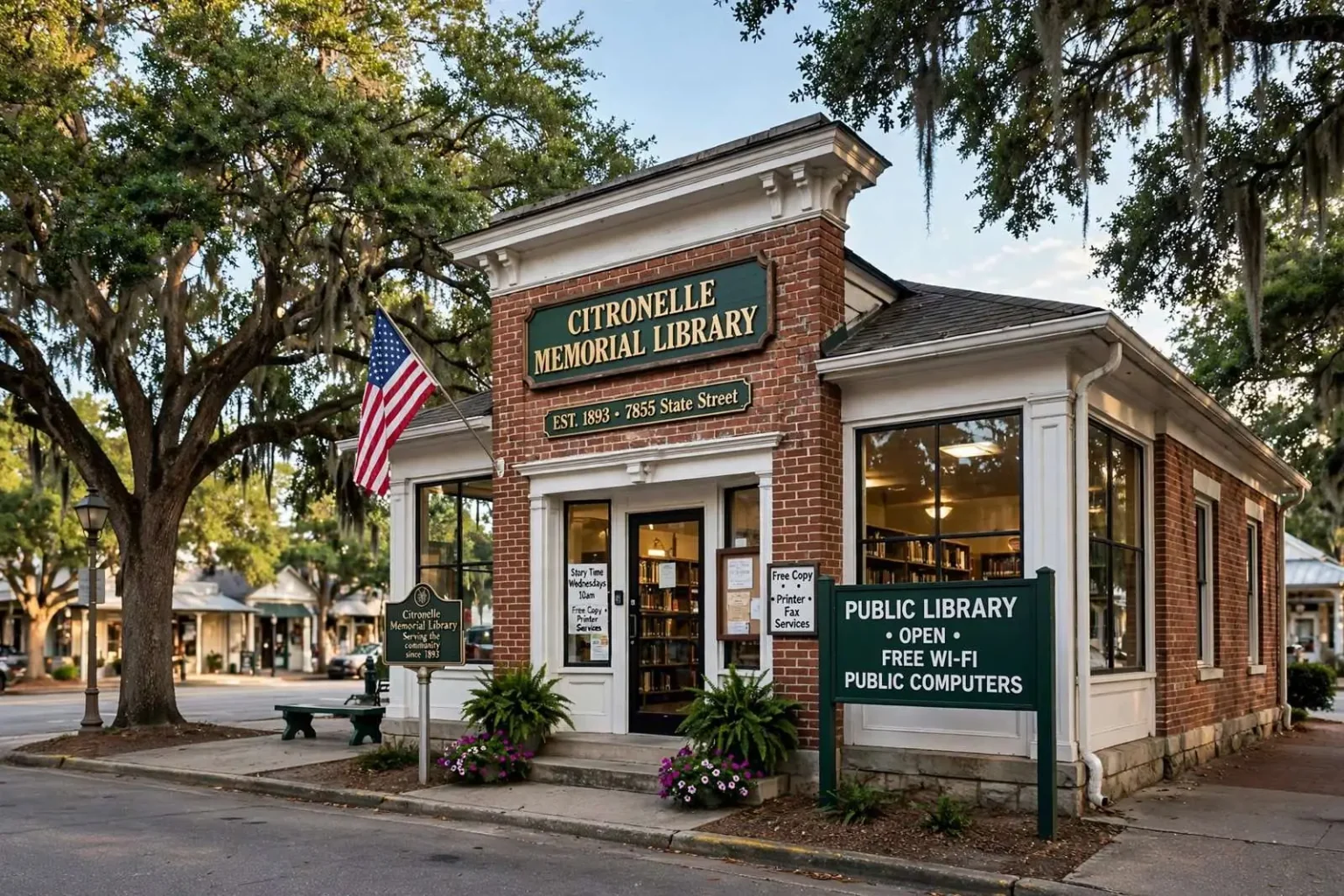
Long before it offered public computers and free Wi-Fi, Citronelle Memorial Library got its start with a much simpler collection: 500 donated books and a $1.00 annual fee for their use. More than 130 years later, the library located at 7855 State Street in Citronelle remains a fixture of the small Mobile County community it was built to serve.
A Library With Roots Back to 1893
Citronelle Memorial Library was formed in June 1893, making it one of the longer-standing community institutions in the area. Its origins as a modest, donation-based collection reflect a common story for small-town Alabama libraries of that era, many of which began as informal reading rooms before growing into full public library systems.
Today, the library has grown well beyond its 19th-century beginnings. It is fully accredited both within Mobile County and through the Alabama Public Library System, a status that connects it to statewide library resources and standards even as it continues to serve its local community directly.
Modern Services for a Small-Town Library
Citronelle Memorial Library’s offerings today extend well past its original book collection. Alongside its books, the library maintains a video collection for patrons and provides computers for public use, giving residents access to technology and the internet through free Wi-Fi.
The library also offers practical services for the community, including a printer, copier and fax machine available for public use. Black and white copies cost 25 cents each, while color copies are 50 cents each. Patrons needing to send or receive a fax can do so for $1.00 per page.
Leadership Today
The library is currently led by Head Librarian Tina Bender, who oversees its day-to-day operations and services for the Citronelle community.
From its founding with a few hundred donated books to its current role as an accredited member of the Alabama Public Library System, Citronelle Memorial Library has remained a consistent resource for residents seeking reading material, technology access and basic office services in one place.
Citronelle and the geography of Mobile County
Citronelle is a small city in northern Mobile County, set inland from the Gulf Coast and historically tied to the timber and railroad economy of southwest Alabama. Its location north of Mobile along the old Mobile and Ohio Railroad corridor made it a way station in the nineteenth century, and the coming of the railroad is part of the reason a community library could take root in 1893 with a few hundred donated books and a modest annual subscription fee. Many of the small public libraries in Alabama began exactly this way, as the byproducts of civic clubs, churches and women’s societies that pooled donations to create reading rooms where none had existed. The transition from a subscription library, where patrons paid a small annual fee, to a free public library is a familiar arc for institutions of this era.
The library’s 7855 State Street address places it in the heart of Citronelle, within walking distance of the city’s commercial core. State Street runs through the center of town, and the library’s long presence on it is part of why it has remained a recognizable landmark for generations of local families.
How Alabama’s library system is organized
Alabama’s public library system is structured in tiers. The Alabama Public Library Service, the state-level agency, coordinates accreditation, training and shared resources across the state. Beneath it, regional and county-level systems operate the local branches that residents actually visit. A library that is fully accredited, as Citronelle Memorial Library is, has met the state’s standards for collections, staffing, hours and governance, which makes it eligible for state support and interlibrary loan networks. For a small-town library, accreditation is a meaningful endorsement: it signals that the library is meeting the same baseline as larger urban branches, even if its collection size and staff are smaller.
That accreditation matters in practical terms. It connects Citronelle’s patrons to the broader state catalog, allowing residents to request books from other libraries and access shared electronic resources. For a community of Citronelle’s size, the value of that connection is significant: a small branch can offer its patrons a much larger library without needing to own every title on its shelves.
The role of small-town libraries today
Modern small-town libraries do far more than lend books. The presence of public computers and free Wi-Fi at the Citronelle branch reflects a wider shift in the role of public libraries, which have become important points of internet access in rural and small-town America. For residents without home broadband – a real gap in many parts of Mobile County outside Mobile and the Baldwin County shore – a library computer or Wi-Fi connection can be the most reliable way to file a job application, complete schoolwork or access government services. A printer, copier and fax machine, even at modest per-page fees, fill similar practical needs, since few other places in a small community offer the same combination.
Those services are not incidental to the library’s mission. They are part of why libraries in towns like Citronelle continue to be funded and supported, and why librarians such as Head Librarian Tina Bender play a role that goes well beyond cataloging. The continuity of the library since 1893 is a measure of how deeply it has become part of the community’s daily life.
Looking ahead
From 500 donated books and a dollar annual fee to an accredited branch of the Alabama Public Library System, the Citronelle Memorial Library’s history is a useful reminder of how a single community library can outlast the changes around it. Its modern services, including computers, Wi-Fi and office equipment, are essentially contemporary answers to the same question the original 1893 founders were trying to answer: how to make information and resources available to the people of Citronelle. The form has changed, but the role has stayed remarkably consistent.
A library, a town, a sense of place
Community libraries of this age tend to be repositories of local memory as well as of books. Patrons, employees and volunteers often donate or contribute to a library’s history, and small branches frequently hold scrapbooks, photographs and city directories that would be hard to find elsewhere. Even when such collections are modest, they give a library a second function as a quiet archive of the place it serves. The Citronelle Memorial Library’s 130-plus years put it in a position to have collected, intentionally or not, a record of how a Mobile County town has changed across the twentieth and into the twenty-first century. That ongoing work of preservation is part of the work of librarians like Bender and her predecessors.
It is also why losing a small library would mean losing more than books. The institution that began with 500 donated volumes and a dollar annual fee is now, in effect, a multi-purpose community service center, and it is hard to imagine replacing that combination in a town of Citronelle’s size without building it deliberately. The continuing investment in the library, evident in its accreditation and its modern equipment, is in part a recognition that.
How residents can use the library
For residents and visitors, the practical entry points to the library remain straightforward. Patrons can borrow from the book and video collections, use the public computers or connect to the Wi-Fi, and take care of basic office tasks at the printer, copier and fax. The library’s accreditation means its cardholders can also draw on the wider state library system for materials the local branch does not own. For a small community library that has had to do more with less for more than a century, those interconnections are exactly the kind of leverage that keeps a branch useful well beyond what its four walls could hold.
A tradition that stretches across Alabama
Citronelle is one of dozens of small Alabama communities whose libraries outlasted the generations that founded them. Places like Eufaula, Tuscumbia, Marion, Greensboro, Selma and a long list of county seats operate branches that began as reading rooms or association libraries in the late nineteenth century, often under the sponsorship of a women’s literary society or a church group, and grew into accredited public libraries over the following decades. The names of the founders have often faded, but the institutions they left behind remain the most consistent civic presence in many small towns. The Citronelle Memorial Library, in that sense, is not an exception; it is an example of a pattern that has played out across the state. The fact that it is still operating in 2026, still accredited, and still expanding the kinds of services it offers is the most direct evidence that the original investment – 500 books and a dollar a year – has paid back many times over.
Why a small library still matters
For a small town, a library of this kind often serves as a default public space as much as a collection. Children visit for story times and summer reading programs; older residents come in for newspapers and conversation; job seekers use the computers; small business owners send and receive faxes. None of those activities requires a large institution to be valuable, but each depends on a quiet, well-maintained place staffed by people who know the community. That is what Tina Bender oversees at the Citronelle Memorial Library, and it is what 500 books and a dollar annual fee in 1893 were already trying to provide.