Citronelle Man Gets a Year in Prison for Glock Switch Found by Mobile Police During Mardi Gras
Kelvin Barnes, 29, of Citronelle was sentenced to a year in prison for illegally possessing a machine gun after Mobile police arrested him downtown during Mardi Gras with a Glock switch, the Justice Department said.
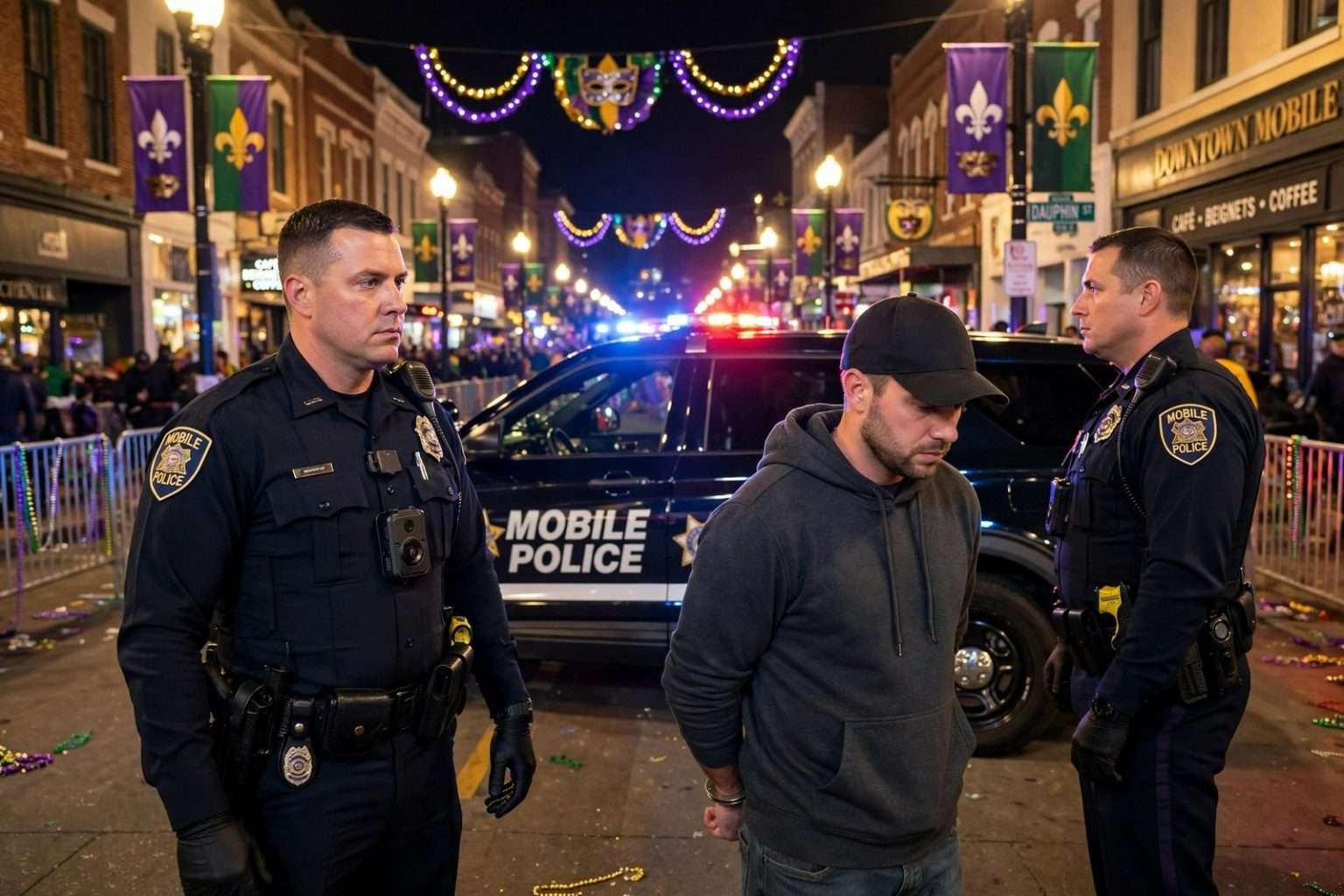
MOBILE COUNTY, Ala. — A Citronelle man has been sentenced to a year in federal prison for illegally possessing a machine gun after Mobile police arrested him with a machine gun conversion device — commonly called a Glock switch — while patrolling downtown Mobile during Mardi Gras, according to the U.S. Department of Justice.
Kelvin Barnes, 29, received the one-year sentence for illegal possession of a machine gun, the Justice Department said in a news release announcing the outcome of the case.
Glock switch arrest during Mardi Gras
According to court documents, the case began on Feb. 15, when Mobile Police Department officers were patrolling downtown Mobile during Mardi Gras. Officers arrested Barnes for having a machine gun conversion device.
Downtown Mobile is the heart of the city’s Carnival season, drawing large crowds to watch parades roll through its streets on the busiest nights of the celebration. Mobile police maintain a heavy presence downtown throughout the season to manage crowds and keep parade routes safe.
The Justice Department release did not include further details about the circumstances of the arrest, such as exactly where downtown it took place, what led officers to Barnes, or whether the device was installed on a firearm at the time.
What is a Glock switch?
A machine gun conversion device, also known as a Glock switch, is designed to convert a semiautomatic pistol to a fully automatic machine gun, “allowing the firearm to fire multiple rounds with a single pull of the trigger,” the Justice Department release said.
The devices are typically small enough to fit in the palm of a hand and attach to the back of a pistol’s slide. The nickname comes from the popular Glock line of handguns the devices are most often associated with, though the term is commonly used for conversion devices in general.
The difference between semiautomatic and fully automatic fire is the central issue. A semiautomatic firearm fires one round each time the trigger is pulled. A fully automatic weapon keeps firing for as long as the trigger is held down, until the ammunition runs out — which is why federal law treats it as a machine gun.
How federal law treats conversion devices
Under federal law, a conversion device itself counts as a machine gun. The legal definition of a machine gun includes not only fully automatic firearms but also any part designed and intended solely and exclusively for converting a weapon into a machine gun. That means a person can face a machine gun charge for possessing a switch even if it is not attached to a gun.
Federal law generally makes it illegal for private individuals to possess a machine gun that was not lawfully registered and possessed before May 1986. Because newly made conversion devices fall outside that narrow exception, possessing one is a federal felony carrying a maximum penalty of up to 10 years in prison.
Alabama has also moved to crack down on the devices under state law, making possession of a Glock switch a state felony. That gives prosecutors the option of pursuing cases in either state or federal court. In this case, the matter was handled federally, as reflected by the Justice Department announcement.
What a one-year federal sentence means
Barnes’ sentence of a year is well below the statutory maximum for the offense. Federal judges determine sentences using the advisory U.S. Sentencing Guidelines, which take into account factors such as the specific conduct involved, a defendant’s criminal history and whether the defendant accepted responsibility, along with other factors set out in federal law.
The Justice Department release did not say whether Barnes pleaded guilty or was convicted at trial, and it did not detail any term of supervised release, fines or other conditions that may be part of his sentence. There is no parole in the federal system; defendants serve their sentences subject only to limited credit for good conduct.
Part of a broader focus on Glock switches in Mobile
The Barnes case is one of several in the Mobile area in recent months involving conversion devices. Law enforcement agencies nationwide have warned that the devices, which can be cheaply made and easily concealed, make firearms far more dangerous in crowded places because of how quickly they fire and how hard they are to control.
Recent local cases include a Mobile man charged under the state’s Glock switch law after a traffic stop (read our earlier report) and a federal case against a man accused of selling the devices disguised as keychains (read more). The defendants in those cases are presumed innocent unless and until proven guilty in court.
About Citronelle
Citronelle is a small city in northwestern Mobile County, more than 30 miles north of downtown Mobile. The Justice Department release identified Barnes as a Citronelle resident but did not indicate any connection between the case and the city itself; the arrest took place in downtown Mobile.
By the numbers
- 29 — Kelvin Barnes’ age, according to the Justice Department.
- 1 year — the prison sentence he received.
- Feb. 15 — the date Mobile police arrested him downtown during Mardi Gras.
- 10 years — the maximum federal prison sentence for illegal possession of a machine gun.
What we know and what we don’t
What we know: Barnes, 29, of Citronelle, was arrested Feb. 15 by Mobile police officers patrolling downtown Mobile during Mardi Gras for having a machine gun conversion device. He has been sentenced to a year in prison for illegally possessing a machine gun, according to the Justice Department.
What we don’t know: The release did not say what led officers to Barnes, whether a firearm was recovered with the device, how the case was resolved before sentencing, or what conditions will follow his release.
How to report illegal firearms
Anyone with information about illegal firearms or conversion devices in the Mobile area can contact the Mobile Police Department or the Bureau of Alcohol, Tobacco, Firearms and Explosives, the federal agency that enforces federal firearms laws. In an emergency, call 911.