
All Politics Is Local: Previewing Mobile County’s August Municipal Elections
From Saraland to Bayou La Batre, voters across Mobile County prepared to choose mayors and council members on Aug. 26, with runoffs to follow. Seasoned observers offered their reading of the races.
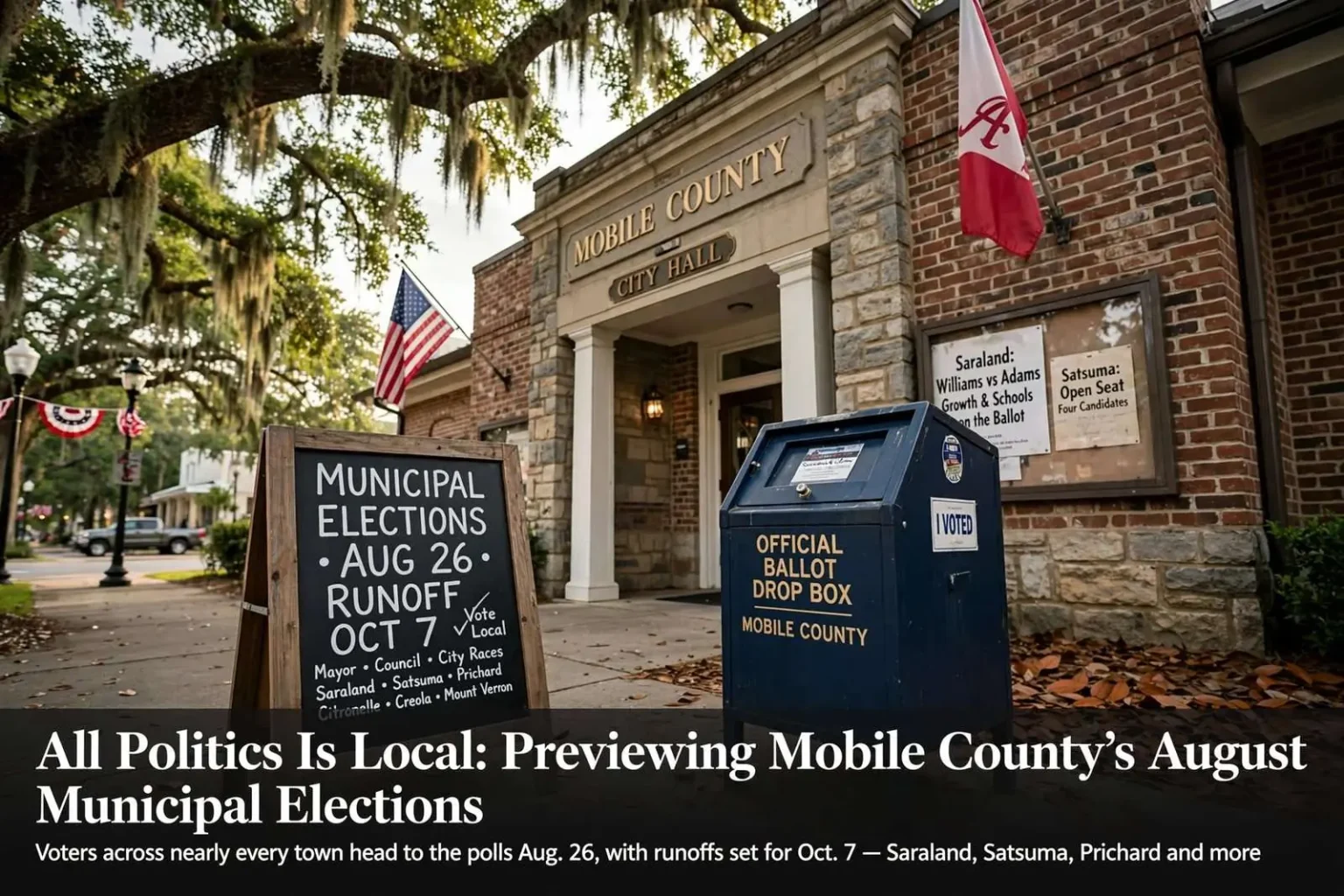
Municipal elections were around the corner across Mobile County, with voters in nearly every town preparing to choose mayors and council members on Aug. 26 and, where needed, in Oct. 7 runoffs. Some contests were as heated as a Gulf Coast afternoon; others drew little notice. Here is a look at the races and the reading offered by a number of seasoned local observers.
Saraland
In the self-styled “Gateway to Progress,” Mayor Ken Williams sought a fourth term against long-time friend and Place One Councilman Marvin “Skooter” Adams, a former city sewer superintendent whom Williams had once coached in youth baseball. The personal history between the two men gave the race an unusual texture: the incumbent and his chief challenger knew each other’s families, strengths and records in detail, and neither could caricature the other without contradicting years of shared history.
With a steel mill, a proposed racetrack and a new school system on the horizon, the race pitted growth-minded voters against residents who preferred a steadier pace. Saraland had spent years courting industrial development along its corridor near Interstate 65, and the arrival of a major steel operation promised jobs and tax base — along with traffic, strain on infrastructure and the kind of change that long-time residents notice immediately.
The city’s breakaway school system complicated the picture further. Saraland’s decision to secede from the Mobile County Public School System and build its own schools had transformed the city’s appeal to young families and put new demands on the budget, and the candidates’ differences over how fast to grow tracked closely with how voters weighed those trade-offs.
Observers gave Williams an edge with the city’s senior citizens, while Adams needed strong turnout among newer residents west of Interstate 65, where subdivisions had expanded the city’s population and reshaped its electorate. A last-minute council entry by former mayoral candidate Ron Mitchell against retired state trooper Benny Peoples, and a contest between two members of the same church, drew particular interest — the kind of locally personal matchups that municipal ballots produce and that citywide campaigns cannot fully control.
Satsuma
The headline in Satsuma was the decision by Mayor Billy Bush not to seek re-election. The contest to succeed him centered on council member Mark Barlow and retired teacher and civic activist Pat Hicks, with two other candidates in the field raising the odds of a runoff.
Lingering questions over the former administration and the fallout from Saraland’s move to form its own school system added to an unusually crowded ballot, where by one count it seemed half the town was running for something. Satsuma, a small community north of Saraland along U.S. Highway 43, had watched its neighbor carve out an independent school district and seen the consequences ripple through its own civic life, from enrollment figures to property tax discussions to the simple question of which town would act next.
Open-seat races in small towns tend to draw deeper fields and higher turnouts than campaigns against a sitting mayor, and Satsuma fit the pattern. With no incumbent to run against or defend, the candidates spent the summer making the case for their own visions — and voters spent it sorting through a ballot that reached into every corner of town government.
Prichard
Incumbent Mayor Ron Davis faced three challengers, including former Mayor Charles Harden, who campaigned on lowering water bills. Observers expected Davis, who had won a crowded field without a runoff four years earlier, to prevail comfortably.
Prichard’s politics are shaped by the city’s long-running financial pressures, including pension obligations that have weighed on its budget for years and the day-to-day cost of delivering water service in a city with aging infrastructure. High water bills are a persistent complaint in Prichard’s neighborhoods, which made Harden’s signature issue a direct challenge to the incumbent’s record and gave the race its central argument, whatever the polls suggested about the likely outcome.
Prichard’s mayoral contest illustrates a pattern that recurs in north Mobile County’s older cities: incumbents with the advantage of name recognition and a record of steady administration face challengers who run on a single kitchen-table issue. Four years of council minutes, paving schedules and water department decisions give a sitting mayor plenty to defend — and in a city where household budgets are tight, water rates reach every home on the grid.
Citronelle, Creola and Mount Vernon
In Citronelle, incumbent Michael Waltman faced a field that included the widow of a former mayor and the wife of another, a crowded race that observers thought could work to the incumbent’s advantage. Split opposition is a classic feature of small-town elections: when challengers with overlapping support divide the anti-incumbent vote, the sitting mayor can win re-election with a plurality that would not survive a head-to-head contest.
Citronelle, in the far northern reaches of Mobile County, has an economy anchored by oil and gas fields, timber and the farms that stretch across the rolling terrain near the Washington County line. Municipal elections there turn on the same fundamentals as anywhere — roads, water, fire protection — but with a small enough electorate that personal relationships and family histories decide more races than any issue campaign could.
Creola appeared headed for continuity, with a water dispute between the city and the Le Moyne Water Board the issue most worth watching. The conflict over water service in the Le Moyne community is the kind of utility question that dominates small-town politics along the U.S. 43 corridor, where residents may be served by a mix of municipal systems and independent boards, and where who controls the pipes controls both rates and reliability.
Mount Vernon faced an open seat as its long-serving mayor stepped aside, leaving a field led by veteran local figure Leophus Lyde and popular candidate Jerry Lundy. The town of a few thousand residents near the Mobile River and the county’s northern line has long depended on the regional jail and its small-town institutions as anchors, and an open mayor’s race gave the community its first real contest over direction in years.
Bayou La Batre and Dauphin Island
In Bayou La Batre, Mayor Stan Wright sought a third term against former Mayor Warren Seaman and commercial fisherman Rodney Lyons, campaigning on the town’s recovery from Hurricane Katrina. The seafood processing capital of Alabama was among the hardest-hit communities on the Gulf when the storm came ashore in 2005, wiping out boats, docks and processing houses along the bayou, and the pace and shape of the rebuilding effort defined Wright’s two terms in office.
Council races there were expected to be competitive, with several incumbents facing strong, family-backed challengers — a reminder that in a working waterfront town of a couple thousand people, family networks are the true political parties, and council seats change hands on relationships that predate any campaign.
On Dauphin Island, Mayor Jeff Collier drew no opposition, a reflection of broad approval for his stewardship of the barrier-island community. Running unopposed in a town that has weathered hurricanes, beach erosion and the endless mechanics of barrier-island life — from bridge tolls to sand renourishment — signals an electorate that sees its government performing competently and sees no reason to experiment in the middle of ongoing recovery work.
Island politics also carry stakes the mainland rarely thinks about: Dauphin Island is the Gulf’s first line of defense for Mobile Bay, and decisions made at its town hall about development, dunes and emergency preparedness ripple across the entire bay system.
The absence of opposition in some races and the crowding of the ballot in others is the usual August rhythm of municipal politics in Alabama, where qualifying deadlines set months earlier determine which towns get a full campaign season and which get a quiet procession to the ballot box. State law staggers municipal elections across the four years between presidential cycles, keeping small-town ballots separate from the noise of national campaigns and ensuring that turnout is driven by local loyalties rather than partisan momentum.
Chickasaw
Chickasaw drew notice for the emergence of a citizens group formed in response to a metal-shredding plant, which fielded a slate emphasizing police protection and crime. Mayor Jim Trout, a favorite son of the city, was seen as well positioned, though the organized opposition represented the first cohesive challenge to a sitting administration there in some time.
The dispute over the metal-shredding operation brought the kinds of questions industrial towns across Alabama know well: noise, truck traffic, environmental risk and the balance between jobs and quality of life in a residential community. A citizens organization that begins as a protest against a single facility can evolve quickly into a political slate, and Chickasaw’s version fielded candidates around the theme of public safety — an issue that touches every household and resists easy counterargument.
For Mayor Trout, the challenge was unusual in degree rather than kind. Incumbents in small cities are rarely opposed by organized slates, because the effort required to qualify a full field of candidates usually exhausts the organizing energy of even the most determined citizens group. Where it happens, it signals a level of resident engagement that can reshape a city’s politics well beyond a single election, win or lose.
How the Runoff Works
The Oct. 7 runoff date exists for the races where no candidate clears a majority on Aug. 26. Alabama municipal law requires a candidate to win more than half the vote to claim a seat outright; otherwise the top two finishers meet again three weeks later, in a campaign compressed into a sprint of door-knocking and lawn signs. Runoffs are most likely in the crowded fields — Satsuma’s four-way mayor’s race, Citronelle’s multiple challengers — and least likely where a popular incumbent faces scattered opposition.
For voters, the practical meaning is that the August ballot is not always the final word. A race that looks decided in late summer can extend into October, and the smaller electorate that turns out for a runoff — typically a fraction of the general election vote — gives organized campaigns and committed neighborhoods outsized influence.
As one veteran put it, all politics is local — and it rarely gets more local than a small-town election, where a church congregation, a coffee-shop rumor or a single well-timed endorsement can decide who wins.
The Aug. 26 ballot across Mobile County’s municipalities captured that truth in miniature. From Saraland’s contest between old friends to Mount Vernon’s open seat, from the water-rate argument in Prichard to the citizens slate in Chickasaw, every race on the calendar was decided by the same small, intimate arithmetic: neighbors, families, congregations and the question of who best represents a town of a few thousand people. Whether the outcomes arrived in August or required the October runoff, the county’s towns would spend the fall governed by the choices their neighbors made.