A Mobile Reader Took Jeff Sessions to Task Over the Nation’s ‘Financial Soul’
In a letter to the editor, Mobile's Pierre Pelham argued that Alabama's senior senator had been silent when it counted - on the Iraq war and on the mortgage system - and had no standing to lecture on finance.
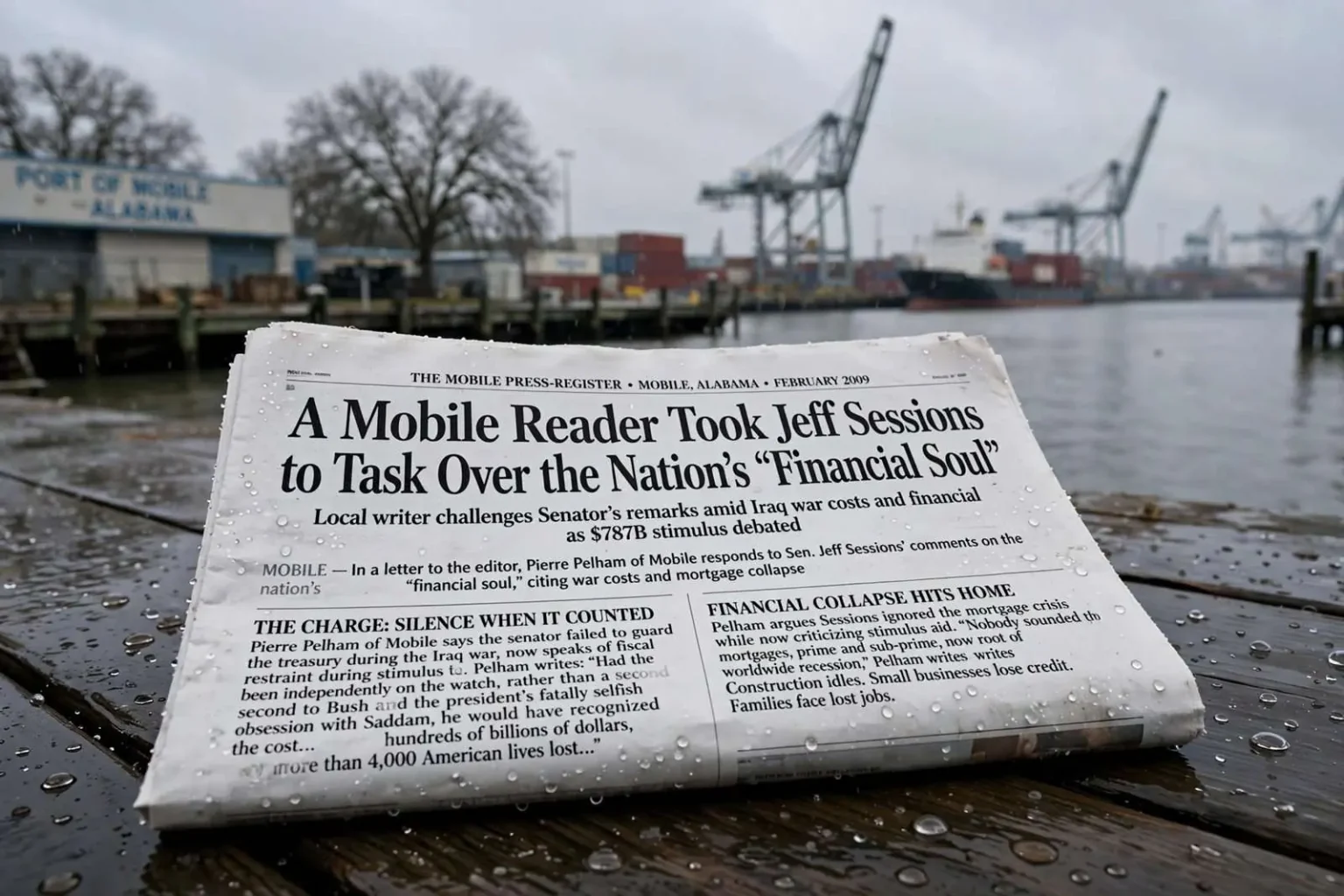
MOBILE — Alabama’s senior senator had lately taken to speaking about the country’s “financial soul.” A Mobile reader was not prepared to let the phrase pass. In a letter to the editor, Pierre Pelham of Mobile responded to remarks by U.S. Sen. Jeff Sessions, as reported in the local daily, in which the senator positioned himself as a guardian of the nation’s finances at a moment when Congress was debating an economic stimulus package of unprecedented size.
The exchange was one citizen’s rebuttal to one senator’s framing, conducted in the oldest public forum available — the letters page of the morning paper. But the letter’s arguments ranged across both of the catastrophes that defined the era: a war already fought and paid for in blood, and a financial collapse then spreading through every corner of the economy, including the neighborhoods of Mobile.
The Charge: Silence When It Counted
Pelham’s argument was that Sessions had not exercised that guardianship when it might have mattered. “It is unfortunate that Jeff’s political loyalty blinded him to the peril to our country’s soul at an earlier time,” Pelham wrote. Had the senator been “independently on the watch,” rather than “a second to Bush and the president’s fatally selfish obsession with Saddam,” he would have recognized the cost of the Iraq war — “hundreds of billions of dollars,” more than 4,000 American lives lost, and more than 25,000 service members blinded, maimed or otherwise disabled.
The figures Pelham cited were, at the time he wrote, the accumulating ledger of a war in its sixth year. The human toll — the wounded and disabled counted alongside the dead — was the part of that ledger that reached into communities like Mobile, where National Guard and Reserve deployments had become routine and where military families clustered around the port, the bases and the shipyards.
The core of the charge was consistency. A senator who claimed the title of fiscal guardian, Pelham argued, should have been guarding the treasury when the largest discretionary spending decisions of the era were being made — not discovering thrift only when a new administration proposed spending of its own.
A Failure With Many Authors
The letter then turned to the crisis then unfolding. Sessions’ use of the phrase “financial soul,” Pelham wrote, implied a command of finance, “but he ignored mortgages, both prime and sub-prime, so greedily deficient that they form today the root of a worldwide recession.”
Pelham was careful to spread the blame. “Nobody in or out of government sounded enough of an alarm to cause an examination of a mortgage system that was toxic to its core and bound to end badly,” he wrote — a puzzling failure in itself. More incomprehensible still, he argued, was that derivatives built on those mortgages “were approved by debt rating agencies, accepted by various financial bodies, and sold to sophisticated bankers over most of the world.”
That chain of failure — sloppy lending, unwatched, then packaged and stamped as safe by the institutions paid to judge risk — was the mechanism then working itself out in headlines. For a reader in Mobile, the abstractions had local faces: construction trades idled as homebuilding stalled, banks tightening credit on small business, retirees watching statements shrink.
The result, he wrote, loomed as “the worst recession since the Great Depression”: workers laid off, long-established businesses shutting their doors, unemployment climbing, and the prospect — “unthinkably” — of hunger when unemployment insurance ran out. The language was not rhetorical decoration. Alabama’s unemployment rolls were growing by the week that winter, and the safety net beneath them was thinner than most residents had ever had reason to learn.
‘This Is No Time for Master of the Universe Drivel’
The letter closed with an appeal that was as much about tone as about policy. “Jeff, among other ‘leaders,’ needs to be reminded that this is no time for ‘Master of the Universe’ drivel,” Pelham wrote. “People — our neighbors, our countrymen — are hurting. The hurt is real and growing by the day. Washington has to help. Now.”
The phrase he reached for was an accusation of detachment — the borrowed language of financial-fiction arrogance, aimed at officials who spoke of the crisis as an abstraction. Against it, Pelham set the concrete: neighbors, countrymen, hurt, now. It was the rhetoric of a man who believed the debate in Washington had lost contact with the kitchens where the recession was actually being lived.
Sessions was offered an opportunity to respond to the letter. He did not.
The Moment It Was Written In
The letter appeared at the height of the fight over the American Recovery and Reinvestment Act, the roughly $787 billion stimulus package that President Barack Obama would sign into law days later. The measure combined tax cuts, aid to states, and infrastructure and energy spending, and it was drafted explicitly as a counterweight to an economy in free fall. In the Senate, it passed without a Republican vote to spare, and no Republican senator was more identified with opposition to it than Sessions.
Sessions, a Republican who had represented Alabama in the Senate since 1997 and who had previously served as the state’s attorney general and as U.S. attorney in Mobile, was among the measure’s consistent critics, arguing that the spending would burden future generations with debt. His “financial soul” remarks came from that position — an argument that the true measure of the nation’s solvency was its fiscal discipline, and that the stimulus betrayed it.
The unemployment rate in Alabama was climbing steeply that winter, and the Gulf Coast — dependent on construction, shipbuilding, tourism and the port — was feeling it. Each of those sectors moves with credit and consumer spending, and both had seized up. Builders had no buyers to sell to; the port and the yards felt the slowdown in trade orders; the beach economies faced a winter of cancelled bookings from families no longer spending.
Against that backdrop, the senator’s defenders would say the letter misread him: warning about debt was governing for the future, not ignoring the present. His critics, Pelham chief among them, read the same record differently — a guardian who had slept through the spending that broke the bank and woke only to object to the repair bill.
The Letters Page as Public Record
The letter to the editor is an old institution, and in Alabama it has long done work that more formal commentary does not. Written by people with names and addresses published, subject to the discipline of a few hundred words, letters pages carry the unpolished argument of a community — the response of the retired accountant, the contractor, the pastor. Pelham’s letter was a substantial entry in that genre: structured, quoted, and aimed precisely at one public figure’s own words.
It also preserved something the daily news cycle could not. Speeches by senators are transcribed everywhere; the responses they provoke from their own constituents are recorded almost nowhere but the newspaper that printed them. To read Pelham’s letter now is to hear the recession as it sounded in Mobile in real time — not as a statistic to be charted but as a series of failures that, in the writer’s view, could and should have been stopped.
What the Letter Asked For
Strip away the argument about Iraq and the mortgage system, and the letter’s demand was simple: attention. Pelham wanted his senator to look at the actual damage — the dead and wounded of a war of choice, the laid-off workers of a financial collapse, the families one missed check from hunger — and to govern from that sight. The grievance was not that Sessions reached different conclusions. It was that, in Pelham’s telling, he had reached them without ever doing the looking.
That is a charge every elected official hears at some point, but it landed with particular force in a season when the stakes were measured in foreclosures and enlistments. The letter did not accuse the senator of corruption or incompetence, only of loyalty — loyalty to a president and a party when independent judgment was owed. In the political vocabulary of the Gulf Coast, that was as damning as it needed to be.
Whether one agreed with him or not, the letter recorded something worth preserving: how the recession sounded from Mobile, in the voice of a man who had watched the whole sequence unfold and had decided to put his name to an objection. The senator went on speaking about the nation’s financial soul. The reader had answered, in print, with his own accounting — a war’s cost, a system’s collapse, and a plea that Washington remember the people actually paying for both.