Tim James Challenges Byrne to Debates, Opens Mobile HQ with Four Mayors Behind Him
James demanded a series of public debates as attack ads roiled the Republican primary, then opened a Mobile headquarters flanked by the mayors of Satsuma, Citronelle, Bayou La Batre and Chickasaw.
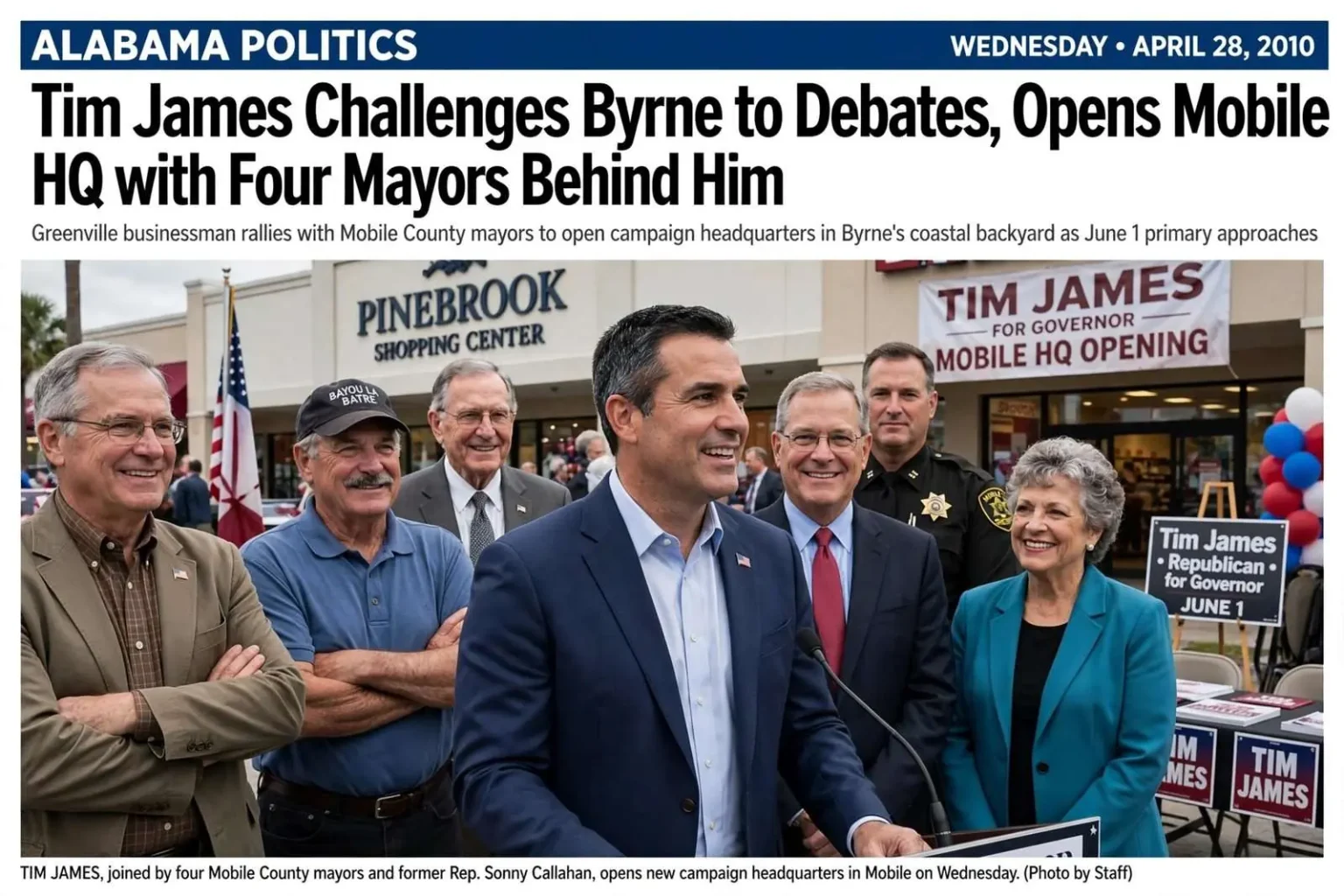
Tim James, the Greenville businessman running for the Republican nomination for governor, challenged rival Bradley Byrne to a series of public debates on Thursday and then took his campaign directly into Byrne’s coastal backyard. The move came with the June 1 primary drawing near and the contest’s tone turning harsher by the week.
‘I’m calling you out’
James issued the challenge at a news conference at the State Capitol in Montgomery, in the middle of a primary that has grown steadily uglier as television advertising has escalated. “It’s time to bring all of the attacks and allegations out in the open,” James said. “Let’s take this beyond dueling press releases and talk show chatter.”
Critics of James have linked his campaign, and the Alabama Education Association, to the attack ads that have been running against Byrne — spots paid for by a group called True Republican PAC whose donors have not been disclosed. Alabama’s campaign finance rules at the time allowed political action committees to transfer money to other PACs before it reached a candidate or a cause, a practice critics called laundering and defenders called legal, and the arrangement made it extraordinarily difficult to trace who was paying for a given advertisement. The AEA, the teachers’ lobby that ranked among the most influential forces in Montgomery, had a long record of backing candidates it viewed as friendly to its agenda and of financing campaigns against those it did not.
James argued that the public record between the two candidates is stark. He pointed to Byrne’s support for, and his own opposition to, Gov. Bob Riley’s Amendment One — which James called “the largest proposed tax hike in Alabama history.” The 2003 tax referendum, which would have raised income and property taxes by roughly $1.2 billion a year, had been resoundingly rejected by voters, and for a decade afterward a candidate’s position on it served as a shorthand for his fiscal philosophy.
He also claimed that despite Byrne’s self-description as a conservative reformer, campaign finance records suggest he is captive to special interests. James, the son of former Gov. Fob James, had built his own profile as an outsider businessman, and his campaign’s bet was that a record of opposing tax increases and party establishment favorites would outweigh Byrne’s advantages in name recognition and endorsements.
Byrne’s answer
Byrne spokeswoman Marty Sullivan said the candidate has no qualms about engaging James on the issues — but that James should first clear the air about his lobbyist and fundraiser’s role in funneling money through political action committees “to help pay for dishonest smears against Bradley.”
“And [James has] missed several golden opportunities to denounce AEA and the Democrat Party for pouring money through a bogus front group into the Republican primary,” Sullivan said. “Tim says he’s for ethics and against PAC transfers, but actions speak louder than words.”
The exchange captured the central strategic question of the primary: whether James can make Byrne’s record the issue before Byrne makes James’ funding the issue. Both campaigns understood that in a low-turnout primary, the candidate who defines the terms of the debate — tax records or attack ads — would hold the advantage going into a possible runoff.
Four mayors and a former congressman
James was in Mobile on Wednesday to open a campaign headquarters at Pinebrook Shopping Center at McGregor Avenue and Airport Boulevard — figuratively, if not literally, in Byrne’s backyard. The Republican front-runner lives in Montrose, across the bay in Baldwin County, and had built his lead on business community support and a long career in local Republican politics. Opening a headquarters in Mobile County, the largest pool of primary voters on the coast, was a statement that James intended to contest that ground rather than concede it.
At the opening, James accepted and trumpeted endorsements from several Mobile County mayors: Satsuma’s William Stewart, Bayou La Batre’s Stan Wright, Chickasaw’s Byron Pittman, and Citronelle’s Loretta Presnall, who was unable to attend the news conference. The four municipalities stretch across the county — Satsuma and Chickasaw to the north, Citronelle to the northwest, Bayou La Batre on the southern shore — and their mayors brought with them the networks of small-town Alabama politics that turn out voters in June primaries.
County Commissioner Mike Dean was on hand, as was former congressman Sonny Callahan, who serves as James’ state chairman. Callahan, who represented the 1st District for nearly two decades before retiring in 2003, remained one of the most recognizable figures in coastal Alabama Republican politics, and his chairmanship gave James a bridge to the party’s older establishment.
Mobile County Sheriff Sam Cochran attended the event as well, though he has not publicly endorsed James and, facing his own race in November, has stayed formally uncommitted. A sheriff’s presence at a gubernatorial headquarters opening counted for little on paper and a great deal in person: county sheriffs command some of the deepest name recognition in Alabama politics, and their implicit favor is prized by every statewide candidate.
A fish fry called off
Byrne’s campaign, meanwhile, canceled a community-wide fish fry scheduled for Saturday at Homewood Park because of the threat of severe weather, Sullivan said. The cancellation, attributed to forecasts of the stormy weather that routinely sweeps through the Gulf Coast in spring, cost the front-runner a scheduled day of retail politicking but little else; his campaign continued to hold the advantages of money, endorsements and poll standing.
Byrne’s coast-heavy coalition was itself a product of years of accumulation. A Mobile native and former state senator from Baldwin County, he had served as chancellor of the state’s two-year college system and dean of the University of Alabama School of Law before entering the race, and his endorsements drew from the business associations and municipal leadership of both coastal counties.
The coastal fight
The endorsements matter more than the ribbon-cutting. Mobile County’s smaller municipalities — Satsuma, Chickasaw, Citronelle, Bayou La Batre — represent precisely the sort of turnout James needs if he is to cut into the Eastern Shore and Mobile suburban base that Byrne has assembled. A mayor’s endorsement rarely moves headlines, but it moves robo-calls, yard signs and the informal word-of-mouth networks that decide who votes in a June primary.
The arithmetic of the race rewarded exactly this kind of grinding local work. With a crowded field splitting the Republican vote, the likeliest path to the nomination ran through a runoff weeks after the primary, and runoff elections in Alabama are famously small — decided by a fraction of the electorate, often the most engaged and best-organized voters. Endorsements from mayors, commissioners and a former congressman were, in practical terms, claims on those voters.
With the June 1 primary approaching and a runoff a real possibility, both campaigns are treating south Alabama as contested ground rather than settled territory. Byrne entered the stretch as the favorite; James’ challenge was to give coastal Republicans a reason to believe the front-runner could be beaten — and the debate challenge, the headquarters opening and the mayor endorsements were all aimed at that single target.
The shadow war over the airwaves
The True Republican PAC spots had become a genuine political problem for Byrne well before James’ debate challenge. Airing in the state’s television markets through the spring, the ads attacked the chancellor’s record without any visible source willing to claim them, and the denials that followed — from James’ campaign, from the AEA, from the PAC itself — only deepened the impression that Alabama’s loose campaign finance rules were being used as designed. Candidates in the state could legally accept money from PACs that had themselves received money from other PACs, breaking the trail back to the original donor, and no disclosure requirement forced the chain into the open.
Ethics reformers had spent years pushing the Legislature to ban PAC-to-PAC transfers, and the practice was already the most cited exhibit in the debate over the governor’s ethics package. The 2010 primary gave both parties fresh examples of why the ban mattered: a contest between two Republicans being shaped, in part, by advertising money that neither would claim and no one could trace. James’ public position — that he was for ethics and against PAC transfers — sat uneasily beside the ads running in his favor, and Byrne’s campaign intended to keep that tension at the center of the race.
The AEA’s role carried its own irony for Republican audiences. The teachers’ association had been the dominant force in Alabama Democratic politics for decades, and its endorsement was close to worthless in a Republican primary. But its capacity to fund independent campaigns — through intermediaries whose donors stayed undisclosed — meant it could influence a Republican primary all the same, by financing attacks on the Republican candidate it preferred to lose. That dynamic, more than any single advertisement, was what James and Byrne spent the spring fighting over.