School Board Hopeful Quits Democratic Primary, Calls County Party ‘a Disgrace’
LaVeeshia Pittman abandoned the Democratic primary for Mobile County school board District 3, saying party leaders discouraged her. The county chairman said no one in the party had ever met her.
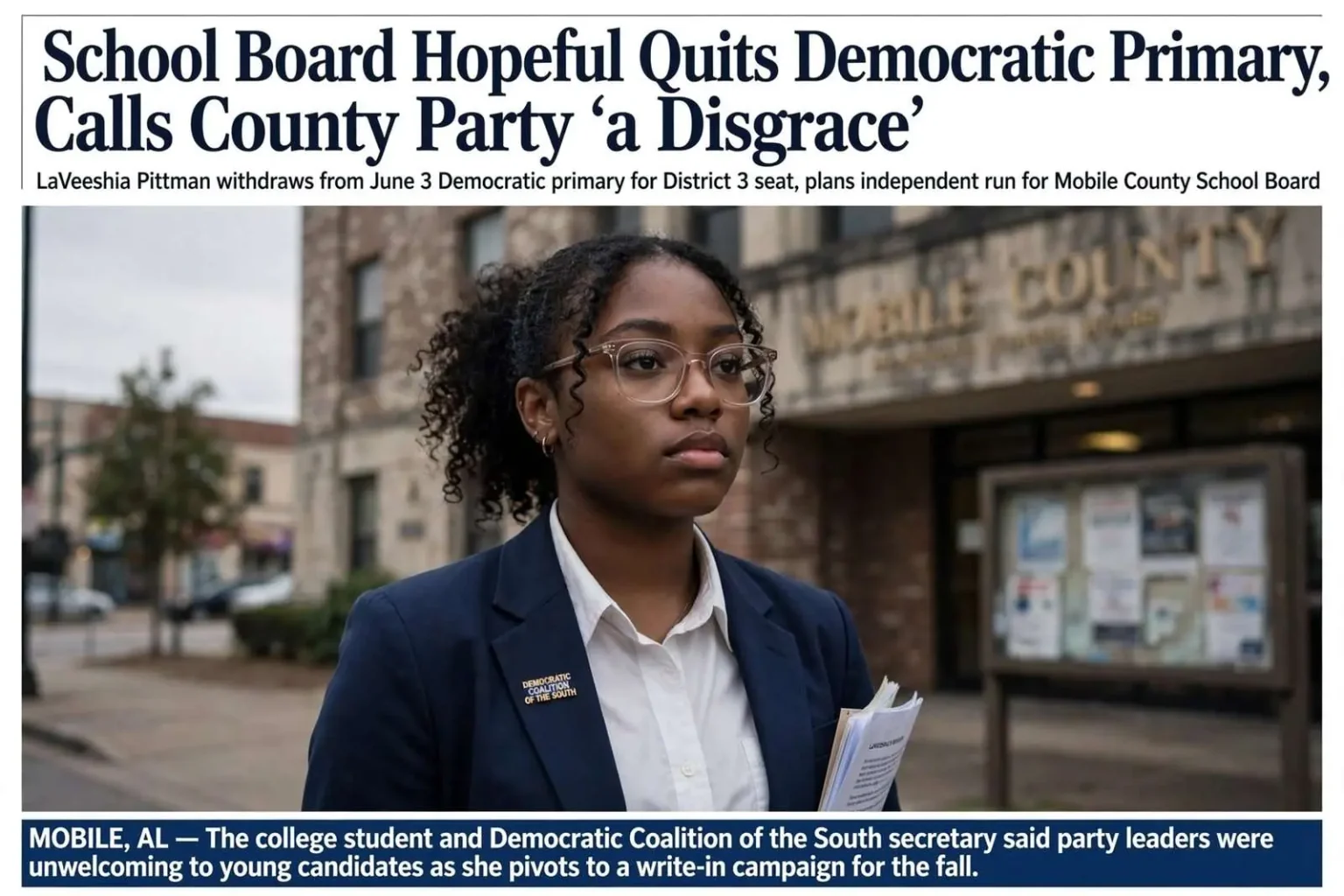
A young candidate for the Mobile County Board of School Commissioners walked away from the Democratic primary Thursday night with a parting shot at the party she had hoped to represent, saying local leaders had made her unwelcome and calling the county organization “a disgrace.”
LaVeeshia Pittman, a local college student and secretary for the Democratic Coalition of the South, announced in a press release that she was dropping out of the June 3 Democratic primary for the District 3 school board seat. She said she would press on as an independent or a write-in candidate in the fall general election.
The announcement arrived late in the qualifying season, when candidates have paid fees, lined up supporters and, in Pittman’s case, scheduled fundraisers — which is what made the exit more than routine housekeeping. Alabama’s qualifying deadlines are hard gates: once they pass, the ballot is set, and a candidate who leaves the primary has no way back into it. Pittman’s only remaining routes to the November ballot were the two she named.
‘No passion or concern for young adults’
Pittman said her decision grew directly out of how she was received by Mobile County Democrats and the people who run the local party. The organization, she argued, had shown no interest in cultivating young candidates and had actively discouraged her from qualifying.
“I am disgraced by the attitude of the local officials that claim to be leaders for this local Democratic Party in Mobile County,” her statement read. “… they show no passion or concern for young adults that desire to serve the community and seek elective office. I have decided to remain out of the Democratic primary for the nomination. I also feel that I wasn’t welcome after talking to several of the local democratic leaders.”
That reception, she said, left her unwilling to hand over her qualifying fee “to an ungrateful local party.”
“I will use my funds to establish a grassroots campaign to run as an independent or write-in candidate for the Mobile County School Board seat for District 3 that I desire to serve,” Pittman continued. “Young people of Mobile County should open their eyes and ears and start evaluating their local leaders whether they are elected or appointed and know who and what type of people that are representing them.”
Her critique touched a question larger than one race. Mobile County’s Democratic organization, like county parties across Alabama, had for decades been an incumbent-protection machine as much as a recruiting one, and openings on bodies like the school board tended to be inherited by figures with long histories in the organization. A college student with no prior race behind her would have been, by that culture’s arithmetic, someone to be tutored rather than backed — and Pittman was telling the county, in a press release, that she rejected the arrangement.
Party chairman: ‘I have never met Ms. Pittman’
The accusations left Mobile County Democratic Party Chairman Brad Warren puzzled. Warren said that neither he nor, to his knowledge, any member of the party’s executive committee had ever laid eyes on the candidate now denouncing them.
“… I have never met Ms Pittman, and to my knowledge, no one on our Executive Committee has either,” Warren said. “Her comments are unacceptable as she has never stepped through our doors, let alone expressed her concerns.”
The chairman’s reply reframed the dispute without resolving it. Pittman’s charge was that local leaders had discouraged her; Warren’s answer was that local leaders had never encountered her at all. If both accounts were accurate, the discouragement she described would have come from figures on the party’s edges rather than its leadership — and the exchange illustrated how thin the contact between a county party’s formal structure and a first-time candidate can be. Either way, the public split left the party’s young-growth problem on display: an organization accused of neglecting new candidates was, in its own defense, noting that none had come to its meetings.
Pittman said she notified her own chairman, the Rev. Gary Johnson, of her decision before the qualifying deadline and asked for his support in the fall.
The road to the ballot
Leaving a primary is one thing; getting onto a general election ballot in Alabama is another. Pittman said she would begin gathering the signatures required to qualify as an independent, and that if she fell short of the threshold she would mount a write-in campaign instead — a far steeper climb, since write-in votes must be spelled and counted individually.
The two routes differ sharply in what they demand. Alabama’s independent qualification requires a petition signed by a percentage of the voters in the district, gathered by hand and verified against registration rolls — work that has to be finished on the state’s schedule, not the candidate’s. A write-in candidacy requires no paperwork at all, but it asks voters to do something Alabama ballots almost never reward: write a name legibly enough to be counted. In a county where school board races are low-profile and often decided in the primary, a write-in campaign is usually an act of persistence more than of realistic expectation.
She insisted the base of support she had assembled would follow her out of the primary. Her backers, she said, came from Satsuma, Chickasaw, Creola, Prichard and parts of Toulminville, and she described breaking the news to them as painful.
“It’s was a sad day on last evening (Wednesday) when I had to meet with my supporters, business leaders and community activists that where supporting my campaign for the local school board … and tell them all, that I was exiting the Democratic primary,” Pittman said. “Our plans now are to move forward with what we have, which I believe is a great amount of support and work toward the general election.”
The geography she named matters for understanding the district. District 3 spans the northern reaches of Mobile County, from the small industrial cities of Satsuma and Creola and the incorporated town of Chickasaw down through Prichard — a city that had weathered decades of economic decline and municipal financial strain — and into the Toulminville neighborhood of northwest Mobile. It is a district where the school system’s struggles are not abstractions, and where a candidate who can show up at churches, community meetings and small businesses can build the kind of grassroots list she described, even without a party’s machinery behind her.
The withdrawal came with a financial cost as well. Pittman had hoped to raise roughly $7,500 at a private fundraiser scheduled for Saturday, with $50-a-plate tickets sold to relatives in California and to local residents, educators and business leaders. That event, her release said, had been postponed.
The arithmetic of her campaign made the postponement consequential. A $7,500 haul is modest by any standard, but for a first-time candidate running outside a party structure it is nearly everything — enough for signs, mailers and the legwork budget of a petition drive. Losing the date on which it would have been collected forced the campaign to run on what it had already raised, and pushed the fundraiser’s proceeds, whenever they arrived, toward a different kind of race than the one for which the tickets had been sold.
A party she says she is not leaving
For all the heat in her statement, Pittman did not renounce her politics. She said she would remain with the Democratic Coalition of the South and would “always be a Democrat” — a distinction between a national party she still claims and a county organization she says failed her.
The distinction was more than rhetorical. The Democratic Coalition of the South, the organization she served as secretary, exists precisely because some Southern Democrats feel unrepresented by both the national party’s national temperament and their local organizations’ habits. Remaining its secretary while running against the county party was consistent with that position: loyalty to an ideology and a community of Democrats, withheld from a particular local committee.
Her parting message to young voters carried the same logic. “Young people of Mobile County should open their eyes and ears and start evaluating their local leaders whether they are elected or appointed,” she wrote — a summons aimed not at party-switching but at scrutiny, the kind that asks who occupies the county’s committees and whether they answer to the people they claim to lead.
The District 3 school board seat, being vacated by retiring Commissioner Hazel Fournier, drew a competitive Democratic field in 2008, and Pittman’s exit left the primary to better-established candidates while she attempted to reach November by another route.
Fournier’s retirement marked a generational change on the board. The Mobile County Board of School Commissioners, one of the state’s separately elected county school boards, governs the largest school system in Alabama, a district of tens of thousands of students spread across the city of Mobile, Prichard, Satsuma, Chickasaw and unincorporated communities. District 3’s representative, accordingly, casts votes that shape construction priorities, bus routes and staffing across the county’s northern tier — decisions that land directly on the neighborhoods where Pittman’s support was concentrated.
Whatever became of the race itself, the episode left two records behind. One was a first-time candidate’s account of being turned away from her party — a charge that resonates wherever local organizations struggle to recruit the next generation. The other was a chairman’s account of a candidate who never came to the party’s doors. Both cannot be fully true at once, and neither could be checked against the private conversations she described. What the public could see was the outcome: a young candidate in the state’s largest county, running for its largest school system’s board, choosing the write-in and independent routes over a primary she had been told, in her telling, she did not belong in — and betting her $50-a-plate supporters that the voters of Satsuma, Chickasaw, Creola, Prichard and Toulminville would follow.