March Special Election Looms for House District 105 as Collier Joins Bentley Cabinet
A special election to fill the House District 105 seat in south Mobile County was expected in March after Rep. Spencer Collier left to join Gov.-elect Robert Bentley's cabinet, drawing a large field of prospects.
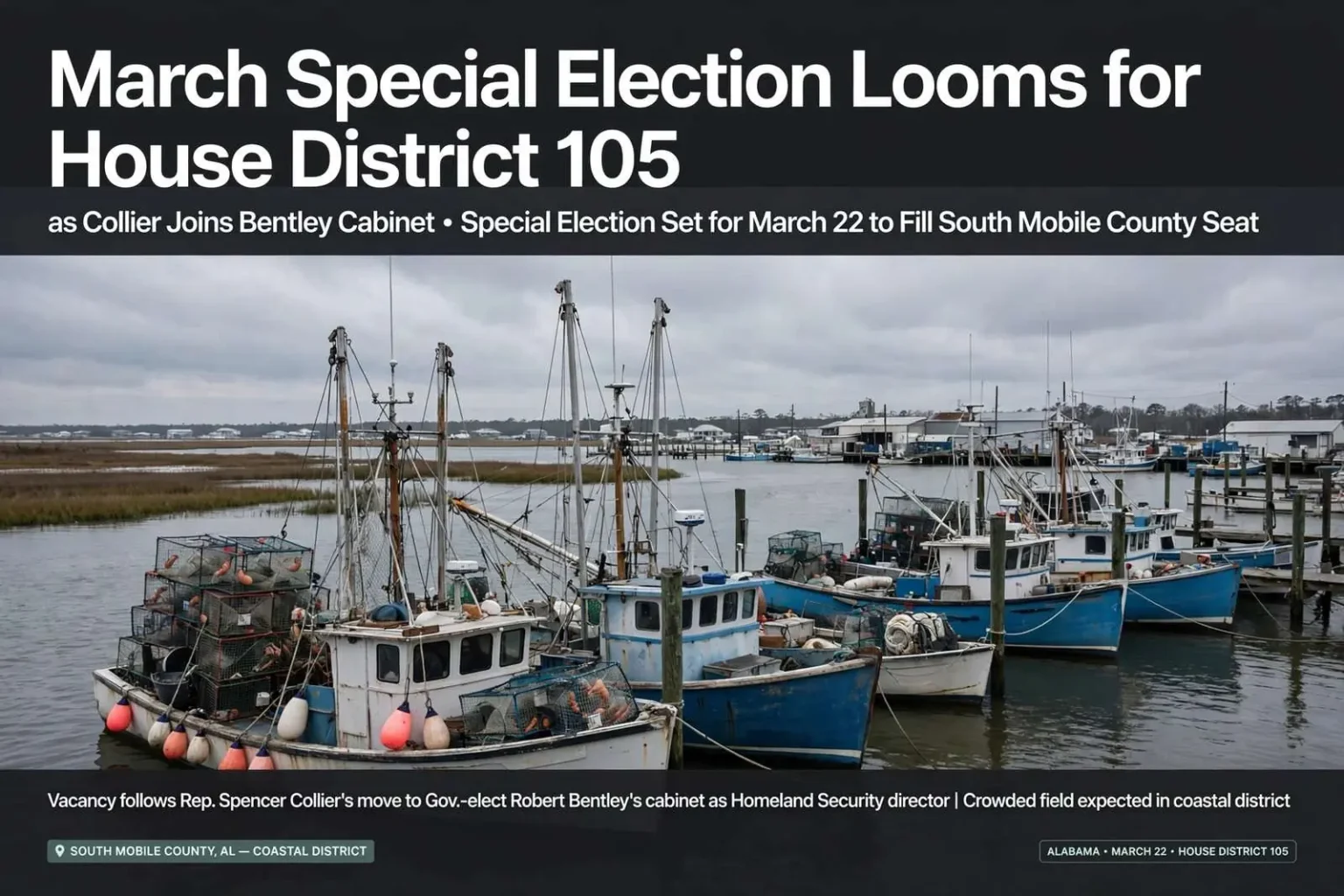
A special election to fill a vacancy in House District 105 was expected on March 22, according to Probate Judge Don Davis, setting up a scramble for the south Mobile County seat.
The vacancy arose from state Rep. Spencer Collier’s decision to join the cabinet of Gov.-elect Robert Bentley as director of Homeland Security. Collier’s departure for the new administration opened one of the coastal delegation’s seats and, with it, an opportunity that a crowded field of prospective candidates appeared eager to seize. Judge Davis identified March 22 as the likely date for the balloting.
A large Republican field was anticipated for the district, which covers a swath of south Mobile County stretching across a string of communities. In Alabama, a vacancy in the Legislature sets off a compressed calendar — the governor issues the writ of election, qualifying opens, and parties move quickly to settle their nominations so a successor can be seated with minimal time left unrepresented. With the March date in view, anyone considering the race had a narrow window to decide, organize and line up support.
Collier’s move to Montgomery also underscored the way a change in administration ripples down to the local level. By tapping a sitting legislator for a cabinet post, the incoming governor set in motion the very vacancy that the special election would fill, a reminder of how personnel decisions at the top of state government reshape representation back home.
A crowded field of prospects
Among the names drawing mention as possible candidates were veteran law enforcement officer Mike Burdine and Scott Buzbee, the recent Democratic nominee for state Senate District 35. Also mentioned were former School Board member Bill Meredith, Bayou La Batre Chamber of Commerce figure Harold Hodges and Chickasaw fire captain Charlie Lyons.
The list did not stop there. Dauphin Island Mayor Jeff Collier, retired schoolteacher Julie Harper, Charlie Rodriguez, Bud Robertson and Doug Sanford were among others floated as potential contenders.
The breadth of the field, spanning law enforcement, education, local business, municipal leadership and the volunteer ranks, reflected both the appeal of an open legislative seat and the political energy in the coastal communities the district takes in. Open seats are rare in a district that tends to keep its incumbents, and the prospect of a short campaign gave candidates with name recognition already built through city halls, schools, fire stations and chambers of commerce a reason to test the waters.
The diversity of the prospective roster also said something about the district itself. House District 105 stitches together communities that differ sharply in character — from the barrier island at Dauphin Island to the seafood town of Bayou La Batre, and across the inland communities and growing suburban edges of south Mobile County. A candidate rooted in any one of those places enters the race with a home base, and the contest would be about building bridges across the rest.
What a special election means
Special elections carry their own dynamics. With a compressed timeline and a single seat at stake, candidates must organize quickly, and turnout often hinges on the intensity of local interest rather than the pull of a general-election ballot. For a district anchored in south Mobile County, the March date meant a brisk campaign season as hopefuls introduced themselves to voters and staked out their positions.
The mechanics favor organization over money in many respects. Without the months-long runway of a regular election cycle, a candidate’s most valuable assets are a network of committed volunteers, a list of voters built through prior campaigns or civic work, and the ability to get supporters to the polls on a single day. That structure rewards figures like municipal officials, school board veterans and first responders whose names already circulate through community life — which helps explain the makeup of the field.
Turnout in special legislative elections is typically a fraction of what a general election draws, which makes every organized vote proportionally more valuable. Candidates and party activists alike spend the compressed season on the unglamorous essentials: phone lists, yard signs, church and civic club visits, and rides to the polls. In a coastal district spread across water-separated communities, logistics matter as much as message — reaching voters on Dauphin Island is a different operation than working the neighborhoods around Tillman’s Corner.
The race also arrived at a politically charged moment in Alabama. The transition to a new governor had reshuffled state government, and a special election in a coastal delegation seat offered an early read on the direction of local politics under the new administration. Whichever way the district leaned, the result would be watched in Montgomery as much as in Bayou La Batre.
What the next representative inherits
For the communities of south Mobile County, the contest promised to be closely watched. The district’s mix of coastal towns and working waterfront communities gave the race a distinctly local flavor, and the roster of prospective candidates suggested that residents would have no shortage of choices when they went to the polls.
Whoever prevailed would inherit the task of representing a district whose fortunes were closely tied to the seafood industry, the working waterfront and the recovery of a coast still reckoning with the aftermath of the Gulf oil spill.
The seafood angle alone set District 105 apart in the Legislature. Bayou La Batre’s fleet and processing houses anchor an industry that few other Alabama districts share, bringing with it a distinctive set of concerns — dockside economics, processing regulation, harbor maintenance and the long recovery of consumer confidence in Gulf seafood after the spill. The next representative would carry those issues to Montgomery along with the ordinary legislative portfolio of roads, schools and budgets that every member manages.
Coastal recovery added urgency to the assignment. The BP oil spill had left communities along the bay and the sound dealing with damaged livelihoods, restoration decisions and the slow work of rebuilding a coastal economy, and representation in the State House meant a voice in how state resources and policies intersected with that recovery. For a district whose map is drawn around water, the March 22 election was never going to be an abstract exercise — it was about who would speak for the working coast in the next legislative session.
The coastal delegation context
The vacancy also shifted the balance within Mobile County’s legislative delegation. Every south Alabama district carries its own portfolio, and losing an incumbent mid-term means losing the committee seats, seniority and institutional relationships that come with him. Collier’s departure for the Homeland Security post gave south Mobile County a fresh face in the delegation at a moment when coastal interests — from oil spill recovery dollars to seafood industry policy — needed advocates in the State House.
Delegation politics matter in practical ways that residents of the district see directly. Road and bridge priorities along the coastal corridors, funding for harbor and waterfront needs, and the position the delegation takes on coastal policy questions all depend on the members who hold the seats. A special election is therefore not merely a contest between candidates; it is a decision about where the district’s voice in those negotiations will come from for the remainder of the term.
How the race takes shape
Between the announcement of the vacancy and the expected March 22 date, the work of sorting the field falls to the parties and the candidates themselves. Prospective contenders must qualify, and in a field this crowded the early contest is often for position — securing endorsements from local officials, consolidating support in home communities and raising the seed money a short campaign demands.
Name recognition plays out unevenly across a district like 105. A Dauphin Island mayor is a familiar figure on the island and in the seafood communities but may need to introduce himself in the inland subdivisions; a fire captain in Chickasaw or a former school board member carries strength in the neighborhoods where he served and anonymity elsewhere. The compressed calendar leaves little time to change that, which is why the campaign will likely revolve around the networks each candidate already had.
For voters, the crowding is a genuine choice rather than an inconvenience. A field that spans law enforcement, education, small business, municipal government and civic volunteering offers more than a partisan ballot question — it offers competing versions of who the district is and who should speak for it. As the candidates qualified and the calendar ticked toward March 22, District 105 prepared to hold one of the region’s first and most closely watched political contests of the year, with the working coast’s future representation on the line and a slate of hopefuls long enough to guarantee that no one could take the outcome for granted.