Lost in Translation: What the EADS Chief Really Said About Building in Mobile
A newspaper interview in August 2008 seemed to say EADS would build commercial aircraft in Mobile whether or not it won the Air Force tanker contract. The company said that was not what it meant.
For a few days in August 2008, it looked as if Mobile had been handed an insurance policy.
A national business newspaper published a lengthy interview with Louis Gallois, chief executive of European Aeronautic Defence and Space Co., the parent of Airbus, in which he discussed the company’s need to expand into the dollar zone. The article stated that EADS and Airbus plans for an assembly line in Mobile did not hinge on winning the aerial refueling tanker contract.
“It’s a strategic move for us to become American citizens,” Gallois was quoted as saying, adding with a grin that the company was bringing a lot of jobs to the United States. “Perhaps it is that which is worrying Boeing. We are bringing too many jobs to the U.S.”
The Reading, and the Correction
Read plainly, the passage suggested the French aerospace giant would build commercial freighter aircraft at Mobile’s Brookley complex regardless of what happened in Washington — a striking claim, because everything the region had been told to that point tied the commercial line to the military award.
EADS said that inference was wrong. Responding through the Mobile Area Chamber of Commerce, EADS North America chairman Allan McArtor explained that Gallois was making a currency argument, not a siting promise. The company needed to expand industrially into the dollar zone to balance the effect of exchange rates on its bottom line, McArtor said, and it did not need a tanker contract to reach that conclusion. But the Mobile final assembly line, he said, remained contingent on the tanker contract — with freighters to be added.
In other words: the strategy did not depend on the tanker. The Mobile plant did.
The distinction was everything to the people following the story from Mobile. A multinational’s industrial strategy could flex with currency markets and boardroom arithmetic; a factory on the Gulf Coast could not. What Mobile had been promised — a final assembly line for aerial refueling tankers, with commercial freighter work layered on top — existed only as long as the Air Force award did.
Why the Distinction Mattered Here
The stakes were enormous and local. A Northrop Grumman and EADS team had won the Air Force competition to replace its aging refueling fleet, a program worth up to $40 billion, with assembly planned at Brookley. Boeing protested the award, and the Government Accountability Office sustained key elements of that protest, throwing the competition back to the Air Force and throwing the Mobile project into limbo.
That was the situation when the Gallois interview appeared. Mobile’s tanker hopes — celebrated when the February award was announced, shaken when the GAO ruled — hung on a re-competition whose rules, timing and outcome nobody in either Washington or Mobile could predict. Into that uncertainty came a report that the company’s chief executive was signaling Mobile would get its plant either way.
For a few days, local boosters allowed themselves the reading. The exchange-rate logic was real: Airbus builds and sells in euros but earns much of its revenue in dollars, and a weak dollar had made the imbalance painful. Moving more production — and more costs — into the United States was genuinely a strategic hedge. And EADS had, in fact, committed to U.S. industrial expansion in ways that could take forms beyond the tanker.
But McArtor’s correction drew the line where the company had always drawn it. The dollar-zone strategy could be satisfied in many ways; the Mobile assembly line, as configured, was tied to the tanker award. The freighter version of the aircraft was an addition to that line, not an independent substitute for it.
The Saga That Framed It
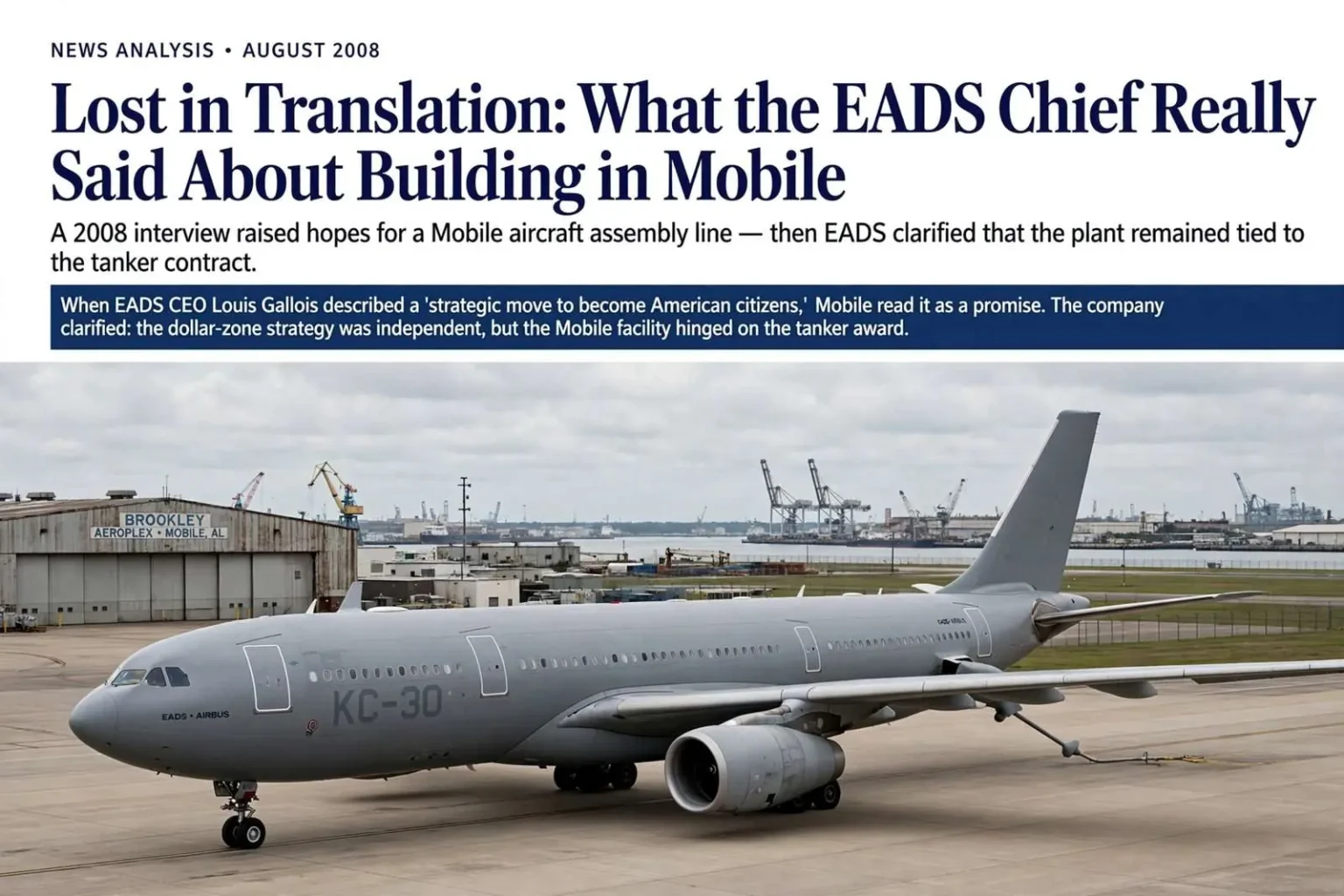
Understanding the moment requires recalling how extraordinary the previous months had been. In February 2008, the Air Force chose the Northrop Grumman-EADS team over Boeing for the tanker replacement program — a decision that stunned the aviation world and electrified Mobile, which had spent years positioning Brookley for exactly that prize. The winning design, based on the Airbus A330 airframe, would be assembled in Mobile as the KC-30 tanker, and the $40 billion program would have made the city a builder of large military aircraft for decades.
Boeing’s protest, filed with the GAO within weeks, was sustained in June on key elements of the evaluation, and the Air Force was directed to revisit the competition. Overnight, Mobile’s certainty became contingency. Every public statement from either camp was parsed for signs of what the re-competition would bring — which is precisely the context in which a single paragraph in a business interview could read like a lifeline.
The “Lost in Translation” framing of the episode is the point. Gallois, speaking to a national business publication about corporate strategy, was answering a question about currencies and global balance sheets. Mobile readers, scanning the same words for news about their city, extracted a different article — one about a plant. Neither reading was dishonest; they were different questions asked of the same sentence.
McArtor’s reply, routed through the chamber rather than a press release, restored the original meaning. The company’s commitment to expanding in the dollar zone stood. Its commitment to Mobile remained exactly what it had been: contingent on the tanker, structured to add freighter work if the award held.
What Followed
The limbo outlasted the summer. The Air Force’s attempt to re-run the competition unraveled amid rules disputes and procurement fights in Washington, and the tanker saga stretched on for years — through a suspended solicitation, a restructured competition in which Northrop ultimately declined to bid again, and a final award to Boeing in 2011. Mobile’s tanker assembly line, the project the Gallois interview had seemed to insure, never happened.
Yet the episode’s larger arc bent differently. EADS did keep expanding in the dollar zone, exactly as its chief executive had said the strategy required. Airbus opened the A320 final assembly line at Brookley in 2015 — the first Airbus final assembly line on American soil — and later added a second line for the A220, making the complex a cornerstone of the company’s U.S. industrial presence. The “strategic move to become American citizens” was real; it simply arrived through the commercial side of the house rather than the military one.
In retrospect, the August 2008 exchange was a case study in how corporate speech lands differently across an ocean and an audience. Gallois was describing a multinational’s hedge against exchange rates; Mobile heard a promise about a factory. Both were partly right, which is what made the correction necessary and the episode worth remembering: the strategy did not depend on the tanker, but the Mobile plant did — and no amount of translation could change that, then or since.
The episode also captured something about Mobile’s unusual position in the tanker story. The city had pursued aerospace for years — recruiting suppliers to Brookley after the Air Force base closed there in 1969, training workers, courting the biggest prize in the defense industry. When Northrop and EADS won in February 2008, Mobile was no longer a long shot; it was the site of a program that would assemble large aircraft for the U.S. Air Force. The protest and the GAO ruling converted that achievement into uncertainty, and uncertainty is the hardest condition for a community to read.
Every communiqué in that period was scrutinized for meaning. Company statements were weighed against each other; the tone of executives’ remarks in Paris or Washington was analyzed for signals about Brookley. Against that backdrop, the Gallois interview did not land as business journalism but as news about Mobile’s future — which is why the correction mattered as much as the story itself.
The currency argument deserves explanation on its own terms, because it was the actual subject of the interview. Airbus, like other European manufacturers, pays much of its workforce and supply base in euros while selling aircraft for dollars. When the dollar weakens, revenue shrinks relative to costs, squeezing margins across the entire production system. Moving more production into the dollar zone — building more of the aircraft where the revenue is earned — is a structural hedge, insulating the company from exchange rates that no sales campaign can control.
That logic, McArtor explained, pointed toward American expansion regardless of the tanker’s fate. But the specific configuration promised to Mobile — a tanker line with freighter work attached — was a function of the military program. The freighter variant existed on the commercial side of Airbus’s catalog, but the assembly line proposal in front of Mobile had been designed around the Air Force award, and the company was not prepared to describe it as freestanding.
Local leaders took the correction without drama, which itself said something about the relationship. The chamber passed along McArtor’s clarification; the story faded; the community went back to watching Washington. There was no accusation of bad faith on either side — Gallois had said what he said about strategy, McArtor had said what he said about Mobile, and both were true within their own frames.
The lesson Mobile drew was more durable than the news cycle. In a program as large as the tanker replacement, nothing is settled until the contract is signed, and even signed contracts can be protested, reviewed and reversed. A city that builds its hopes on one award is a city living on borrowed certainty — and the years that followed tested that lesson repeatedly.
By the time the tanker saga ended with Boeing’s 2011 victory, Mobile had already diversified its bet: the A320 assembly line announcement in 2012 gave Brookley the commercial future that the tanker had promised, and the industrial ecosystem built for the military program — suppliers, training pipelines, workforce — became the foundation for it. The “insurance policy” Mobile thought it had glimpsed in August 2008 arrived years later, in a different contract, with a different name on it. The strategy had not depended on the tanker after all; neither, in the end, did Mobile.