
Connie Hudson to Announce Bid for Mobile County Commission District 2
Mobile City Councilwoman Connie Hudson prepared to formally launch her campaign for the vacant District 2 seat on the Mobile County Commission, joining a Republican field forming quickly ahead of the July 13 special election.
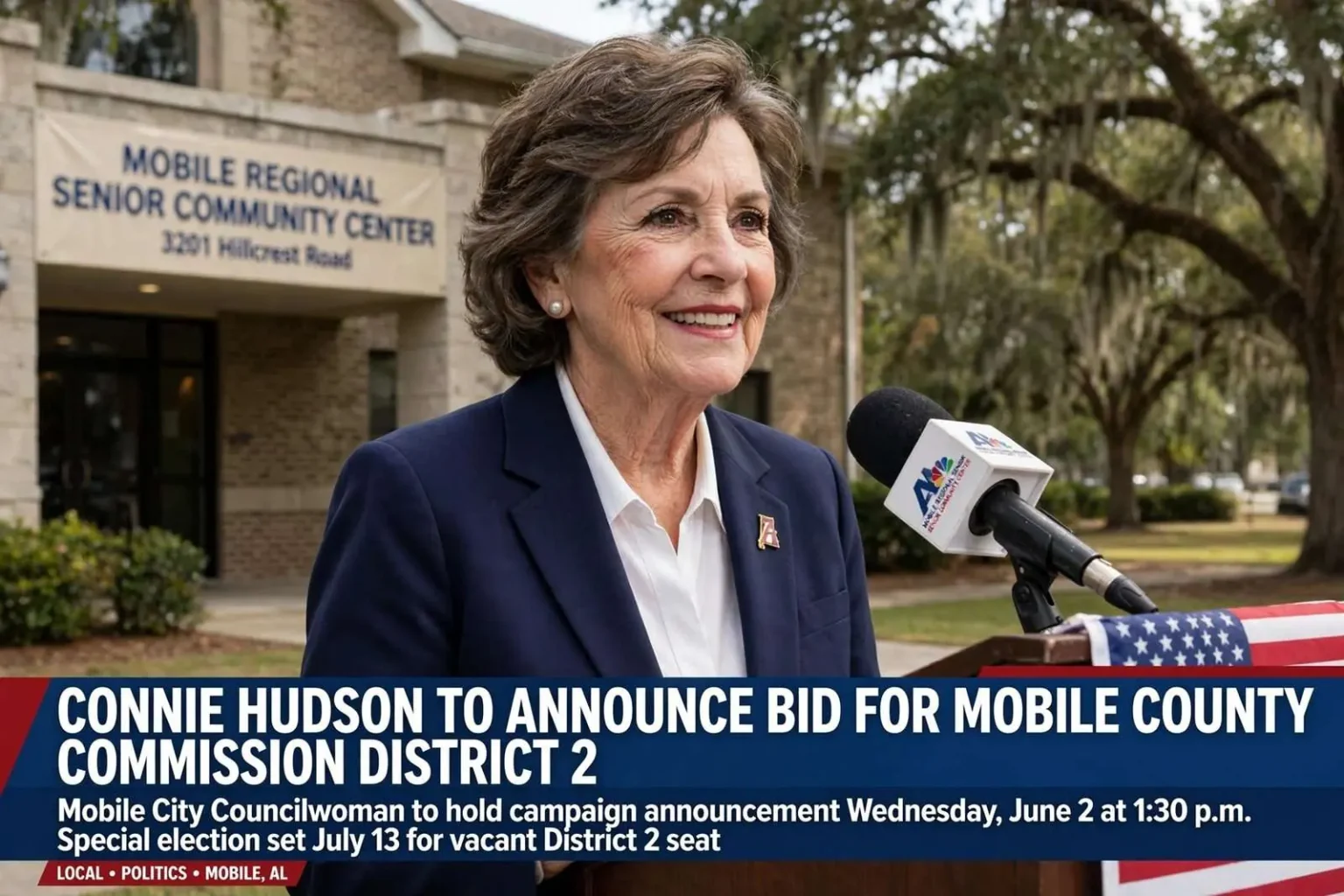
Mobile City Councilwoman Connie Hudson planned to formally announce her candidacy in the Republican primary for the vacant District 2 seat on the Mobile County Commission, with an event scheduled for 1:30 p.m. Wednesday, June 2, at the Mobile Regional Senior Community Center.
Hudson would join a field that formed within days of the resignation of Commissioner Steve Nodine, whose departure from office set a special election for July 13.
The compressed calendar has driven the pace. A seat on the county’s governing board emptied suddenly, and candidates who had considered a 2012 run found the decision forced upon them within a single week — announce now, in a primary compressed into a summer campaign, or wait years for the next opening on a three-member commission.
Nine years on the council
An active community figure in Mobile for more than 30 years, Hudson has served nine years on the Mobile City Council representing District 6, which takes in much of the city’s western and southwestern neighborhoods.
She framed her candidacy around a record she said left no doubt where she stood.
“I have the voting track record that won’t leave you guessing where I stand on important issues like raising sales taxes without a vote of the people,” Hudson said. “I’m consistent in my principles and convictions.”
The reference to sales taxes was pointed. Tax increases adopted without a public referendum had become a recurring flashpoint in Mobile city and county politics, and a candidate’s position on them functioned as a shorthand test of conservative credentials in Republican primaries of that era.
Nine years is a long tenure by Mobile City Council standards, where turnover has historically been high and council members have rarely served long enough to accumulate the institutional knowledge that comes with time. Hudson’s District 6 stretches across some of the city’s fastest-growing residential territory — the western and southwestern neighborhoods where subdivisions, shopping centers and school zones have expanded steadily outward from the older street grid — and her record there is the substance her announcement leaned on.
Economic development record
During her council tenure, Hudson took part in economic development efforts that helped the Mobile area land two of the largest industrial projects in its modern history: the ThyssenKrupp steel plant in north Mobile County and the Austal USA shipbuilding facility on the Mobile River.
Both were pursued through multi-government incentive packages, and both were still ramping up in 2010.
The two projects rewrote the region’s economic picture. The ThyssenKrupp facility, built on a sprawling site in the Calvert area of north Mobile County, represented one of the largest private capital investments ever made in Alabama and anchored an industrial corridor along the Tombigbee River. Austal’s shipyard on the Mobile River downtown converted the city’s port tradition into a modern manufacturing operation building vessels for the U.S. Navy. Neither project would have landed without the coordinated incentive packages that the city, the county and the state assembled together — and Hudson, as a member of the council that voted on the city’s participation, now claims a direct share of that record.
Hudson also spearheaded the construction initiative that produced the Mobile Regional Senior Community Center in 2002 — the same building she chose for her announcement. She has consistently identified public safety, public services and infrastructure improvements as core government responsibilities.
Choosing the senior center for the announcement was a piece of political symbolism that required no explanation for anyone familiar with her council work: the building exists because of an initiative she drove, serving the demographic — older residents of west Mobile — whose turnout decides Republican primaries.
Her Republican credentials included membership in the Azalea City Republican Women and the Mobile County Republican Executive Committee, and she was a member-elect of the State Republican Executive Committee.
A crowded, compressed race
The special election to fill the remaining term of Steve Nodine, who resigned the week before, was set for July 13 — the same day as statewide primary runoffs.
Ralph Buffkin, an administrator in the Mobile County Sheriff’s Office, and Pete Riehm, a commercial realtor and conservative organizer making his first run for office, had also announced.
The timing creates an unusual electoral dynamic. A July 13 special election stacked on top of statewide runoff contests means voters will face a ballot that mixes county commission politics with whatever statewide races go to a second round — a combination that shapes who actually shows up. In a summer election with no presidential contest at the top, turnout is expected to be small and heavily Republican, which magnifies the importance of each candidate’s core supporters and the party networks behind them.
Buffkin’s background in the Sheriff’s Office gives him a law-and-order credential and name recognition among the county’s law enforcement community. Riehm, a commercial realtor and conservative activist, represents the grass-roots organizing wing of the party and is making his first run for public office. Hudson enters with the broadest elected record of the announced field — nine years of council votes, two landmark economic development projects, and a construction initiative with her name on it.
District 2 covers a broad and rapidly changing part of Mobile County, running from portions of the city out through the western suburbs toward Semmes. Growth just outside the city limits had shifted the district’s balance in recent years, giving unincorporated county residents a larger share of the vote than they once held.
That shift matters for how the campaign is run. Voters inside the city limits have seen Hudson’s name on a municipal ballot; voters in the unincorporated areas toward Semmes have not, and the precincts outside the city now outweigh the ones within it. The district’s growth corridor — new rooflines, new schools, congested two-lane roads — is precisely the territory where county services, from sheriff’s patrols to road projects, are felt most directly.
What was at stake
The Mobile County Commission has only three members, which means the District 2 commissioner is never more than one vote away from controlling the outcome of any question before the body.
With the county facing budget shortfalls, deferred infrastructure work, and the first economic shocks from the Deepwater Horizon oil spill, whoever won the seat would arrive with immediate and consequential decisions to make.
The three-member structure gives each commissioner leverage that large councils never have. There are no coalitions to build past a simple majority of two, and a single member can freeze or advance an agenda item by aligning with either colleague. In a budget year marked by shortfalls, the decisions ahead — which road projects proceed, how public safety is funded, how the county absorbs the spill’s economic ripple through its Gulf-front communities and its tax base — will be made by two votes, not five or seven.
The oil spill added an unpredictable variable. Tar on the beaches, closed fishing grounds and a nervous tourism economy had already begun to register by early summer, and the county’s responses — from emergency requests to revenue forecasting — would land on the commission’s agenda regardless of who held the vacant seat.
The Mobile Regional Senior Community Center is located at 3201 Hillcrest Road. For Hudson, the address doubles as a campaign argument: a building she helped create, in the district she wants to serve, on a July ballot that will decide who casts one of only three votes on the board that governs Mobile County.
How the race is likely to unfold
A six-week Republican primary campaign for a county seat leaves little room for a slow build. Candidates will introduce themselves through party organizations — the county executive committee’s precinct structure, the women’s clubs, the civic leagues of west Mobile and Semmes — rather than through the paid media blitzes that longer campaigns allow. Name identification will be built one neighborhood meeting at a time, and the candidate who can field volunteers for yard signs and poll working in July heat will hold an edge that money struggles to replace.
The runoff question also shadows the race. With multiple candidates in the field, a July 13 result that produces no majority would send the top two to a further runoff — extending a compressed special election into the fall and keeping the commission short-handed even longer. Candidates will be calculating not only how to win but how to survive a second round, which favors those with a defined base over those running a broad, diffuse appeal.
For the city-county relationship, the election’s outcome carries practical weight. The District 2 commissioner represents territory that includes both city neighborhoods and the unincorporated growth areas, and the commission’s votes on shared projects — road improvements, park spending, emergency management — shape how smoothly Mobile’s municipal and county governments work together. Hudson’s nine years across the street at Government Plaza give her an insider’s familiarity with those relationships; her rivals will run on the perspective of outsiders to them.
Whatever the outcome, the speed of events has been the story. A commissioner’s resignation, a special election date, a primary field and a formal announcement — all inside a single month, all landing on a ballot that shares a summer Tuesday with statewide runoffs. By the time voters go to the polls on July 13, the newest chapter of Mobile County politics will already be decided, and the three-member commission will have its third vote.