Mobile County Commissioner Stephen Nodine resigned his District 2 seat late Thursday, ending the impeachment case pending against him in circuit court and setting off an immediate scramble among Republicans to succeed him in a special election set for July 13.
Through his attorneys, Nodine said the decision was in the best interests of his family and his District 2 constituents. Both statements were undoubtedly true. But neither was the immediate reason the resignation came when it did, rather than closer to the June 8 opening of his impeachment trial.
A deposition he was not going to give
Attorneys were scheduled to question Nodine under oath at the Baldwin County Jail on Friday morning. “That was not going to happen,” said Nodine attorney Dennis Knizley — at least not in any form the prosecution would have found useful.
Arrangements had been under way to bring Mobile County Circuit Judge Sarah H. Stewart into the session. Knizley had advised the court that he intended to have his client decline to answer every question by invoking his rights under the Fifth Amendment. Each refusal would have required a ruling from the bench, making the judge’s presence a practical necessity.
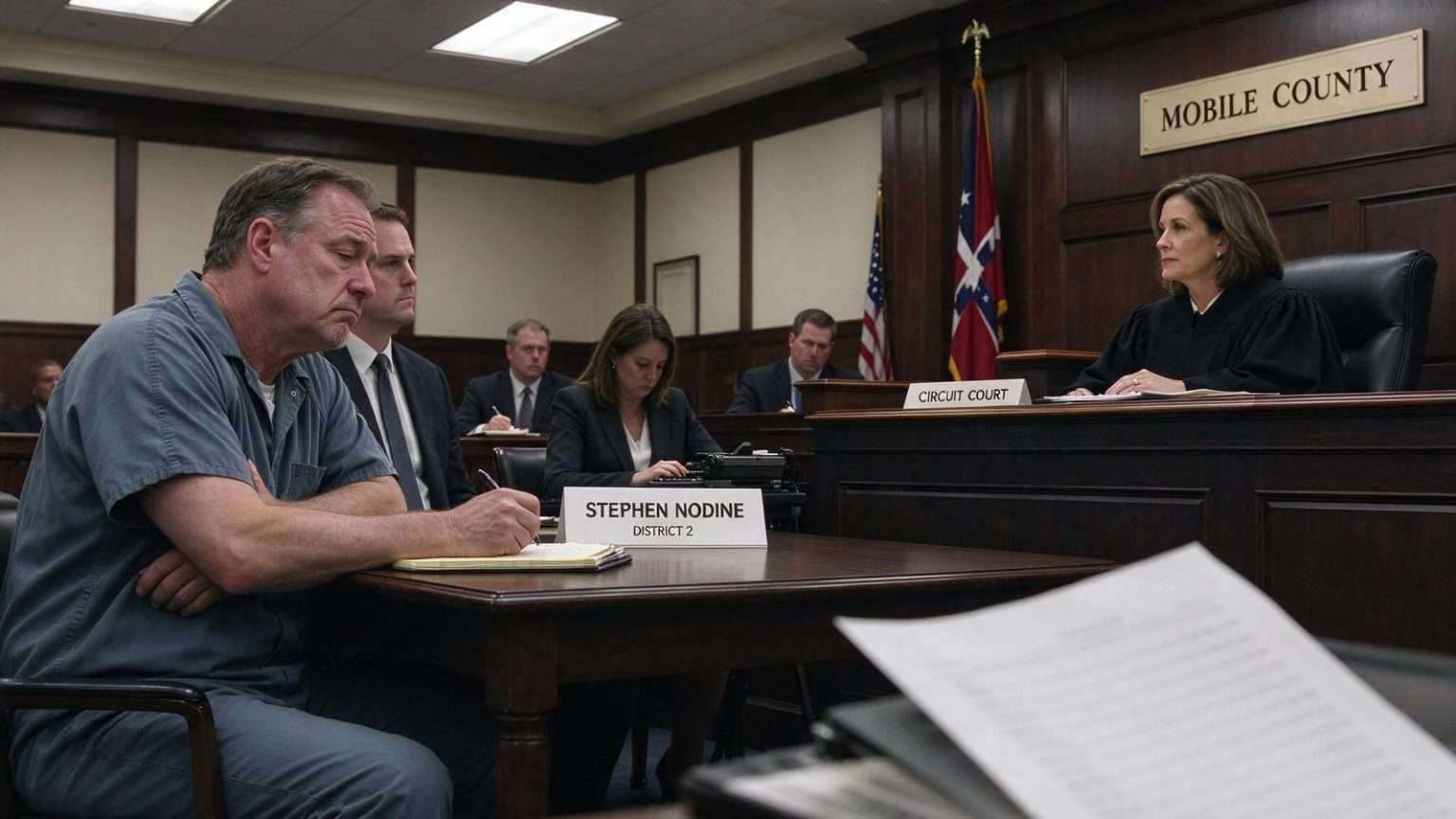
“… she would have to rule on every one, so she might as well be there,” Knizley noted. The image says everything about the session that was never held: a commissioner in a jail jumpsuit, a judge listening to dozens of identical invocations, prosecutors establishing nothing, and a transcript that would have read as a long line of silences.
With a murder charge pending against him in the May 9 shooting death of Angel Downs, Nodine was almost certain to leave office rather than submit to sworn questioning, whether that moment arrived at a Friday deposition or on June 10, after the state rested its impeachment case. Anything he said under oath in the impeachment matter would be available to prosecutors in the murder case, and anything he refused to say would be public.
Why the resignation ends the case
An impeachment proceeding under Alabama law exists for one purpose: to remove an officeholder. Once the officeholder is gone, the case has nothing left to accomplish. There is no punishment to impose, no record to expunge, no judgment to enter. The proceeding dies with the resignation, and the state’s enormous investment — investigators, prosecutors, a judge’s docket, weeks of preparation — evaporates in a single afternoon.
The same pattern had played out in Mobile not long before, when Circuit Judge Herman Thomas resigned from the bench shortly before his case reached the Court of the Judiciary. Thomas, accused of serious judicial misconduct involving inmates he encountered through his criminal docket, stepped down rather than face a disciplinary tribunal that could have removed him with a formal stain on the record. His subsequent criminal trial ended in acquittal on the most serious charges, but the resignation itself had already closed the institutional chapter.
For prosecutors, the lesson is a familiar frustration. Impeachment and removal proceedings are instruments of institutional accountability, and a defendant who controls the one asset being targeted — the office itself — can defuse the entire process by handing it back. Nodine did precisely that, two days before the deposition and a week and a half before the trial’s scheduled opening.
How Nodine got here
The impeachment case grew out of the discovery, in December, of marijuana and prescription drugs in Nodine’s county-owned pickup truck — a scandal that would have ended most political careers on its own. But the May 9 death of Angel Downs transformed a drug-and-misconduct scandal into a criminal catastrophe. Downs, a Gulf Shores real estate agent who had been in a relationship with Nodine, was found shot to death outside her home, and within days Nodine was identified as the suspect, arrested, charged and jailed.
A commissioner charged with murder could not plausibly sit on a three-member board that controls a budget approaching half a billion dollars, sets policy for county roads, parks and emergency services, and speaks for roughly 400,000 residents of the county outside municipal lines. The impeachment filing by the state was the formal answer to that impossibility; the resignation was the informal one.
Nodine’s rise had been long and improbable. A Baldwin County native who built a career in business and public service, he had served as a city councilman in Gulf Shores and as a state government official before winning the county commission seat, and he was widely viewed as a coming figure in Mobile County’s Republican establishment. Colleagues described him for years as tireless on district roads and constituent work — the kind of politician voters re-elect because the potholes get filled.
That reputation is precisely what made the fall so steep. A commissioner whose public identity rested on responsiveness and accessibility was, within six months, a jail inmate facing both removal and a murder indictment, with his name on the front page every week and his district unrepresented in the meantime.
The scramble to replace him
The resignation set off an immediate scramble among Republicans for a seat the party had held comfortably for a decade. Under Alabama law, a vacancy on the Mobile County Commission is filled by special election, and the July 13 date gave candidates barely a month to organize — to file, to raise money, to assemble the precinct-level networks that decide low-turnout summer elections.
Special elections of this kind reward whoever moves fastest. With no incumbent to run against and no time for a long campaign, name recognition within the district’s civic networks — municipal councils, chambers, Republican clubs from Tillman’s Corner to Theodore and Grand Bay — counts for more than ideology. Expectations in Republican circles framed the contest as a crowded, fast and expensive scramble, with party unity tested in the heat of a July vote.
For District 2’s constituents, the interim meant representation by absence. The commission continued meeting with two members, and the board’s procedures and weights shifted around the empty chair. Roads and drainage complaints in the district still moved through county staff, but the advocate who had built a career answering them was gone, and his replacement would not arrive until the special election settled the question.
The July 13 date also compressed the county’s calendar. A summer election in south Alabama competes with vacations, beach traffic and general distraction, which is why turnout in such races regularly falls far below general-election levels. Whoever survived it would take office mid-year, inherit a budget cycle in progress and begin, immediately, the work of rebuilding a district’s faith in its representation.
The legal machinery behind the decision
Nodine’s calculations were governed by two parallel proceedings with different rules. The impeachment case, filed in circuit court, asked whether his conduct made him unfit for office; the murder case, in Baldwin County, asked whether he killed Angel Downs. Everything he did in one would echo in the other.
That double exposure explains the Fifth Amendment strategy Knizley laid out. In the impeachment matter, silence carries no direct penalty — a defendant cannot be removed for refusing to testify — but each refusal in front of a judge creates a public record of evasion, and the sequence of questions prosecutors ask would itself become part of the murder case’s preparation. By declining to appear at all, through a resignation, Nodine denied prosecutors their deposition, their trial and their transcript in one stroke.
The scheduling of the deposition at the Baldwin County Jail underscored how far the situation had deteriorated. Questioning a sitting commissioner in a jail visitation room, under judicial supervision, about his fitness for an office he could no longer exercise was the final scene of a drama that began with drugs in a county truck and ended with a death in Gulf Shores. The resignation spared the county the staging of it.
What remains after a resignation
The criminal case was untouched by the resignation. Murder charges do not disappear when a defendant steps down from public office, and Nodine’s defense in Baldwin County would proceed on its own calendar, with all of the pretrial battles — bond, evidence, expert testimony — that a homicide prosecution brings. The impeachment file, by contrast, was effectively closed the moment the letter took effect.
County government, meanwhile, absorbed the shock the way large institutions do. The two remaining commissioners carried on, staff kept the district’s service requests moving, and the Republicans of District 2 began sorting out candidacies for a race that would conclude with a new commissioner just as the county’s summer budget deliberations reached their peak.
The episode also became, for Alabama’s county officials, a case study in the limits of removal. Impeachment exists on the books for precisely the scenario of a charged, jailed officeholder — and yet the defendant’s own choice to resign accomplishes faster and more completely what the state’s process would have taken weeks to do. The state keeps its powder dry; the office empties itself.
For Mobile County, the spring of the resignation was the second such institutional shock in a short span, following the Thomas affair, and it left both a vacancy on the commission and a standing question about vetting and accountability that the county’s political class would carry into the July 13 election. The voters of District 2 would answer it with a ballot; the lawyers would answer it with the murder case still to come.