Frozen Toes and Folded Flyers: A Mobile Lawyers’ Daughter Works the New Hampshire Primary
A University of Alabama junior from Mobile spent seven weeks and one bitter January in New Hampshire doing the unglamorous work that keeps a presidential campaign alive.
Long days in a small office
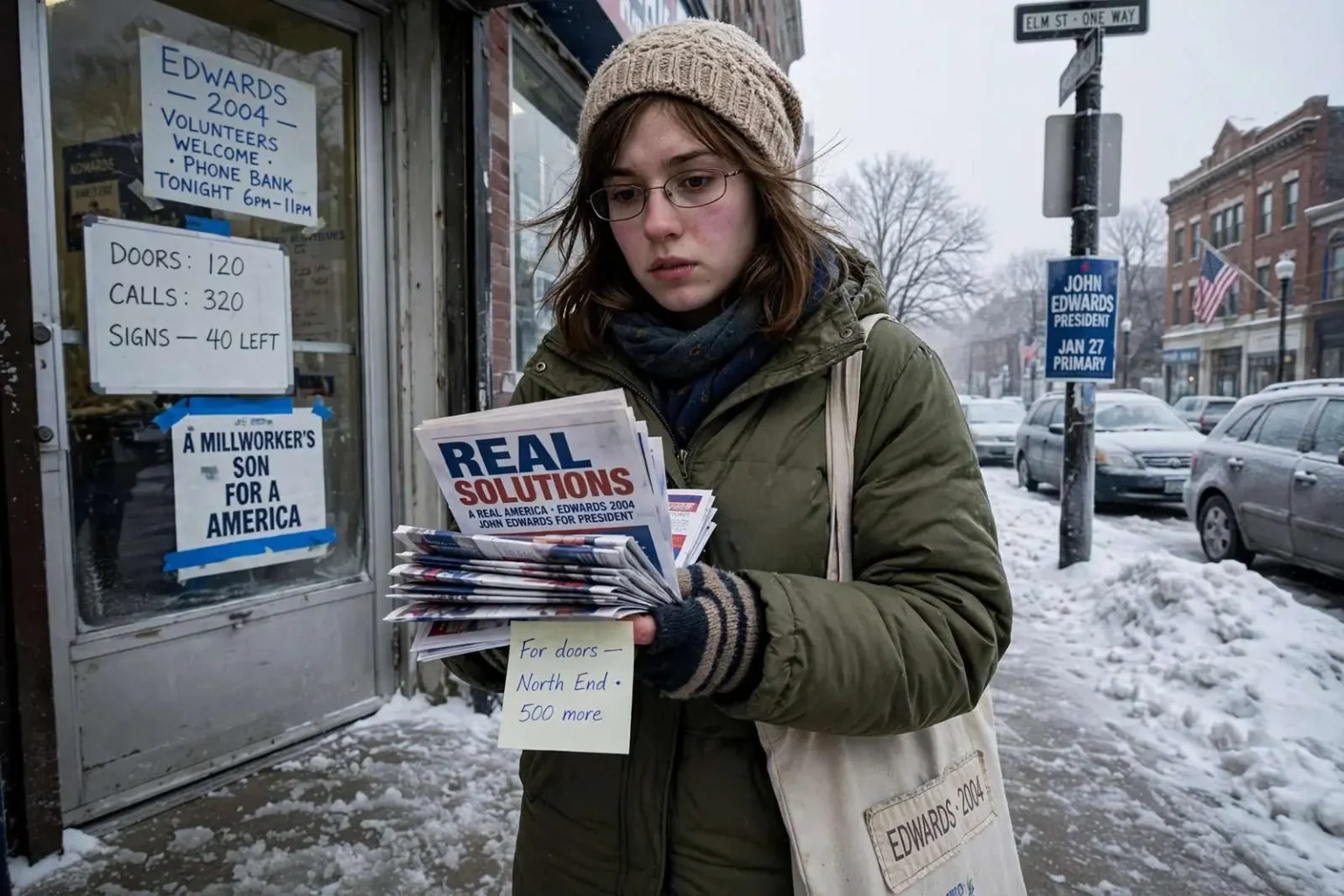
The Edwards operation, she said, ran on a smaller intern staff than any of the other major Democratic campaigns, and it made up the difference with hours. The field was crowded — Howard Dean, Wesley Clark, Dick Gephardt, Joe Lieberman, Dennis Kucinich, Al Sharpton and Kerry all had New Hampshire operations that year — and every one of them leaned on the same renewable workforce: college students on winter break, working for nothing but experience and proximity to history.
“We worked long days starting at 9:30 a.m. and not ending most nights until 10 p.m. and often later than that,” she recalled. The interns were the ones who assembled the first run of the campaign’s “Real Solutions” booklets, staying up an entire night to do it. The phrase became the spine of the Edwards message: real solutions for a real America, built around a stump speech she heard so many times she could recite it.
“He believes in an America where the son of a millworker can go toe-to-toe with the son of a president,” she said, quoting the line that framed Edwards’ biography against President George W. Bush’s. The millworker’s son from Robbins, North Carolina, built a candidacy on that contrast — a one-time trial lawyer from a mill town running against the son of a president and the grandson of a senator — and Pennington heard the theme repeated at house parties, diners and town meetings across the state.
New Hampshire, she found, is a place where the ordinary rules of political distance do not apply. The first-in-the-nation primary is organized around retail politics: small rooms, house parties, the expectation that any voter can corner a candidate at the local diner. Candidates were a common sight on the sidewalk outside the office window. Voters expected to shake a hand more than once before making up their minds.
“This personal contact was the norm in New Hampshire, and the ‘Granite Staters’ were not happy unless they got to meet a candidate face-to-face several times,” she said. “I distinctly remember walking in two parades on the Fourth of July, and every candidate was walking with measly interns like me.”
That Fourth of July tableau — senators and governors marching in small-town parades alongside unpaid college students — is the part of the primary season that never makes the highlights. New Hampshire’s towns hold their parades and candidate forums months before the vote, and the campaigns treat the summer as the season to be seen everywhere at once.
January, and the cold
The experience took hold. With her professors’ permission, she flew to Manchester on the Thursday before the January primary and returned to class the following Wednesday. The work was the same, only now it was done in temperatures that ran from the mid-teens to below zero. A Mobile native who had never worked outdoors in a New England winter was suddenly holding signs, knocking doors and standing outside polling places in air that numbed fingers in minutes.
“I worked harder in those five days than I ever have,” she said.
A typical day began around 8 a.m. and ended after a staff meeting at 11:30 p.m., sending volunteers home near midnight or 1 a.m. The night before the primary was worse: in by 7 a.m., work straight through, quit around 3 a.m., then back at 4:30 a.m. for an election-day “sign blitz” that ran until 7. After that came the polls, where the interns supplied the youth and visible energy every campaign wants photographed on voting day.
“At one point, ice had even formed between my toes,” she said.
The lesson at the end
Effort of that kind is not always rewarded, which is itself the durable lesson of campaign work. Edwards finished fourth in New Hampshire with about 12 percent of the vote, in a near tie with retired Gen. Wesley Clark. Kerry and Dean ran far ahead of the field that night, and the result narrowed the Democratic contest to the two of them within days.
He kept going anyway, and by the late winter he was the last serious obstacle in the path of U.S. Sen. John Kerry of Massachusetts, who is now the presumptive Democratic nominee for the November election against President Bush. Edwards won his home state of South Carolina on the same night he fell short in New Hampshire and stayed in the race through Super Tuesday before suspending his campaign and endorsing Kerry.
Her father saw something more than enthusiasm in her account of the campaign. He noted her reading of the Democratic map: that the party’s last two presidents, Jimmy Carter of Georgia and Bill Clinton of Arkansas, were Southerners, as was Lyndon Johnson of Texas before them, and that a Northeastern Democrat, particularly a liberal one, would be a harder sale. “Pretty good observations for a college junior,” he said.
The Southern Democrat theory had shaped the party’s presidential calculus for a generation — it was why a mill town lawyer from North Carolina drew the internship crowd in the first place — and it was about to be tested in the choice Kerry faced on a running mate.
With Kerry’s running mate still to be named, the question of whether Edwards should join the ticket left her divided. “On one hand a Kerry/Edwards ticket would be unbelievable and would appeal to the hardcore liberals and to the conservative Democrats and independents,” she said. “But I also feel that President Bush is coming into this election with strong supporters, and the key ingredient to winning any election is lots and lots of money.”
As much as it pained her to say it, she said, she thought the president would be difficult to beat, and she did not want Edwards on a losing ticket. “So I guess we will just have to wait and see,” she said.
History answered her sooner than expected. Kerry named Edwards to the ticket that summer, and the Southern strategy Pennington had described became the Democrats’ official argument for the fall. Bush won anyway, carrying every Southern state but one, and the intern who had walked two Fourth of July parades with a candidate’s sign went back to Tuscaloosa for her junior year — carrying, as her father noted, a more precise read of American politics than most people acquire in a lifetime.
The mechanics of the New Hampshire primary reward exactly the kind of labor interns perform. The state’s first-in-the-nation status, protected by law and by the stubbornness of its election officials, means campaigns must maintain full field operations in a state of roughly 1.3 million people — dozens of town committees, hundreds of house parties, and a volunteer structure that can surge in the final week. Interns are the connective tissue of that structure: they find the venues, recruit the crowds, keep the sign inventory moving and make sure a candidate is never standing in an empty room.
Manchester, where Pennington flew in for the final week, is the state’s largest city and the campaign world’s de facto capital in primary season — a former mill town whose downtown hotels and union halls host the events candidates cannot skip. From there the campaigns fan out to Nashua, Concord, Portsmouth, Keene and the small towns in between, where a selectman’s endorsement or a well-attended coffee hour can matter more in January than any advertisement.
The summer internship had its own geography. Seven weeks in 2003 meant living through the candidate introduction season, when voters were still meeting the field and the campaigns were still hiring staff. For a University of Alabama junior, the summer doubled as an education in how campaigns are actually built: how a press operation stages an event, how a field director tracks precincts on a whiteboard, and how a message like “Real Solutions” gets printed, folded and hand-delivered in time for the next day’s events.
Pennington’s route into campaign work was unusual for a Mobile family but not unheard of along the Gulf Coast, where college students with political interests often spend a summer or a semester working a primary in an early state. Her parents, both Mobile attorneys, watched from home as the weekly updates arrived, and her father’s later commentary on the Southern-Democrat theory reflected the family’s habit of arguing politics around the dinner table.
The intern economy she described has changed little since. Campaigns budget for a handful of paid staff and fill the gap with students who trade a semester or a summer for the credential, the stories and the contact list. Some go on to professional politics; most, as the saying goes, go back to school. Either way, the temporary army is rebuilt every four years, and New Hampshire is where it musters first.
The result in New Hampshire that January also illustrated the odd arithmetic of early states. About 12 percent of the vote is a distant fourth in a five-way race, but in a contest decided by tens of thousands of ballots spread across ten counties, it is also enough to keep a campaign funded, staffed and in the conversation. Edwards’s camp did exactly that, converting the near-tie with Clark into a second-act strategy aimed at the Southern states voting a week later — a plan that Pennington’s own regional analysis had anticipated before the results were in.