Turnout Runs ‘Extremely Low’ Across Mobile County on Primary Day
Mobile County Probate Judge Don Davis reported light voter participation at polling places from Citronelle to Saraland as Alabamians voted in party primaries, while campaigns readied election night gatherings across the city.
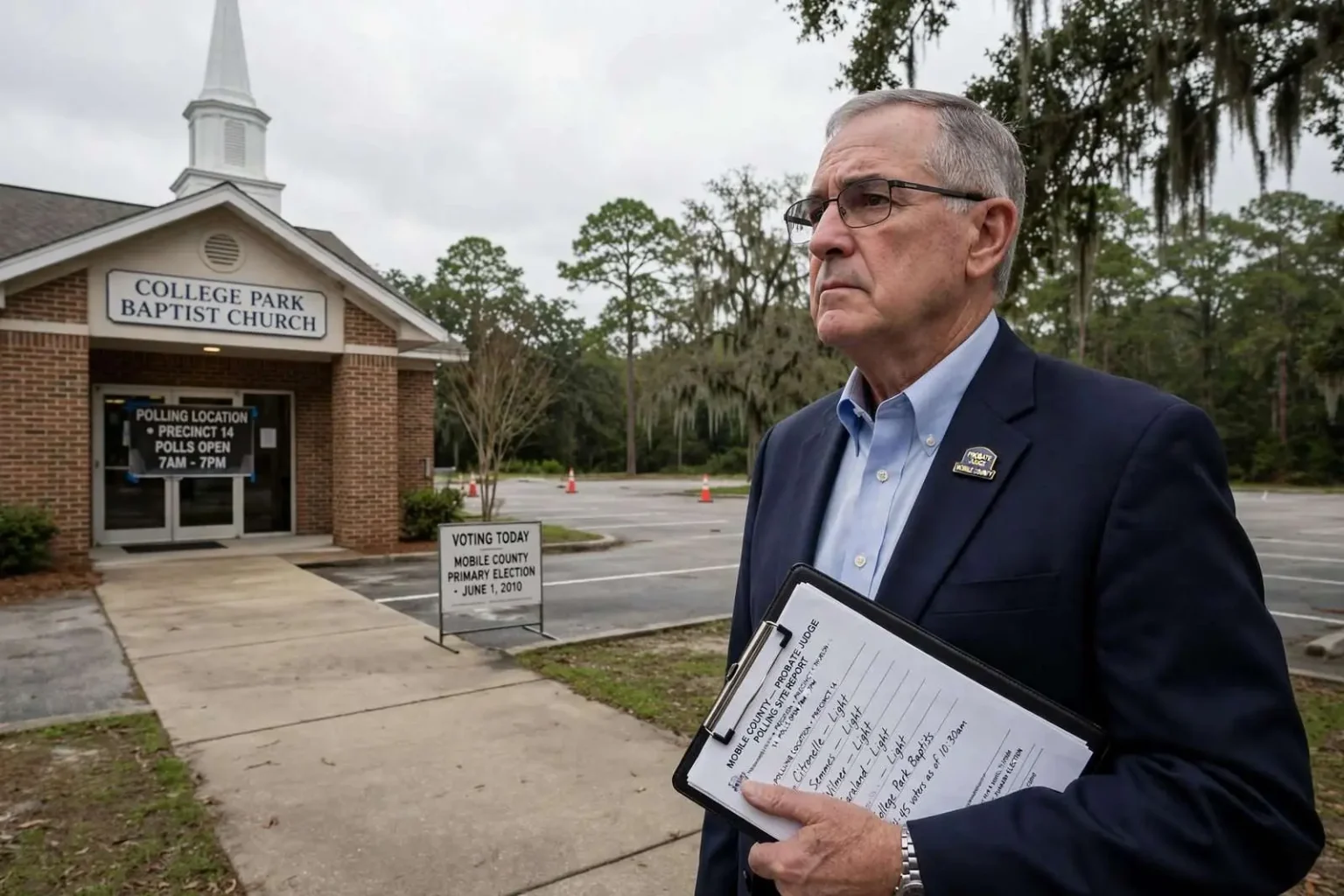
Voter participation across Mobile County ran “extremely low” through the morning hours of Alabama’s party primaries, Probate Judge Don Davis reported Tuesday, as campaigns for governor, district attorney and a string of legislative seats waited on returns.
Davis, whose office administers elections in Mobile County, spent the morning working his way from the north end of the county southward. By about 10:30 a.m., he had visited 14 polling stations, beginning in Citronelle and moving through Semmes, Wilmer and Saraland. Every location, he said, showed light participation.
The route he traveled on election morning spans nearly the full width of Alabama’s largest county — from the timber country around Citronelle on the Mississippi line, down through the fast-growing bedroom communities of Semmes and Wilmer, into Saraland on the northern approach to the city. A probate judge who spends primary day in the field sees more of the county’s electorate, or its absence, in a morning than any campaign poll can show.
“We just left College Park Baptist Church near the University of Mobile and all indications point to a very low turnout,” Davis said. “One of the locations had just 44 or 45 voters so far.”
The judge said the thin numbers did not surprise him. Primaries traditionally draw fewer voters than general elections, and Mobile County’s public schools had let out for the summer only the week before, which meant a considerable number of families were away on vacation.
The school-calendar detail is an underrated piece of election arithmetic in south Alabama. Mobile County Public Schools is the largest school system in the state, and when its classrooms empty for the summer, thousands of households shift their routines — some to the beach, some to relatives in other states, some simply out of the habits that make a trip to the precinct easy. An election that lands within days of the last bell competes with all of that.
Davis declined to estimate what share of the county electorate would have voted by the time polls closed at 7 p.m. But the pattern of the morning, reported precinct by precinct as he moved south, pointed to a day on which only the most committed voters would take part — and every campaign watching the numbers knew what that meant for the arithmetic that would follow.
Watchers and complaints
While the polling places sat quiet, the machinery of election monitoring hummed. Secretary of State Beth Chapman said her office had received complaints of reported voter fraud from Greene, Macon, Perry and Wilcox counties — all in the Black Belt, none in the Mobile area. The Voter Fraud Unit of her office had been in contact with the U.S. Department of Justice about the allegations, and Chapman had requested the maximum number of federal agents and poll observers for the June 1 primary.
The Black Belt counties named in the complaints are among Alabama’s smallest by population and among its most closely watched on election days, with a long history of contested local contests and allegations on all sides. Federal observers, dispatched under the federal voting rights statutes, are a routine presence in such counties in closely fought cycles; what was unusual was the state’s own fraud unit working the phones with the Justice Department before the polls had finished opening.
Voters were directed to an elections hotline for reporting problems. The hotline serves as both a diagnostic tool and a public signal: it gives voters a number to call when something at a precinct looks wrong, and it gives the secretary of state’s office a running picture of the day’s trouble spots while the polls are still open.
Locally, the Common Sense Campaign, a tea party organization focused on voter education, had interviewed candidates for governor, attorney general and Congress from Alabama’s First and Second districts and posted video of those interviews online for voters to review.
The group’s approach reflected the emerging style of the tea party movement in Alabama in 2010: less a traditional endorsement machine than a verification operation, putting candidates on camera answering questions and letting voters judge for themselves. In a low-turnout environment, that kind of content found its most receptive audience among the voters most likely to show up — the engaged, the angry and the already-converted, who shared the videos with their networks and arrived at the polls with their minds made up.
The organization’s emphasis on the First District was natural — it is the seat that includes Mobile and Baldwin counties — but its reach into the Second District and the statewide races showed how a small volunteer operation could cover an entire ballot simply by publishing what it filmed. For candidates without large advertising budgets, the interviews were free airtime; for the campaign’s watchers, they were a record of what every contender said before the votes were counted.
Election night gatherings
By evening, candidates and their supporters were scattered across Mobile and Montgomery awaiting results, and the geography of the victory parties told its own story about the races at stake.
Former Circuit Judge Herman Thomas, challenging state Sen. Vivian Figures in the Democratic primary for the District 33 seat, planned to gather supporters at Cafe Royal, 101 Dauphin St. in downtown Mobile, at 6:30 p.m. The district, drawn to follow a corridor through Mobile’s African-American neighborhoods and across the bay, was one of the legislature’s most contested Democratic primaries that year, pitting a former judge with name recognition against an incumbent senator with deep ties in the community.
Republican district attorney candidate Ashley Rich scheduled a campaign celebration at the Inca Grand Hall, 3556 Halls Mill Road, beginning at 6 p.m. The district attorney’s race was an open-seat contest that year, and Rich — a career prosecutor — was one of the candidates vying for the nomination that would effectively decide the office in a county where the Republican primary is usually the real election.
U.S. Rep. Jo Bonner planned an election night viewing party at 7 p.m. in the Crystal Ballroom of the Battle House Hotel. The historic downtown hotel, restored to its place as the city’s formal gathering place, was the fitting backdrop for a congressman whose renomination was expected — the kind of race that draws a crowd of loyalists rather than an anxious watch party.
Republican gubernatorial candidate Bradley Byrne and his family planned to watch returns from the RSA Activities Center in Montgomery. The capital was the natural staging ground for a statewide race, and Byrne — the former two-year college chancellor who had entered the governor’s race as one of its best-known establishment figures — had built his campaign around an organization designed to survive a long primary season and, if necessary, a runoff.
Gubernatorial candidate Tim James, who picked up an election-day endorsement from Dr. Fred Wolfe, the longtime pastor of Cottage Hill Baptist Church in Mobile, planned to watch results at the Renaissance Hotel in Montgomery. James, son of a former governor, had run his campaign on blunt, border-security-flavored themes, and the endorsement from Wolfe — pastor of one of Mobile’s largest churches — handed him a headline precisely where it mattered most on election day, among the voters most likely to turn out in a light-primary year.
The two men were competing in a Republican field for governor crowded enough that no one expected a first-ballot decision; the June primary was widely understood to be a sorting exercise that would send the top finishers to a July runoff. That expectation shaped the night’s mood at both headquarters: the campaigns were watching not only their own numbers but each other’s margins, doing the arithmetic of who would advance.
Across the bay in Baldwin County, district attorney candidate David Green and his supporters gathered at Jesse’s Restaurant in Magnolia Springs, while rival Hallie Dixon held an election celebration at the Blue Marlin Restaurant on U.S. 98 in Fairhope. Both were challenging incumbent Judy Newcomb, along with Ken Hitson.
The Baldwin County race drew three challengers against a longtime incumbent district attorney, an unusual show of ambition for a single office and a reminder that the Eastern Shore’s fast-growing communities had produced a generation of lawyers ready to run. The choice of venues — a beloved restaurant in a town of a few hundred people, and a landmark on the Fairhope stretch of the highway — mirrored the campaigns’ needs: in a light-turnout primary, a candidate’s most valuable asset is a room full of committed neighbors.
Magnolia Springs and Fairhope sit at the heart of Baldwin County’s newest political geography — the boomtowns of the Eastern Shore and the coast, where growth has outpaced institutions and where elections are decided by margins measured in the hundreds. A challenger who could rally those neighborhoods had a path; an incumbent who had carried the county for years had a different kind of cushion.
Why low turnout mattered
In a primary decided by a small and highly motivated electorate, organized blocs of voters — church networks, teachers, law enforcement associations, party clubs — carry weight far out of proportion to their numbers. A bloc that can deliver a few thousand reliable votes is a rounding error in November and a kingmaker in June.
Political operatives on both sides understood that a light turnout would magnify the effect of endorsements and get-out-the-vote operations, and several of the day’s outcomes would turn on exactly that arithmetic. The Wolfe endorsement for James on election-day morning was one example: an announcement timed for the last hours of voting, aimed at the churchgoing voters of west Mobile who might still be deciding on the drive to the precinct.
The same logic ran through every race on the ballot. A district attorney candidate with the support of the county’s deputy sheriffs did not need a wave of new voters; a legislative contender backed by a single influential congregation did not need the whole district. In each case the calculation was the same — identify the bloc, count its votes, and make sure every one of them casts a ballot before the 7 p.m. close.
For the county as a whole, the day ended as the probate judge had described it at mid-morning: a primary in which the abstainers vastly outnumbered the participants, and in which the decisions that would govern south Alabama for the next four years were made by the most decided — and best organized — sliver of its electorate.