Radio Tell-All Roils Nodine Case as Successors Eye District 2 Seat
A former Mobile radio personality published an account of his past dealings with Commissioner Steve Nodine, while local Republicans began maneuvering for a county commission seat not yet vacant.
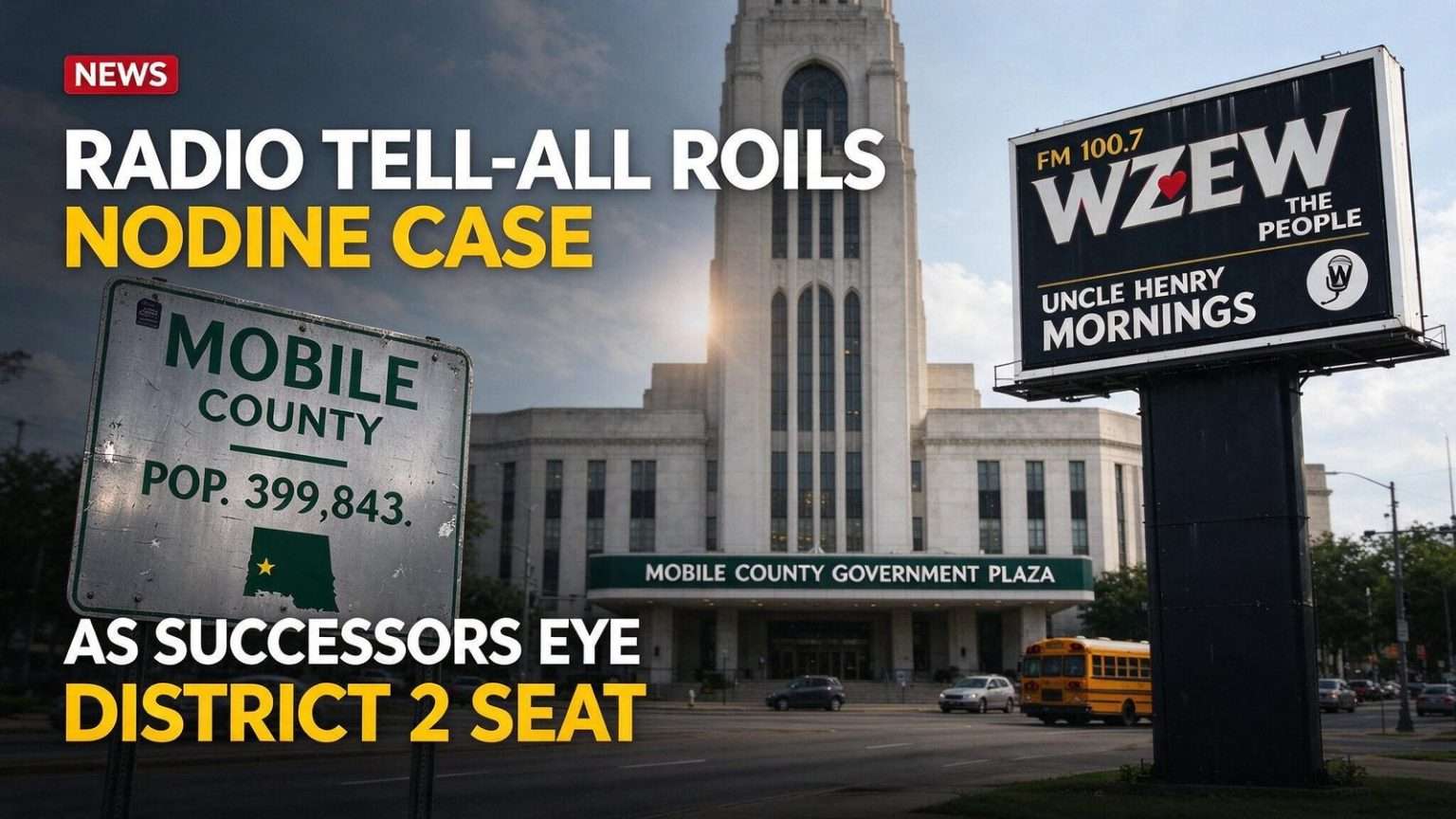
A former Mobile radio personality delivered a blast from the past this week, publishing an account of what he described as his own illicit activities alongside embattled Mobile County Commissioner Steve Nodine and current talk show host Chris Smith, known on the air as Uncle Henry. Shane McBryde titled his recollection “Steve Nodine and Me: How I became friends with a suspected murderer.” The piece landed in the middle of the most turbulent stretch of local politics in years, and it converted the Nodine scandal from a matter of court filings into a subject of raw personal storytelling.
McBryde’s account, published online, described the longtime social orbit that connected Mobile radio, county politics and the after-hours culture that had grown around both. By writing himself into the story, McBryde went where the news coverage of the case had not, offering a first-person portrait of the commissioner’s world in the years before his fall — a world of radio studios, county favor and, in McBryde’s telling, conduct that the writer now described as illicit.
The essay arrived at a moment when every new detail about Nodine carried political weight. The commissioner faced impeachment, a murder investigation, and the prospect of removal from a seat that half of Mobile County’s Republican establishment was already quietly measuring for a new occupant.
The station responds
Smith disputed McBryde’s accusations and his characterization of their relationship during his morning program. Smith, whose Uncle Henry persona has made him one of the most recognizable voices on Mobile airwaves, addressed the matter directly with his audience rather than letting the essay circulate unanswered, disputing both the substance of the account and the way McBryde described their association.
Clear Channel general manager David Coppock declined to address the substance of the account. “It is simply not appropriate to be commenting on the musings of a former employee about his recollections of a decade ago, nearly a decade ago,” Coppock said. “As a matter of policy we don’t comment about employee matters anyway.”
Coppock said McBryde had either been fired or resigned, and that his personnel records had been sent to corporate offices about a month earlier. He suggested the furor had arrived on “a slow news day” when a hot story needed some sizzle, and said he could only assume McBryde held a grudge over his departure or felt professional jealousy toward Smith. He said he had not been in contact with McBryde since he left town.
The general manager’s framing did double duty: it dismissed the essay’s reliability on timing and motive grounds, and it insulated the station from the story altogether. By emphasizing the decade-old vintage of the recollections and the personnel dispute that preceded them, Coppock positioned the station as a bystander to a former employee’s grievance rather than a subject of it.
The response left the underlying questions where McBryde’s essay had raised them. Neither the station nor Smith disputed every detail of the account with specifics, and the essay itself made no claim of criminal wrongdoing against anyone but its author. What it offered instead was color and corroboration for a portrait of Mobile’s interlocking political and media circles that residents had long assumed and rarely seen written down.
Where the Nodine cases stood
Nodine faced impeachment proceedings arising from a four-month investigation that began after a mechanic found marijuana and prescription pain pills in his county truck during a service visit late in 2009. What would have been an ordinary maintenance ticket at the county garage became the seed of an inquiry that consumed the county government, drawing in the district attorney’s office and, eventually, the impeachment process now pending against the district’s commissioner.
He had also been named the only suspect in the murder investigation into the shooting death of Angel Downs eight days earlier in Gulf Shores. He had not been charged in that case. The distinction between suspect and defendant mattered legally — no charge meant no bond hearing, no arraignment, no criminal file in the Baldwin County courthouse — but it did little to slow the political consequences, which were arriving on their own calendar.
The impeachment proceedings moved on their own track, separate from any criminal case. Impeachment in Alabama is a civil remedy aimed at removing an officeholder, not at punishing a person, and its standard of proof and its procedures differ entirely from the criminal courts. The four-month investigation that preceded it gave the impeachment case its factual foundation: the county truck, the drugs found inside it, and whatever else the inquiry uncovered about how the commissioner conducted himself in office.
A seat that is not yet open
With an impeachment trial on five counts expected to begin within three weeks, the jockeying had already begun among prospective successors for the District 2 seat on the Mobile County Commission. Among those drawing mention in Republican circles were City Council members Connie Hudson and John Williams, County Treasurer Al Sessions, state Rep. Jamie Ison, conservative activist Pete Riehm and Ralph Buffkin, an executive with the Mobile County Sheriff’s Office who lost to Nodine in a Republican runoff in 2004.
The list spanned nearly every faction of Mobile County Republican politics. Hudson and Williams sat on the City Council and brought citywide name identification. Sessions held countywide office as treasurer. Ison represented the district’s interests in the Legislature. Riehm carried the activist wing’s banner. Buffkin, six years after his runoff loss to Nodine, represented the faction that had never accepted the commissioner’s hold on the seat. Each name on the list had a constituency, a donor base and a reason to believe the moment favored him or her.
None of the speculation was premature by local standards. In Alabama politics, prospective candidates position themselves for vacancies long before vacancies exist, and the five-count impeachment trial gave the exercise a fixed countdown. Once a trial date was set, the question of who would hold the seat stopped being hypothetical and became a matter of arithmetic: the trial would run a matter of weeks, and its outcome would almost certainly produce either a resignation or a removal.
How a vacancy would be filled
Under the arrangement then in force, Gov. Bob Riley would likely appoint a replacement if Nodine resigned or was removed from office. Because more than a year remained in the term to which Nodine had been elected, a special election would be scheduled as soon as practical after any appointment. The two-step process — an appointee chosen by the governor, followed by a special election in which voters render their own verdict — gives the party that controls the governor’s office enormous leverage over the interim.
That combination, an appointment followed by a special election, is what turned a legal proceeding into a political scramble. An appointment would confer the advantages of incumbency — staff, committee assignments, a voting record and months of public visibility — on whoever received it, and every name on the list of prospective successors understood that the governor’s decision could effectively decide the seat before any voter went to the polls.
District 2 covers a large share of west Mobile and is one of only three seats on a commission that controls county roads, public works and the county budget. The commission’s compact size magnifies each individual member’s power: with three votes deciding everything, a single commissioner can steer paving schedules, drainage projects and capital spending across an area that includes some of the fastest-growing neighborhoods in the state.
For ambitious Republicans in Mobile County, an appointment would confer the advantage of incumbency before voters ever weighed in. That prospect shaped the behavior of everyone watching the impeachment trial: county commissioners, legislators and city council members all had reasons to stay visible, stay friendly with the governor’s office, and stay ready.
A caution
No vacancy existed. Nodine remained in office, had entered no plea in the impeachment case, and had been charged with no crime in connection with the death of Angel Downs. The impeachment trial could end in acquittal on the counts, the murder investigation could produce no charges, and the commissioner could yet serve out the term to which the voters elected him. Every scenario built on his departure rested on outcomes no court had yet delivered.
That caution applied with particular force to the murder investigation. Naming a suspect is an investigative determination, not a legal one, and it confers no presumption of guilt. The evidence that led investigators to name Nodine as the only suspect had not been tested in any courtroom, no charge had been filed, and the man at the center of it remained, in the eyes of the law, an innocent man with an office to hold and a trial to prepare for.
But by the middle of May the questions being asked around Government Plaza had less to do with whether the commissioner would survive than with who would take his place. The shift in the conversation — from whether to who — captured how completely the scandal had reshaped the county’s political assumptions in a matter of weeks. What began with a service visit to the county garage had become an impeachment trial, a murder investigation, a radio essay dredging up a decade of after-hours history, and a roster of successors measuring the drapes.
The radio essay added a dimension the court filings could not: the social history. Mobile’s political culture has always run through a small set of institutions — the courthouse, the commission office, the radio studio, the downtown clubs — and the people who move among them. McBryde’s account put that world on the record from the inside, and the reaction to it showed how much of that world still had defenders, deniers and reputations to manage.
For Smith, the episode was an unwelcome turn for a show built on commentary about everyone else’s conduct. The morning drive-time host who had spent years opining on the scandals of others now found his own history the subject of someone else’s broadcast-ready essay, and his response — disputing the account on air while the station’s management dismissed it as an ex-employee’s grudge — was the standard playbook for a story that has no official record to correct it.
For the county, the episode was a sideshow to the main events still scheduled: an impeachment trial on five counts beginning within three weeks, a murder investigation that had named its only suspect, and a governor’s office that would soon hold the power to fill a commission seat worth more, in practical influence, than most elected offices in Alabama. The scramble around that seat, already visible in the names being mentioned for it, would define Mobile County politics for the rest of the year — whatever the courts decided about the man who still held it.