Insiders Sort the Winners and Losers of Alabama’s Primary Night
The morning after Alabama's June 1 primaries, political veterans across the Mobile Bay area tried to explain Robert Bentley's surge, Artur Davis's collapse and the defeat of a sitting attorney general.
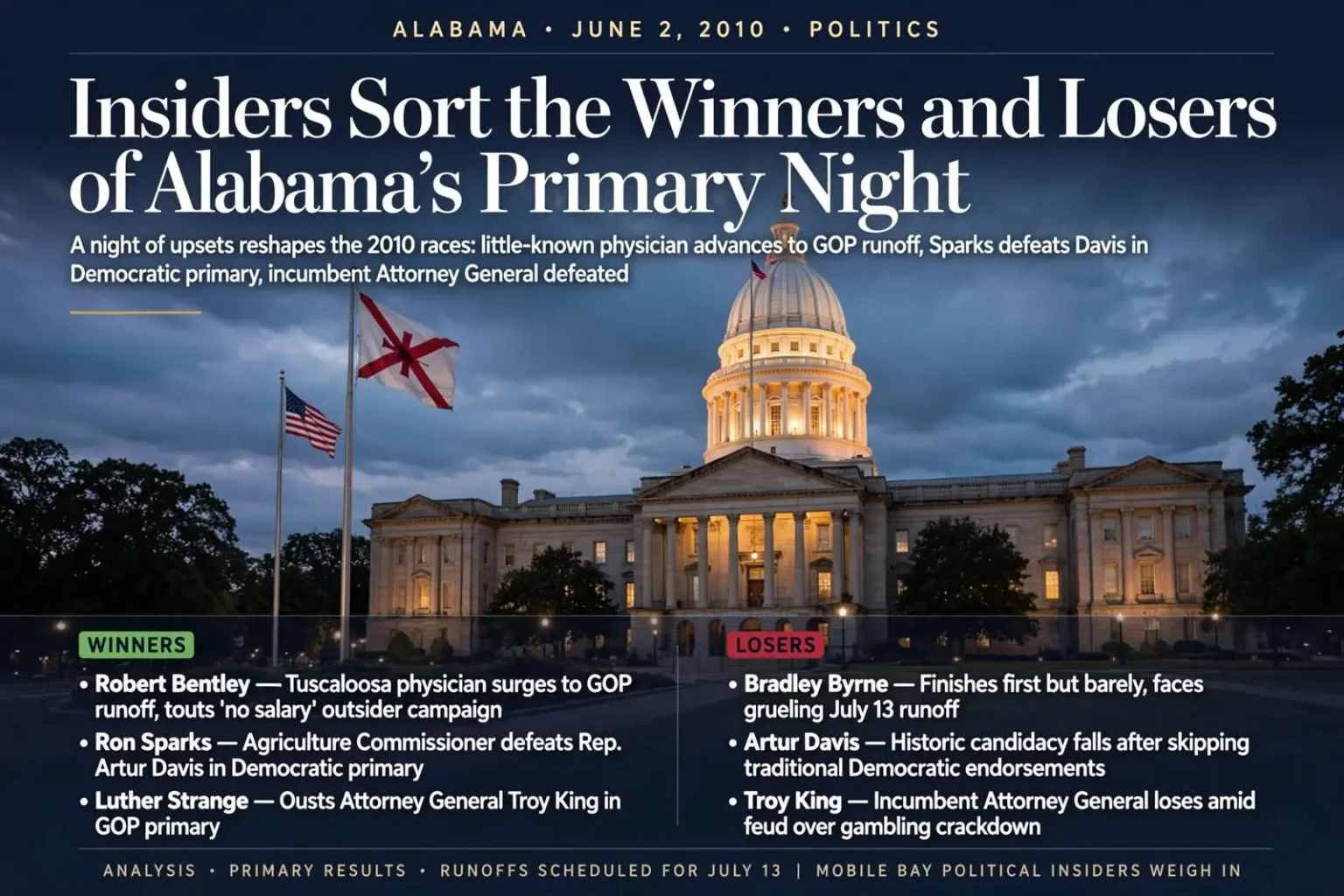
The morning after Alabama’s June 1 party primaries, the state’s political class woke to a set of results almost nobody had forecast. A little-known Tuscaloosa physician had elbowed his way into the Republican runoff for governor. A sitting attorney general had been turned out. And a congressman widely expected to make history had been beaten by a margin that stunned even his opponents. In a state that prides itself on predictable politics, it had been a night of overturned expectations from top to bottom of the ballot.
Political observers around Mobile Bay, most of whom spoke on the condition that their initials rather than their names be published, offered their readings of the wreckage. The initials-only arrangement is a familiar courtesy in Alabama political coverage, where the people who run campaigns and judge them often prefer their candor unattributed — and the candor on this morning was unsparing.
The Bentley surprise
Robert Bentley, a Tuscaloosa dermatologist and state legislator, spent the campaign as an afterthought while Bradley Byrne and Tim James spent millions attacking each other. He emerged in second place. Bentley had run a quiet campaign built around his personal story and his pledge not to accept a salary as governor, a message that cut through the negative advertising the two frontrunners trained on each other all spring.
“Win, lose or draw, a candidate rarely considered to be a legitimate contender has managed to come to bat with the big boys,” said a former candidate identified as MJU. “He offered an alternative to candidates who chose to sling mud rather than focus on the issues.”
Others credited advertising tone. “His low-key style and ‘I won’t take a salary’ type comments came at the right time for the voters — they trust him,” said an attorney writing as CTR. “At a time when people are generally not happy with the political establishment, he comes across as an honest outsider.”
A businessman was blunter: “Tim reminds us of ‘the past’ and Bradley may be too cerebral (and angry) for the Alabama voter, but they can surely understand a nice guy who won’t take a salary and reminds them of their family doctor.” The comparison captured the campaign’s accidental dynamic: while two well-funded candidates defined each other in the eyes of the electorate, the third man in the race was being defined only by his own commercials.
Byrne led, but barely
Byrne finished first, yet several panelists counted him among the wounded. “Where was the Mo’? He sure spent a lot of money to be first in a squeaker,” said a lawyer identified as NRG. “His support seems to be a mile wide and an inch deep.” Byrne, a former two-year college chancellor whose reform record had made him the establishment favorite, entered the night expecting a stronger showing than a narrow first-place finish.
Much of the damage was attributed to the Alabama Education Association, whose leaders, Paul Hubbert and Joe Reed, spent heavily against Byrne. The AEA had opposed Byrne since his tenure auditing and restructuring the two-year college system, work that had clashed with the organization’s interests, and the primary became the organization’s best chance to end his candidacy. Whether that spending had accomplished its purpose or merely hardened his support was a matter of dispute among the panelists, several of whom expected the AEA to redouble its efforts before the July 13 runoff.
The runoff calculus was unforgiving for both survivors. Byrne needed to consolidate the voters who had preferred his rivals; Bentley needed the six weeks to introduce himself to an electorate that had barely considered him. With James eliminated and his backers up for grabs, both campaigns would be fighting over the same pool of anti-establishment voters that had just delivered Bentley’s surprise.
Artur Davis and the Democratic machinery
The night’s most emphatic result was Agriculture Commissioner Ron Sparks’s defeat of U.S. Rep. Artur Davis in the Democratic primary for governor. Davis, a Harvard-educated congressman from Birmingham, had been discussed for years as a historic candidate — the state’s first Black governor, if the voters agreed — and had assembled a campaign built on independence from the party’s traditional gatekeepers.
Davis had declined to seek the endorsements of the Alabama Democratic Conference and the New South Coalition, the two Black political organizations that had shaped Democratic primaries for decades, and had voted against the federal health care law despite representing a district whose voters relied on it. Both decisions were calculated to broaden his appeal beyond the Democratic base. Both came home to roost on primary night.
“He turned his back on his political base, and they rewarded him by not giving him votes and endorsements,” said MJU. “How many people thought that Ron Sparks would beat Artur Davis like a rented mule?” asked a marketing executive. Sparks, the two-term agriculture commissioner, had run a conventional campaign through the party’s traditional networks and swept the organizations Davis had passed over.
Several observers argued that in a low-turnout primary, the black political organizations Davis had bypassed retained decisive influence — and that his loss was less a referendum on President Obama than a failure to protect his own base. The lesson the panelists drew was almost mechanical: in an Alabama Democratic primary, the endorsement infrastructure is not decoration. It is the machine that turns voters out, and no amount of independent fundraising replaces it.
Troy King falls
Attorney General Troy King lost the Republican nomination to Luther Strange after a long public fight with Gov. Bob Riley over electronic bingo. The dispute had consumed the attorney general’s office for more than a year: Riley’s task force raided electronic bingo casinos across the state while King, whose office would ordinarily handle such prosecutions, sought to take over the gambling docket and slow the raids. The feud became one of the defining intraparty battles of Riley’s final years in office.
“Poor Troy King. This guy never had a chance,” said a politico writing as USO. “Once ‘Bingo Bob’ threw him under the bus and to the wolves he was a non-starter.” An entrepreneur was more direct: he listed illegal gambling interests as the day’s clearest losers. Strange, a former state party chairman who had lost a primary for lieutenant governor four years earlier, ran as the candidate of the anti-gambling position and rode it to the nomination.
The end of a name
Down the ballot, George Wallace Jr. lost the Republican nomination for state treasurer to Young Boozer — a result several panelists read as a milestone. “The Wallace era IS OVER,” said the businessman quoted above. “Young Boozer’s election made it clear that the George Wallace name is no longer magic.” George Wallace Jr., son of the four-term governor and one-time presidential candidate, had spent decades in state office on name recognition alone; Boozer, a retired finance executive with an unmistakable name of his own, put an end to it with a campaign that spent less and said more.
Baldwin County’s own night
The drama was not confined to statewide races. In Baldwin County, the state’s fastest-growing county and a Republican stronghold, voters headed into July runoffs for district attorney and two seats on the county commission. The district attorney’s race, in particular, had drawn attention across the Bay, since the office prosecutes everything from coastal development disputes to the caseload generated by the county’s explosive growth along the Highway 98 and Interstate 10 corridors.
County commission runoffs in Baldwin carry more than local significance. The commission controls zoning, road-building and infrastructure spending in a county that has doubled its population in a generation, and the Republican nomination — tantamount to election in most Baldwin races — settles how that growth will be managed. Turnout in the June primary set the field for those contests, and the July runoff would decide them.
What came next
The primaries settled less than they appeared to. Republicans faced a July 13 gubernatorial runoff, Democrats a runoff for attorney general, and Baldwin County voters runoffs for district attorney and two county commission seats. In the intervening weeks, every campaign that had survived the night would have to decide whether to court the voters of the candidates who had just lost — and the losers themselves would discover how much their endorsements were worth.
The results also set up the general election contrasts that would define the fall. The Republican gubernatorial field had spent the primary arguing about which of its candidates was most conservative; the winner would face a Democratic nominee chosen by a different coalition entirely. And in races like attorney general, where the primary fight had been about gambling policy, the general election would test whether that issue moved voters beyond the Republican base.
For all the drama of primary night, the panelists agreed on one thing: the campaign was only at intermission. Six weeks stood between the survivors and the runoffs, and the spring’s most surprising candidates would have to prove their nights were not accidents. The 2010 electorate, angry and unsettled, had already discarded two statewide incumbents and a frontrunner’s money; nobody in either party was assuming anything about the summer to come.