Mobile Council Field Takes Shape: Hudson Seeks a Third Term, Wallace Courts District 3
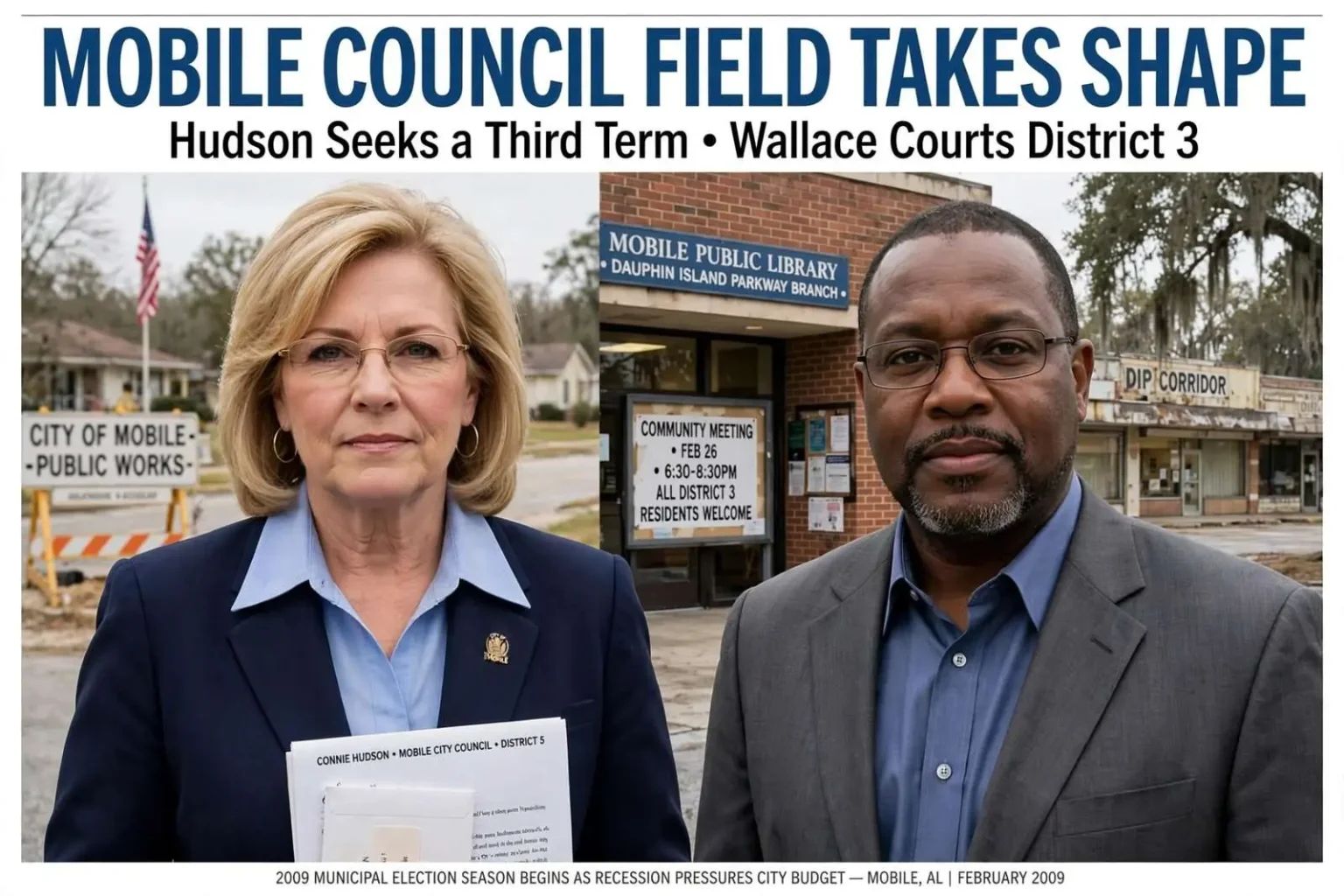
With municipal elections set for the summer of 2009, Councilwoman Connie Hudson announced a bid for a third term while challenger Ron Wallace scheduled his first community meeting in District 3.
MOBILE – The 2009 municipal election season began to take visible shape in February, as one incumbent on the Mobile City Council announced her intention to seek a third term and a candidate in another district started the slow work of introducing himself to voters. The opening moves of the cycle revealed both the habits of Mobile politics — long relationships, modest budgets, neighborhood-scale campaigning — and the anxieties of the moment, as the national recession squeezed the city budget that every council race would be fought over.
Hudson goes for a third term
Councilwoman Connie Hudson announced her bid for a third four-year term in a letter to supporters. She framed her candidacy around fiscal restraint and basic services. “It is my utmost desire to continue to serve the citizens of Mobile with an emphasis on conservative fiscal management of tax dollars, an agenda that prioritizes public safety, public service and infrastructure improvements, and the recruitment and expansion of jobs and job programs for our area,” Hudson wrote.
The letter arrived with a self-addressed envelope for contributors, the traditional opening move of a municipal campaign in a city where council races are won on modest budgets and long memories. Mobile’s seven-member council — six district seats and one at-large position — rewards incumbents who keep their districts’ potholes filled, their parks mowed, and their phone calls returned, and Hudson had built her two terms on exactly that arithmetic in her west Mobile district.
Hudson’s emphasis on “conservative fiscal management” was not chosen at random. The council spent the winter of 2009 arguing over money: the city’s revenues were falling with the national recession, and members were being asked to justify appropriations — among them the money that had gone into the Gulf Coast Classic football game — that looked considerably harder to defend than they had a year earlier. The Classic, a longtime Labor Day tradition between historically black colleges that Mobile had helped fund, had become a flashpoint in the budget debates over whether the city should be in the business of subsidizing events at all. A candidate running in that climate needed to establish early that she was a careful steward of the tax dollar, and Hudson’s letter did precisely that.
Wallace opens his campaign in District 3
In District 3, Ron Wallace, who had announced his candidacy for the council seat, said he would hold his first community meeting on Thursday, Feb. 26, from 6:30 to 8:30 p.m. at the Dauphin Island Parkway branch of the Mobile Public Library. Wallace urged residents and business owners in the district to attend and to bring their ideas for improving the district and the city.
The choice of venue was itself a statement. The Dauphin Island Parkway corridor — known to nearly everyone in Mobile simply as DIP — had spent years as a byword for disinvestment, with vacant storefronts, aging motels, and streets that bore the wear of serving as the gateway to Dauphin Island and the southside’s waterfront communities. A community meeting at the DIP library branch, within sight of the corridor’s struggles, told District 3 voters that Wallace intended to campaign where the district’s problems lived, not in the comfortable halls of west Mobile. The branch itself, one of the Mobile Public Library’s neighborhood locations, was the kind of public amenity that district residents fought to keep funded — a quiet reminder of what city budgets meant on the ground.
District 3 sprawls across much of southern Mobile, taking in the DIP corridor, parts of the Tillman’s Corner area, and neighborhoods stretching toward the bay. Its council seat carries particular stakes in any election year because the district’s needs — commercial revitalization, infrastructure repair, flood drainage — are the kind that require sustained advocacy at Government Plaza over many years.
The recession sets the tone
The 2009 cycle would unfold against fiscal conditions no Mobile council candidate had faced before. Sales tax revenues — the city’s lifeblood — were falling as consumers pulled back, the national financial crisis had frozen the credit markets cities rely on for capital projects, and every appropriation was newly scrutinized. Incumbents like Hudson ran on their records of stewardship; challengers like Wallace ran on the argument that fresh attention was needed. Both messages drew their force from the same pressure.
The winter’s budget fights had also redrawn the council’s internal alliances, and candidates entering the race in February were, in effect, asking voters to evaluate not just their districts’ interests but their theory of what city government owed its people in a downturn. Hudson’s answer: discipline, public safety, and roads. Wallace’s answer, implied in a community meeting format rather than a fundraiser: listen first, spend deliberately, and rebuild the neighborhoods the recovery might otherwise pass by.
Months remained before qualifying closed and the August election arrived, and other seats would draw their own fields of candidates and incumbents. But the season’s first two announcements sketched the themes that would run through all of them — fiscal caution in a recession, the defense of neighborhoods and basic services, and the patient, personal retail politics that Mobile’s council races have always turned on. The self-addressed envelope and the library meeting room, in their different ways, were both the same message: this campaign will be won one voter, one block, and one budget line at a time.
How Mobile council campaigns work
Mobile’s council districts each hold roughly 50,000 residents, and campaigns for the seats are correspondingly intimate. Candidates typically raise tens of thousands rather than hundreds of thousands of dollars, relying on yard signs, civic club appearances, church visits, and mail pieces rather than television. In that environment, an announcement letter with a return envelope is not a formality — it is the campaign’s first contact with the network of past supporters whose repeat contributions and word-of-mouth endorsements will carry the race. Incumbents begin with the advantage of a built-in network of constituents who have called the council office and gotten results.
The February timing also followed Mobile’s campaign rhythm. Qualifying for municipal races opens in the summer, but serious candidates spend the spring building name recognition through community meetings and neighborhood association appearances, so that when the formal campaign begins they are re-introducing themselves rather than introducing themselves. Wallace’s Feb. 26 meeting was the first entry in that ledger — the earliest way a non-incumbent can demonstrate seriousness.
The district stakes
For Hudson’s district, a third-term bid signaled continuity: the western Mobile neighborhoods she represented had grown into the city’s commercial heart along Airport Boulevard and Schillinger Road, and her record centered on the infrastructure — drainage, roads, parks — that rapid growth demands. Districts on the city’s growing western edge compete for a disproportionate share of capital spending, and a senior councilwoman with committee standing is the district’s advocate in that competition. A third term also carried the prospect of seniority within the council itself, where influence accrues to members who have chaired committees and weathered multiple budget cycles.
For District 3, the open campaign carried the opposite promise: change. The DIP corridor’s long decline had become the district’s defining issue, and successive representatives had made its revival a stated priority. The corridor’s problems were structural — an aging commercial strip built in the mid-century boom, competition from newer retail inland, and the slow decay that follows — but its potential was equally structural: a direct route to Dauphin Island’s beaches, waterfront access along the bay, and neighborhoods of mature oak-lined streets minutes from downtown. Whatever candidate ultimately won the seat would inherit both.
The Gulf Coast Classic and the budget mood
The winter’s controversy over the Gulf Coast Classic illustrated the budget climate every 2009 candidate would run in. The annual football classic, played on Labor Day weekend and historically a major event for Mobile’s black community, drew thousands of visitors and fill hotel rooms downtown, but its city funding had become a test case in the council’s recession-era debates over subsidies. Critics asked why the city was paying for a football game while cutting services; defenders pointed to the economic activity the event generated and its cultural importance. The dispute was resolved in that year’s budget rounds, but its memory shaped the campaign language that followed — candidates learned that every line item now had a constituency against it.
That scrutiny extended across the city’s traditional spending. Mobile, like cities across the country, was confronting the first full budget year of the recession, and the council’s deliberations had become longer, more contentious, and more public. Candidates in every district would be asked where they stood — on the Classic, on employee positions, on capital projects — and the February announcements showed both Hudson and Wallace adjusting to that new reality: one promising discipline, the other promising engagement.
The 2009 election was still months away, and much would change — more announcements, more meetings, the summer’s qualifying deadline, and the August vote itself. But the season’s opening month established its terms. In west Mobile, an incumbent with two terms of records and a letter asking her supporters to stand with her again. In the south, a challenger opening with a library meeting on the corridor that needed him most. And over both, the recession’s shadow, making every promise about tax dollars a promise that would be measured line by line.