University of South Alabama Mobile
From Manila to Mobile: Estella Dorn and the Festival That Taught a City Its Neighbors
The executive director of the Mobile International Festival, born in the Philippines and a Mobilian since 1984, addressed the Sunrise Rotary Club on the event that has introduced schoolchildren to the world since 1982.
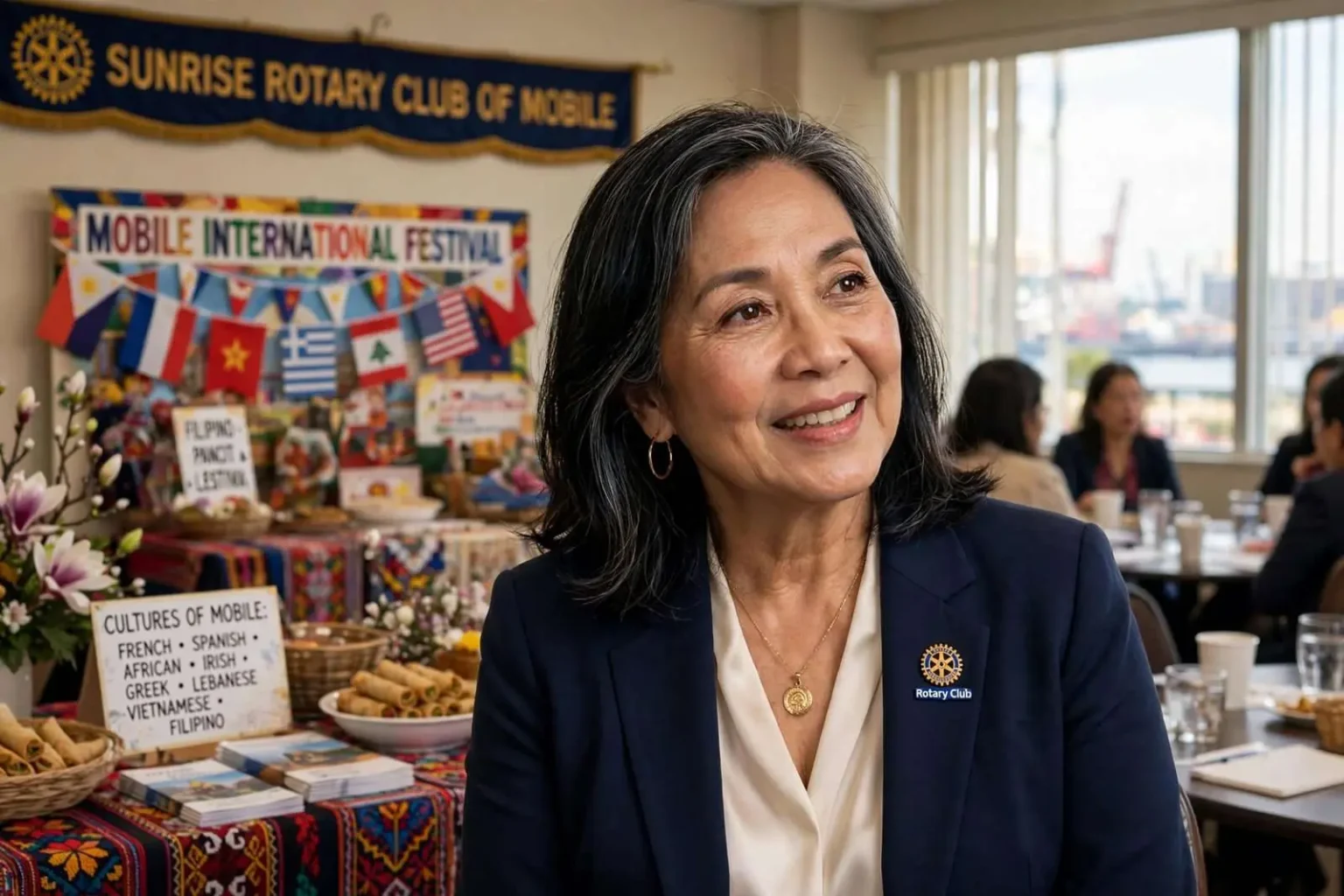
MOBILE – Estella Dorn, executive director of the Mobile International Festival, was the featured speaker at the Sunrise Rotary Club of Mobile this week, bringing with her the story of an event that has spent more than a quarter-century persuading a port city to look closely at the cultures already living inside it.
The Rotary appearance followed the pattern that has defined Dorn’s years with the festival: an ambassador’s round of luncheons, school visits and civic clubs, carrying the message that Mobile’s diversity is not a modern novelty but a heritage three centuries deep.
A festival with a classroom purpose
The Mobile International Festival was established in 1982. Its founding purpose was not entertainment but education: to help schoolchildren learn about the many international cultures represented in Mobile, and to share those cultures with everyone else as an annual event.
That founding generation of volunteers built the festival around the school-day visit — thousands of students moving through displays of food, dress, music and crafts, each staffed by community members presenting their own heritage. For many Mobile schoolchildren, the festival’s booths were the first close-up look at a world beyond the neighborhood, delivered by neighbors rather than textbooks.
That mission reflected something true about the city that is easy to miss. Mobile has been a port for three centuries, and the people who came through it – French, Spanish, African, Irish, German, Greek, Lebanese, Vietnamese, Filipino – did not simply pass through. They stayed, opened businesses, built churches and, in time, cooked at a festival where a school group could travel from one country’s table to the next in an afternoon.
The city’s colonial story is older than the United States itself. Mobile was founded as a French colonial capital at the dawn of the eighteenth century, passed through Spanish and British hands, and absorbed African, Caribbean and European peoples in every generation since. The city’s Mardi Gras — the oldest celebration of its kind in the country — grew from that creole inheritance, and its Catholic parishes, with names drawn from France, Spain, Ireland and Italy, still anchor neighborhoods across the city.
Later waves of arrivals added their own rooms to the house. Lebanese families, many arriving through the port in the late nineteenth and early twentieth centuries, built businesses and churches and became part of the city’s commercial fabric. Greek families founded a parish that remains a center of community life. Vietnamese families settled after the war and transformed the seafood industry in Bayou La Batre and Coden, south of the city. Filipino families — many drawn by the military and maritime trades, later by the hospitals — put down the roots that would eventually produce the festival’s own director.
Where the cultures met the table
The genius of the festival, as its founders conceived it, was to let the communities speak for themselves. Instead of an outside institution describing the world’s cultures, the festival invited each community to set its own table — to decide what to cook, what to display, what to play and what to explain. The result was less an exhibit than a gathering, and the schoolchildren who moved through it met the cultures in the person of a neighbor standing behind the booth.
Over more than two decades, the event grew into one of the region’s signature celebrations of diversity, drawing families, students and volunteers from across the Gulf Coast. Its longevity said as much as its size: an annual event survives for a quarter-century only if each generation of organizers recruits the next, and if the communities it serves keep finding it worth their Saturday.
The director’s own passage
Dorn’s biography reads like a map of that same movement. She was born Maria Estela Gustilo Igpuara in Manila, the Philippines, the only child of Maria Criste Gustilo and Ramon Igpuara. She attended Catholic schools as a girl and later graduated from St. Paul College of Manila and the University of the East with an associate degree in business administration.
Her schooling carried the marks of the Philippines’ history — an American-era educational system taught in English, and a Catholic heritage planted by Spain more than three centuries earlier. Manila itself, a Pacific port city shaped by successive waves of trade and empire, offered a young woman from its neighborhoods a template for what a port city’s culture becomes: layered, adaptive and open to the water’s traffic.
In 1978 she went to work for the Imperial Iranian Air Force, and it was there that she met the man she would marry. The posting placed a Filipina business graduate in Tehran in the late 1970s — a world capital on the edge of upheaval — and the work introduced her to American servicemen and contractors whose orbits crisscrossed the globe.
In 1980 she married retired U.S. Air Force Capt. Weems C. Dorn Jr. at the St. Louis Cathedral in New Orleans. The choice of church suited both of them — the cathedral stands in the oldest quarter of the most Catholic city in America, and its congregation has married Gulf Coast couples for generations. The couple lived in Louisiana for four years before moving to Mobile in 1984, where they remained.
She became a naturalized American citizen in 1985 — a step she has described to civic audiences as the moment her American story became her own rather than an accident of marriage. The naturalization ceremony, which immigrants across the Gulf Coast attend every year, converted a Filipina businesswoman into a citizen of the city she had already chosen.
In 1993 she was named president of the Mobile International Festival, and she went on to chair the International Relations Committee for the Mobile Tricentennial — the citywide observance of Mobile’s 300th birthday, an anniversary that reached back to the French founders of 1702 and forward to the city the three centuries had built.
Why the biography matters to the mission
Dorn’s path — Manila to Tehran to New Orleans to Mobile — gave her leadership of the festival an authenticity no resume of committee service could match. When she told Rotary audiences that Mobile’s cultures were living communities rather than exhibits, she spoke as someone who had herself been the newcomer: the woman behind the booth who arrived with an accent, learned the city, and stayed.
Her ascent from volunteer to president to executive director tracked the festival’s own growth. An event founded by civic-minded volunteers in 1982 had, by the 1990s, become an institution requiring management — budgets, school scheduling, volunteer recruitment, community outreach — and Dorn’s business training, her fluency across cultures and her instinct for hospitality suited the role.
Under her direction, the festival deepened its school programs and broadened the communities it represented, adding to the roster of booths as the Gulf Coast’s immigrant map kept changing — new arrivals from Southeast Asia, Latin America and elsewhere joining the established French, Greek, Lebanese, German, Vietnamese and Filipino tables.
A port city’s oldest lesson
The festival’s message to Mobile has always been a lesson the port itself teaches: cities that trade with the world eventually marry it. Goods, ships and sailors come and go, but the families who follow the trade routes stay, and their children grow up as locals. The cultures Dorn listed in her Rotary talk — French, Spanish, African, Irish, German, Greek, Lebanese, Vietnamese, Filipino — are not additions to Mobile’s history. They are its history, one arrival at a time.
Mobile’s identity has absorbed each wave without erasing any. The city eats it — in the gumbo and the Greek pastries, the Vietnamese markets south of town and the Lebanese tables that have fed generations of Mobilians. It prays it, in the Catholic parishes founded for Irish dockworkers and French colonial families. It celebrates it, most visibly in a Mardi Gras season whose societies carry names from three continents.
The International Festival put all of that into a single hall for one weekend a year, and put it in front of the audience that would carry it furthest: schoolchildren. A student who meets a Lebanese neighbor’s tabbouleh and a Filipino classmate’s mother’s pancit in the same afternoon learns, without a lecture, that the world is not abroad — it is across the street.
The civic circuit
Dorn’s week with the Sunrise Rotary Club belongs to the quiet infrastructure of city life. Mobile’s civic clubs — Rotary, Kiwanis, Lions, Exchange and their counterparts — have long served as the town square where organizations report to the public: the port’s director on trade, the school superintendent on classrooms, the festival director on the city’s cultures. The talks cost nothing to attend and accomplish what advertising cannot: they turn an institution’s story into a conversation over lunch.
For the festival, every such appearance recruits something it cannot buy — volunteers, school groups, community booths. The event runs on the labor of hundreds of families who cook, sew costumes, assemble displays and stand for a day explaining their heritage to strangers’ children. The director’s job, in season, is to keep that network growing, and the luncheon circuit is where the next decade’s volunteers are found.
The story Dorn carried from table to table in her Manila-to-Mobile journey is, in the end, the festival’s own argument: that the cultures of the world are not visitors here, but residents — and that a city which understands that history will treat its newest arrivals the way the city treated every arrival before them, with a table, a booth and a place in the school day.
More than a quarter-century after its founding, the Mobile International Festival remains what it was in 1982: a classroom the size of a city, run by the people the lesson is about, taught one plate of food at a time.