Mobile County Schools Prepare to Launch Online ‘Envision Virtual School’
The Mobile County school system prepared to open Envision Virtual School for grades 6-12 in fall 2014, capping first-year enrollment at 250 students pending a June board vote.
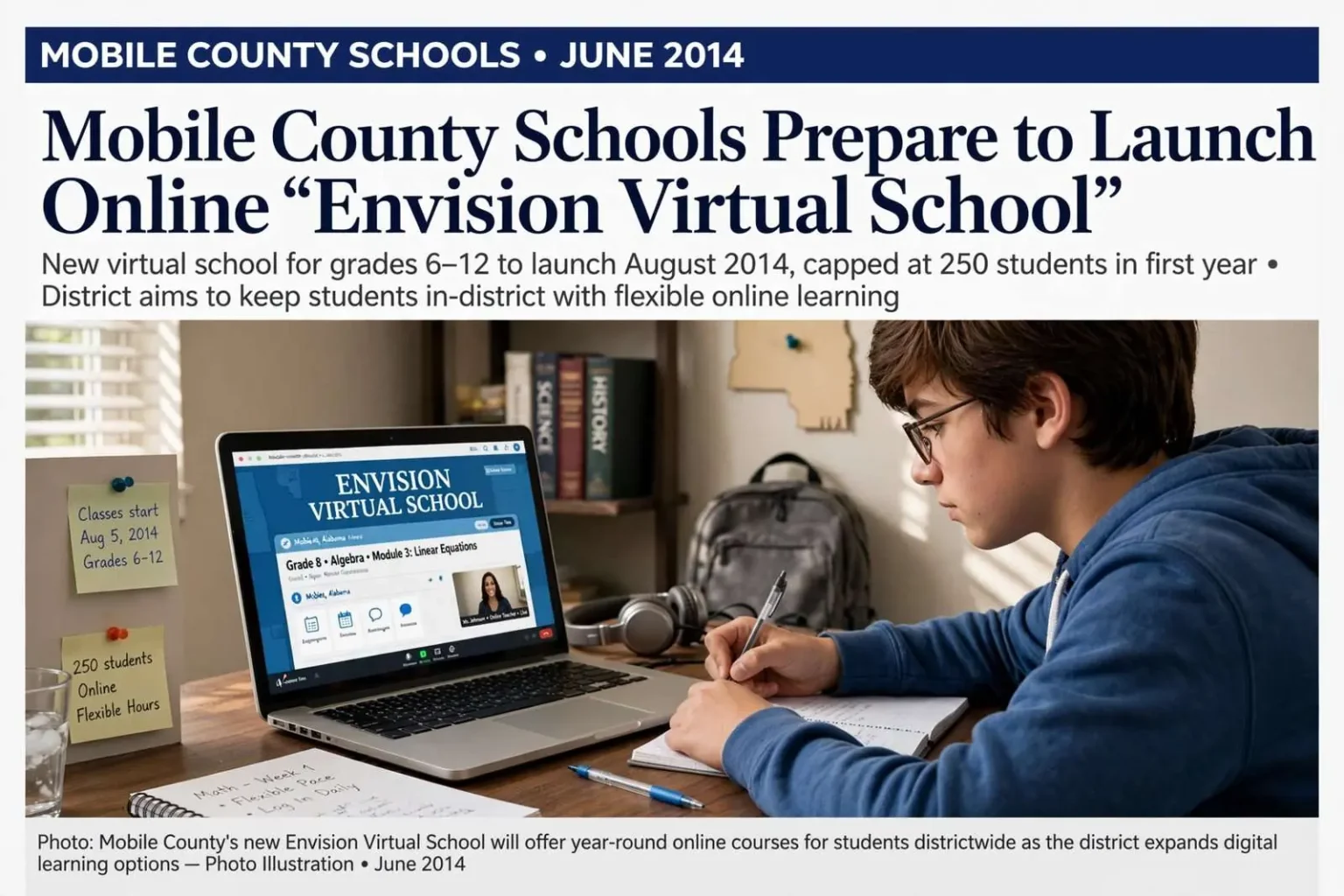
The Mobile County school system prepared in June 2014 to launch a virtual school for grades 6 through 12 at the start of the 2014-15 academic year, a step officials described as a move into the world of online learning.
The new program, to be called the Envision Virtual School, would carry a cap of 250 students in its first year and would be staffed by one principal, one registrar and at least four teachers, each expected to work about four hours per week.
The launch placed Alabama’s largest school system alongside a growing number of districts nationwide experimenting with full-time online instruction — an approach that had moved from the margins of education into the mainstream as broadband access spread and course software matured.
Cost and approvals
The final number of teachers would depend on enrollment, according to Superintendent Martha Peek, who presented the proposal to the Mobile County school board during a work session that Wednesday. The system had already secured approval from the state Department of Education to create the school.
The program was projected to cost $200,000, to be covered with local funds, pending approval by the school board. The board was expected to vote on the proposal at its June 19 meeting. In a district the size of Mobile County’s — which enrolled tens of thousands of students across more than 90 schools — the investment was modest by capital standards, but board members still weighed it in a budget climate still recovering from years of state education funding cuts following the recession.
If enrollment grew, Peek told the board, the virtual school could eventually expand to as many as 500 students. Board member Bill Foster noted that costs would fall as enrollment rose, because the state Department of Education funds teacher positions based on the number of students.
That funding mechanic was central to the program’s business case. Alabama’s education budget allocates teacher units to districts according to enrollment, so students who enrolled in the virtual school would bring state funding with them — students the district might otherwise lose entirely to online programs operating outside the system. Capturing that enrollment, rather than ceding it to other providers, was part of what made the $200,000 startup cost attractive.
Districts across the country had learned that lesson in real time. As statewide virtual schools and charter cyber schools expanded in the early 2010s, traditional districts watched students — and the per-pupil funding attached to them — depart for online alternatives. Building an in-house virtual school was the defensive response: keep the students, keep the funding, and keep the instruction under local control.
A flexible, web-based model
The school was designed to offer what the proposal called “a cutting-edge, virtual education guided by a philosophy of individualized and flexible instruction.” Courses would be delivered through web-based software and would be available from Aug. 5 through July 31, 2015.
The year-round window marked a departure from the traditional school calendar, letting students accelerate through material at their own pace or spread recovery coursework across the summer. For the district, the flexible window also matched the realities of the students the program hoped to attract: competitive athletes with travel schedules, students with medical conditions that make daily attendance difficult, and teenagers balancing school with work.
Officials said they hoped to open registration in July after evaluating presentations from software suppliers. The choice of course platform was among the most consequential decisions in the launch. Virtual school software packages of that era varied widely in quality, and districts that chose well — with rigorous, state-aligned courses and reliable teacher support — built programs that grew; districts that chose poorly spent years rebuilding credibility with parents.
Peek said the long-term goal was for the school to become self-supporting. She pointed to the Baldwin County school system’s own virtual program, which had begun the previous fall with about 20 students in grades 9-12. “We want to make sure we’re offering similar services,” she told the board.
The cross-bay comparison was deliberate. Baldwin County, the state’s fastest-growing system, had positioned its digital program as a signature initiative, and its early results — a small but functioning program in its first year — gave Mobile County a working model close to home. Neighboring districts watch each other closely on initiatives like this, and the willingness of Mobile County’s leadership to cite Baldwin’s program reflected a shared recognition that virtual learning was becoming a standard offering rather than an experiment.
Baldwin’s head start also illustrated the scale question the two systems faced. A program beginning with roughly 20 students and a handful of grades could grow organically, testing its systems before expanding. Mobile County’s proposal, with a 250-student cap across six grade levels, was a larger leap — one that required more staff, more software licenses and more registration infrastructure from day one.
Fitting into a wider strategy
The online option dovetailed with other Mobile County efforts to keep students on track and prevent dropouts, including after-hours credit recovery courses and the district’s Twilight Schools.
Twilight Schools — afternoon and evening sessions serving students who had fallen behind or struggled in traditional settings — had become a signature of the district’s dropout-prevention push. Credit recovery programs similarly allowed students who failed a course to retake it in compressed form rather than repeating an entire year. A full-time virtual school extended the same philosophy to its logical endpoint: students for whom the traditional building, bell schedule and daily commute were the obstacle.
Peek said a virtual school would appeal to families of students who were homebound, who traveled frequently or who simply needed flexible hours, adding that officials had already heard from interested parents. “We’re excited about it,” she said. “We’re moving into the world of technology and online learning.”
The categories Peek described — homebound students, traveling families, students needing flexible hours — mapped onto well-established needs that conventional schools handle imperfectly. Hospitalized and chronically ill students traditionally relied on patchwork homebound instruction; military and transfer families arriving mid-year faced enrollment friction; and older students balancing jobs often dropped credits they could have completed on a flexible schedule. A virtual school consolidated those cases into one program with dedicated staff.
Other school systems across the state, she noted, were also establishing virtual schools. The district’s move aligned with the state education department’s growing support for online learning, as Alabama worked to expand digital course offerings and broadband access in schools during that period.
One difference from the Baldwin model was the question of devices. While Baldwin County issued MacBook Air notebooks to its virtual students as part of a broader technology initiative, Mobile County students would purchase their own devices to take the online courses. “We admire the work they’ve done in Baldwin County,” Peek said.
The device question carried real equity implications. A bring-your-own-device model saved the district the considerable capital cost of issuing laptops to every virtual student, but it also meant that access to the school depended in part on what a family could afford. District officials weighing that tradeoff in 2014 were making the calculation that would preoccupy education technology planners for the next decade — long before the pandemic-era shift to remote learning made device access a universal school-funding question.
What the first year would test
The 250-student cap gave the district a controlled first year. Program designers could watch whether students stayed engaged without the structure of a physical classroom, whether the four-hours-per-week teacher model provided enough support, and whether the software platform’s pacing and assessment tools held up across six grade levels. Those lessons would shape any expansion toward the 500-student target Peek described.
Nationwide experience with early virtual schools had already produced cautionary lessons by 2014. Programs that treated online learning as a software subscription rather than a school — with weak teacher contact and little monitoring of struggling students — recorded high withdrawal rates and poor outcomes. The districts that succeeded paired their platforms with active advising, regular parent communication and early intervention when a student’s coursework stalled.
The staffing plan Peek presented suggested Mobile County understood that balance. A principal and registrar anchored the school as a real institution — with records, enrollment procedures and administrative accountability — rather than a software portal. Teachers working about four hours per week each matched staffing to the enrollment cap while preserving the possibility of adding hours as the program grew.
A shifting landscape for Alabama schools
The Envision launch arrived in the middle of a broader transformation in how Alabama students accessed coursework. The state had been building out its ACCESS distance-learning program for high schoolers, giving rural districts access to courses their small faculties could not staff — Advanced Placement subjects, foreign languages and specialized electives delivered by video and online instruction.
For a district of Mobile County’s size, the full-time virtual school represented a different proposition: not a single course delivered at a distance but an entire school experience conducted online, with the district’s own name, staff and accountability attached. The distinction mattered for families choosing between the district’s offering and the statewide or private online alternatives that had begun marketing directly to Alabama households.
Enrollment numbers in the program’s first year would answer the question every district planning a virtual school faces: whether demand existed at the scale the cap anticipated. The interest Peek reported hearing from parents before the board’s June 19 vote offered early encouragement, but the registration window that July — following the software supplier evaluations — would provide the first hard count.
If the program filled toward its 250-student cap and held its enrollment into the fall, Mobile County would join the ranks of large districts nationally that had converted online competition into an in-house asset. If it stumbled, the district could retrench without the sunk cost of a building — one of the quiet advantages of a school whose campus was a server and whose classroom was wherever a student logged in.
Either way, the June 2014 proposal marked the moment Mobile County’s school system formally entered the world of virtual education, following Baldwin County across the bay and signaling that the state’s largest district intended to compete for students wherever they chose to learn.