Arbitrator Orders David Thomas Back to the Classroom at Bishop State, With Back Pay
An arbitrator ruled that Bishop State Community College fired former school board member David Thomas without cause, ordering him reinstated as an instructor with full back pay. Chancellor Bradley Byrne vowed an appeal.
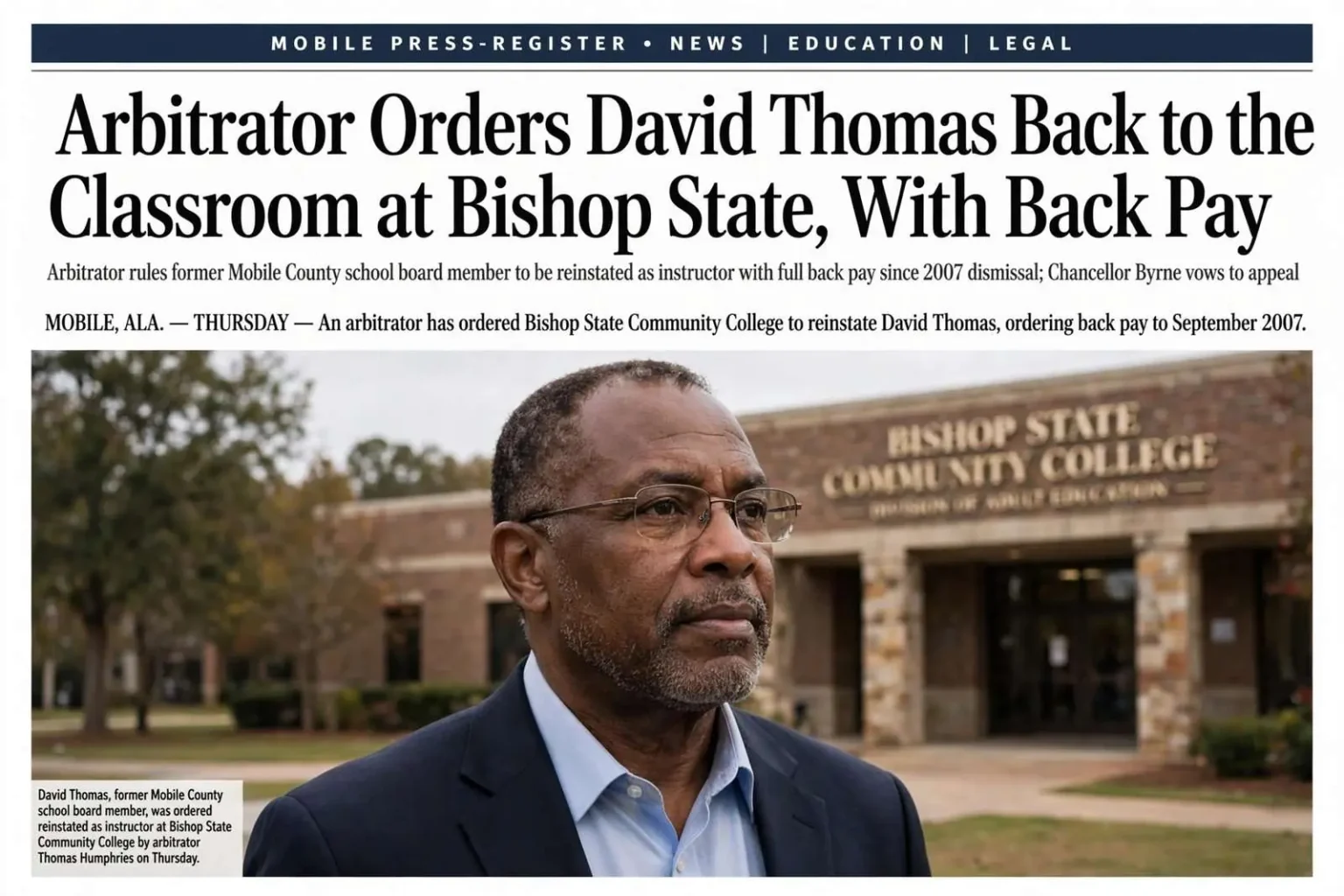
An arbitrator on Thursday ordered Bishop State Community College to reinstate David Thomas, the former Mobile County school board member who was dismissed from the two-year college at the direction of Chancellor Bradley Byrne, and to pay him everything he would have earned since his firing.
Thomas was terminated Sept. 10, 2007. The ruling by arbitrator Thomas Humphries of Fort Lauderdale, Fla., ordered him restored as an instructor with full back pay to that date, and it did so in unusually blunt language.
“Frankly, thorough examination of his job performance reveals little if any evidence that he is deserving of a disciplinary penalty, much less the loss of his job,” Humphries wrote. The chancellor’s office, he continued, had acted on shaky footing. Thomas’s “treatment is found to have been rooted in the arbitrary application of a nonexistent policy, devoid of reasonable standards and a fair and proper investigation,” the arbitrator ruled.
Arbitration is built into Alabama’s education employment law: when a two-year college employee with tenure or contractual rights is terminated, the employee may appeal to a neutral arbitrator whose award binds the college, subject only to limited review in the courts. That is the process Byrne was referring to when he complained about being “forced” to use arbitrators — and it is the process that produced Thursday’s award, one of the most lopsided a chancellor had faced since taking over the system.
Performance on the job versus conduct off it
The distinction at the heart of the decision was between what Thomas did in the classroom and what he had done elsewhere. Humphries determined that Thomas was able to perform his duties at Bishop State irrespective of his troubles outside it, and that while Thomas may have damaged his own reputation and the college’s in the short term, it was not clear his continued employment would harm the school’s legitimate interests over the long run.
Those troubles were considerable. Thomas was impeached from the Mobile County Board of School Commissioners in 2006 after he was found to have improperly used school system money to buy roughly $9,000 worth of Mardi Gras parade throws. He also pleaded guilty to a felony charge of leaving the scene of an accident during Mardi Gras 2005, in which he ran over the foot of an 8-year-old girl in downtown Mobile. As a convicted felon, he is barred from running for public office in Alabama.
The impeachment case — the first of its kind against a Mobile County school board member in modern memory — centered on purchases that mixed personal celebration with public money. The criminal case, resolved in Mobile County Circuit Court, involved a Mardi Gras season accident in the heart of downtown’s parade route. Both became fixtures of local news coverage for two years, and both followed Thomas into the college’s employment records when Byrne’s administration began reviewing personnel across the two-year system.
What the arbitrator separated was the record from the reputation. Humphries found nothing in Thomas’s teaching file — evaluations, classroom performance, duties at the college — that justified discipline, and he refused to treat off-campus misconduct as a substitute for an on-the-job case the college had never actually built.
A partial victory
The ruling did not give Thomas everything he sought. In addition to teaching, he had headed Bishop State’s Division of Adult Education and Economic Development, and the arbitrator did not order the college to restore him to that administrative post. Thomas declined to comment until he had spoken further with his lawyers. His attorney, Cecil Gardner, called the outcome a win nonetheless.
“We didn’t get everything we wanted,” Gardner said. “But we’re not disappointed at all. It was a significant victory for fairness.”
Byrne promises an appeal
Byrne, who had been installed as chancellor of Alabama’s two-year college system with a mandate to clean up a network of campuses battered by corruption investigations — Bishop State among the most prominent — said the college would fight the decision to the end.
Byrne’s arrival at the top of the two-year system followed years of scandal that had reached the department’s highest levels. Federal convictions of sitting board members, indictments tied to legislative influence over hiring, and disclosures of consultants and relatives on college payrolls had made the system a recurring cautionary story in Alabama government. Bishop State in Mobile was among the campuses most affected, with multiple employees and associates charged in schemes involving federal student aid and phantom enrollment, and its Mobile roots meant the fallout played out in hometown coverage that never let the story fade.
“We knew that this was a flawed process to begin with,” Byrne said. “We’ve had some bad luck with these arbitrators from the time we were forced to start using arbitrators as a result of an amendment to the law. We will appeal this to the court of civil appeals. We will ask the court to stay the effect of the ruling until the court of civil appeals rules on our motion.”
Byrne said he did not know precisely how much money Thomas stood to collect if the arbitration award held, but that “whatever it is, it’s too much and we are going to appeal it.”
The chancellor took some consolation in the limits of the order. Because it did not return Thomas to the adult education division, Byrne said, the college would be free to fill that job with someone else.
“That’s good,” he said, “because adult education is of critical importance to the Mobile area right now and we need to have someone there who is first rate. But we don’t think he ought to be reinstated at all, so we’re going to appeal the entirety of the ruling.”
Byrne’s fight with the arbitration process had become a defining conflict of his chancellorship. Appointed to lead the Department of Postsecondary Education after a string of state and federal investigations into hiring, contracting and legislative influence inside the two-year college system, he arrived promising to fire employees whose conduct had brought the network into disrepute — and quickly discovered that Alabama law gave those employees a route back through neutral arbitration. Several of his early terminations had already produced awards against the system, and each one hardened his argument that the arbitration amendment had tied reformers’ hands.
The appeal to the Court of Civil Appeals would test how far a college must document misconduct to justify a firing, and whether an arbitrator’s reading of an employee’s classroom record can withstand review. A stay motion filed with the appeal would determine whether Thomas returned to the classroom while the case continued — and whether the back-pay meter, running since September 2007, kept adding salary while the lawyers argued.
The seat he left behind
Thomas’s departure from the Mobile County school board reshaped that body as well. The remaining commissioners selected the Rev. Fleet Belle to fill his seat, and Belle was seeking election to a full six-year term as a Democrat in the 2008 elections.
The school board seat Thomas had held represented one of the county’s district posts on the board that governs the Mobile County Public School System, the largest school district in Alabama. His impeachment left the board short a member and forced an appointment — Belle, a pastor with deep ties in the district — whose election bid the following year would determine whether the seat changed hands permanently or returned to the political orbit Thomas had left behind. The episode also became part of the board’s modern history: a member removed by his colleagues’ impeachment process, a first for the county in living memory, and a case study cited whenever school board accountability came up in Montgomery.
The dispute was one of several legal fights that trailed the two-year college system through 2008, as Byrne pressed to remove employees he considered liabilities and found that the arbitration process, written into state law, often stood in his way. Each award that went against the system hardened the standoff between a chancellor promising accountability and a statute promising due process.
For Bishop State, the ruling reopened a question the college had thought settled: what its campus community owed to a former school board member whose public fall had played out across two years of headlines. The arbitration answer — a classroom seat, full back pay, and no administrative title — satisfied no one entirely. It restored an employee the arbitrator found had done nothing wrong on the job, left an administrator’s post filled by someone else, and handed the chancellor a fight he had promised to take all the way to the appellate courts.
Whatever the Court of Civil Appeals decided, the award had already made its point inside the system Byrne was trying to reform. Arbitration, whatever its frustrations for management, had done exactly what it was designed to do: review a firing against the record, and overturn it when the record did not support the punishment. The question left open was whether the courts would see the same record the same way.