Ballot of Former Prichard Council President Rejected in Primary Canvass
The June 3 primary ballot cast by a former Prichard City Council president was not counted, the Mobile County Board of Registrars determined amid a lingering dispute over her residency.
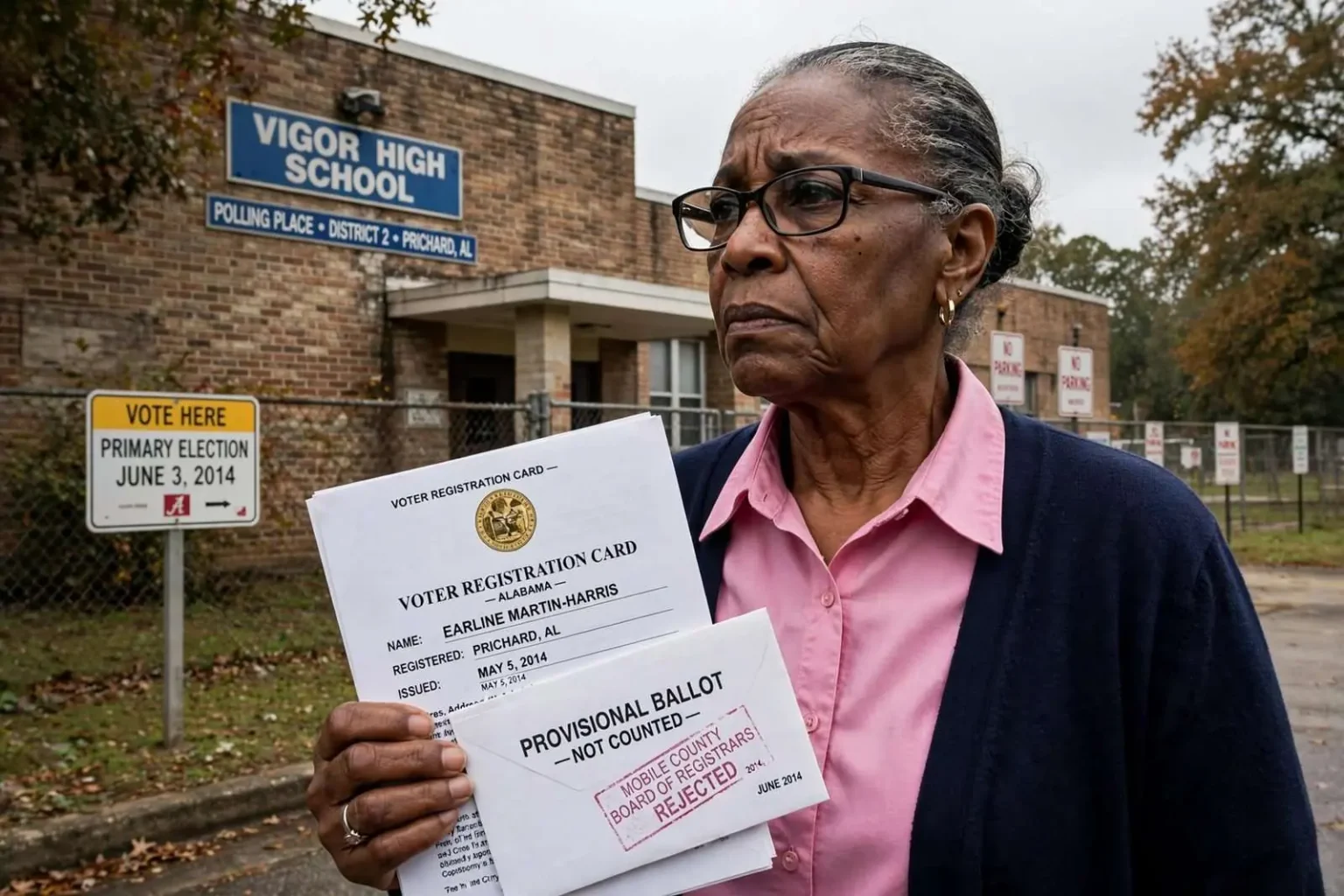
PRICHARD, Ala. — The ballots cast by former Prichard City Council President Earline Martin-Harris and her husband in the June 3 primary “should not be counted,” the three-member Mobile County Board of Registrars determined in June 2014. Mobile County Probate Judge Don Davis confirmed the board’s decision, saying it was made during the canvassing of the primary ballots. He deferred to the board on the specific reasons the ballot was rejected.
Board Chairwoman Pat Tyrrell, who served alongside members Virginia Delchamps and Shirley Short, could not be reached for comment. The canvass — the formal process by which a county’s election officials review, verify and total the ballots cast in an election — is where questions about voter eligibility are typically resolved, and it was there that the board ruled the two ballots out.
The rejection closed one chapter of a dispute that had already claimed a city council seat, but it left open the larger questions Martin-Harris raised about her right to vote in the city where she said she had been registered for more than two decades.
A Dispute Over Voting Rights
Martin-Harris, who declined to comment in detail until she learned more, had said the previous week that she felt her civil rights were violated when she was told she could vote only a provisional ballot after arriving at Vigor High School in Prichard. She maintained that she held the identification and voter registration required to vote in the city.
“I had no reason to think I didn’t have the right to vote,” Martin-Harris said, noting that she had received an updated voter registration card on May 5. She said she had been a registered voter in Prichard since 1992.
Provisional ballots exist precisely for voters whose eligibility is questioned at the polling place. Under Alabama law, a voter whose name does not appear on the rolls or whose identity cannot be verified may cast a provisional ballot, which is then reviewed by the board of registrars after Election Day and counted only if the voter’s eligibility is confirmed. The process protects against wrongful exclusion, but it also means the voter’s ballot hangs in limbo until the canvass.
That is the mechanism that led to the June decision. When the board reviewed the provisional ballots alongside the rest of the primary vote, it determined that Martin-Harris’s ballot and her husband’s should not be counted. The reasons were not spelled out publicly; the probate judge, who sits with the board during canvassing, pointed questions back to the registrars.
Vigor High School, where Martin-Harris was told to cast a provisional ballot, is one of the standard polling places in Prichard, the city north of Mobile whose municipal elections are decided in even-numbered years. For a former council president to be challenged at the polls in her own city made the story resonate well beyond the city limits.
Fallout From a Residency Question
The dispute grew out of a controversy that had drawn attention in late May, when Martin-Harris resigned from the Prichard City Council amid questions about whether she actually lived in Daphne rather than Prichard. She had served on the council since 2000. Her resignation, on May 21, came before a trial was set to begin over the legal questions surrounding her residency.
Martin-Harris said she had stepped down because she lacked the financial means to “fight the state of Alabama,” not because she conceded the underlying claim. She said she could have chosen to run in the special election for the vacated District 2 council seat but had decided against it.
“I don’t want to drag the city of Prichard into any more negative attention,” she said.
Residency challenges against elected officials are rare in Mobile County, and the questions in the Prichard case carried real legal weight: a council member must live in the city she represents, and proof one way or the other generally requires the kind of evidentiary fight that the looming trial would have supplied. By resigning, Martin-Harris ended the litigation but not the questions.
Those same questions shadowed her attempt to vote weeks later. Whether the registrars rejected her ballot because of the residency issue or for some other reason was never stated publicly, but the timing — two weeks after the resignation and the residency controversy that preceded it — made the connection hard to miss.
A Crowded Race for the Open Seat
By the time of the canvass, four candidates had already signed up to run for the District 2 seat, which was to be decided in a special election on Aug. 26. The deadline to qualify was 5 p.m. on June 20, and the winner would hold the office until Prichard’s next municipal election in August 2016.
The candidates who had filed to run were Gwendolyn Williams of Snyder Drive in Prichard; Paula Blevins of North Atmore Avenue in Whistler; Sheila H. Poole of West Turner Road in Prichard; and Carlton N. Wallace of Charles E. Hall Drive in Eight Mile. The slate reflected the neighborhoods that make up the district and its surroundings, from the Whistler community on the city’s southern edge to Eight Mile to the north.
Special elections like Prichard’s are governed by the same machinery as regular municipal votes, but they draw far less attention and often far fewer voters. A Tuesday contest in late August, without a mayor’s race or a national election at the top of the ballot, typically comes down to name recognition, precinct-level organizing and turnout — and in a district the size of Prichard’s, a few hundred votes can decide the seat.
Whoever won would inherit a role Martin-Harris had held through a period of upheaval. She had risen to council president during her years on the body, a position that made her a frequent presence at city hall and in the city’s efforts to manage its finances and services. Her departure left the council short a member and District 2 without a vote on the dais for the summer.
For the city itself, the episode landed during a stretch when Prichard had already weathered years of financial strain and scrutiny. The city, once home to a thriving industrial corridor along U.S. Highway 45, had become a symbol of small-city hardship in south Alabama, and any dispute that reached the county courthouse drew notice from residents weary of negative headlines.
Questions That Outlasted Election Night
For Martin-Harris, the rejected ballot marked another turn in a saga that had already cost her a council seat she had held for well over a decade, leaving open questions about voting rights and residency that lingered well beyond election night.
The case illustrates how separate legal threads can braid together in a single summer: a civil lawsuit over an official’s residency, a resignation on the courthouse steps, and finally a decision by election officials that touched her most basic act of citizenship. Each thread was resolved by a different body — the council seat by her resignation, the lawsuit by its abandonment, the ballot by the board of registrars — and none of them produced the public airing of facts that a trial would have provided.
Voting-rights advocates note that decisions like the registrars’ are made with little public explanation, which can leave voters who lose their ballots without a clear answer or a practical path to appeal. In Prichard’s case, the board’s ruling stood as issued, with the chairwoman unavailable for comment and the reasons unspoken.
What remained clear was the chronology. A voter registration card dated May 5. A resignation on May 21. A June 3 primary at which the former council president was offered only a provisional ballot. And a June canvass at which that ballot, along with her husband’s, was ruled out. For the residents of District 2, the practical business of representation moved on to the August special election — but the story of how a former council president came to be turned away from her own polling place was one Prichard would not soon forget.
How a County Canvass Works
The Mobile County Board of Registrars is the body that maintains the county’s voter rolls and rules on questions of eligibility, including the disposition of provisional ballots. Its three members work alongside the probate judge during the canvass of each election, when every ballot is reviewed and the official totals are fixed. Once a canvass is complete, the results become the certified record of the election, and ballots rejected at that stage are finished — there is no later count that can revive them.
The board’s discretion in provisional ballot review is broad but not unlimited. Registrars are expected to check the voter’s registration status, address and identification against the records on file, and to count any ballot whose eligibility can be verified. Voters whose ballots are rejected are generally notified, though the notification process rarely attracts public attention outside of contested races.
That structure is why Martin-Harris’s path ran through the canvass at all. She was not turned away from the polls — she was handed a provisional ballot, the safety valve Alabama law provides — and the question of whether her vote would count moved to the registrars’ table. There it ended, with a ruling that preserved neither the ballot nor much of an explanation.
The episode also unfolded against the backdrop of Alabama’s identification and registration requirements, which have tightened over the years and shifted more weight onto voters to keep their records current. An updated registration card mailed on May 5 would ordinarily give a voter every reason for confidence at the polls; what happened between that card and the June 3 primary is what Martin-Harris said she could not yet explain when she first spoke about the rejection.
For the four candidates who had qualified for the District 2 special election, the canvass served as a reminder of how narrow the margin between counting and not counting can be. In a small city district, a single precinct’s provisional ballots can rival the victory margin, which is why both campaigns and registrars treat the post-election review as seriously as the election itself.