Prichard Rewrites Its Bingo Rules as the District Attorney Calls the Machines Illegal
The Prichard City Council moved to amend its electronic bingo ordinance, arguing that machines are still bingo. Mobile County's district attorney said the law says otherwise.
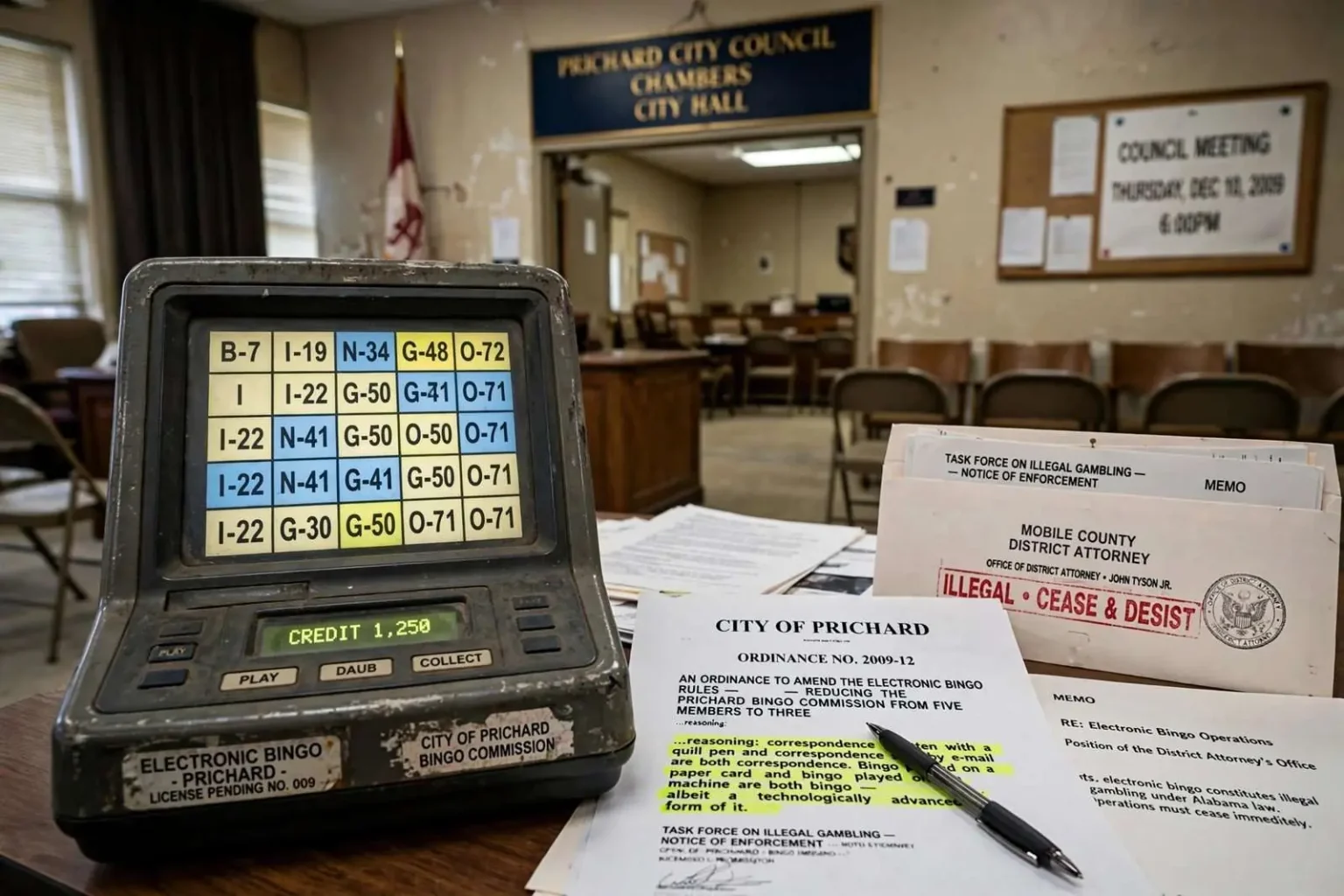
The Prichard City Council was expected to amend its electronic bingo ordinance Thursday, trimming the city’s bingo commission and, in the process, restating an argument that had become the central legal proposition of Alabama gambling in 2009: that a machine can be a bingo card.
The amendment reduces the council-appointed Prichard Bingo Commission from five members to three. The more consequential language is in the ordinance’s reasoning, which holds that technological advances allow electronic machines to comply with a law originally written for paper cards.
The ordinance offers an analogy. Correspondence written with a quill pen and correspondence sent by e-mail are both, inarguably, correspondence. Bingo played on a paper card and bingo played on a machine are, by the same logic, both bingo — albeit a technologically advanced form of it.
That analogy would be tested far beyond Prichard’s city limits. By the winter of 2009, the question of whether electronic bingo machines were really bingo — or slot machines dressed in bingo software — had produced litigation in multiple counties, legislative standoffs in Montgomery and a task force operating under the governor’s office. Prichard’s ordinance was a small city’s entry into the biggest legal argument in the state.
The District Attorney Disagrees
Mobile County District Attorney John Tyson Jr. had already made his position clear. He believed electronic bingo to be illegal under Alabama law, and he said his office would address such operations accordingly.
That was not a rhetorical threat. Tyson had by then taken on a second role as head of Gov. Bob Riley’s Task Force on Illegal Gambling, a body created to enforce the governor’s view that the electronic machines proliferating across Alabama were slot machines wearing a costume. Over the preceding months the task force had staged raids at facilities elsewhere in the state, seizing machines and cash, and had been met by county sheriffs, local judges and, in several instances, armed standoffs of the bureaucratic variety.
The conflict set two layers of Alabama government against each other. County sheriffs in several jurisdictions had licensed bingo halls under local constitutional amendments and defended them as legal; the task force argued that only a state Supreme Court ruling could settle the definition, and it pressed forward with raids while that question made its way through the courts. Into that atmosphere walked a small city on Mobile County’s northern edge preparing to license machines of its own, in the backyard of the task force’s own chairman.
Why the Argument Existed at All
Alabama’s constitution prohibits lotteries and most forms of gambling. But over the years the Legislature had approved local constitutional amendments permitting charity bingo in specific counties and municipalities — a patchwork that left each locality with its own definition of what “bingo” meant.
Operators exploited the gaps. If bingo was legal in a jurisdiction and the law did not specify paper, then an electronic device that arguably performed the same function could be argued into legality. Cities and counties with thin budgets found the argument persuasive, particularly when licensing fees and taxes were attached to it.
The economics were straightforward. A hall of electronic machines open six days a week generates licensing revenue for the city, payroll for local workers and charitable contributions that the operators cite as the public benefit justifying the games. For a municipality with a shrinking tax base, the difference between a legal bingo operation and an illegal casino was measured entirely in courtrooms that had not yet ruled — and the money kept flowing until they did.
The Stakes for Prichard
Prichard’s budget was thinner than most. The city, which sits immediately north of Mobile and had lost roughly half its population since its industrial peak, was in serious financial distress and heading toward a bankruptcy filing and a pension crisis that would draw national attention within a year. Revenue that other cities might have declined on principle was, in Prichard, a matter of arithmetic.
The city’s decline was decades in the making. Once a thriving industrial suburb whose shipyards, mills and military installations made it one of the larger cities in Alabama, Prichard had watched white and middle-class flight hollow out its neighborhoods and its commercial corridors after the 1970s. By 2009 the city had already been through one bankruptcy in the 1990s, and its pension obligations to retired workers were weighing on a budget that could not absorb them — a crisis that would lead the city to stop pension payments outright and file for Chapter 9 protection the following year.
Electronic bingo, had it survived legal challenge, promised the city licensing revenue and jobs. It also promised litigation. The city’s careful drafting — the quill pen, the e-mail, the insistence that bingo remains bingo — was written with a courtroom in mind.
The narrowing of the bingo commission from five members to three drew less notice but was not trivial. A smaller commission is a faster commission, and in a regulatory body appointed by the council, it is also an easier one to control. A three-member board can be convened, can issue decisions and can be overseen with none of the scheduling friction of a larger panel — a practical reform, but also a consolidation of authority in a city government already operating under financial strain.
What Came Next
The dispute Prichard was entering would not be settled by any city council. It would be settled by the Alabama Supreme Court, which over the following years steadily narrowed the space in which electronic bingo could operate, and by federal prosecutors, whose gambling-corruption investigation would reach into the State House itself.
The court’s decisions in a series of bingo cases defined what the six functions of the game required and found that many of the machines operating around the state did not genuinely meet them — rulings that forced halls in Houston County, White Hall and elsewhere to close or fight on. The federal investigation, meanwhile, ended in a 2010 bribery indictment against casino interests and legislators that reshaped the state’s political conversation for years.
For Prichard in December 2009, though, the immediate question was simpler and more local: whether a city with almost no money could write an ordinance strong enough to withstand a district attorney who had the governor behind him. The answer, as it turned out, was no.
The episode stands as a snapshot of Alabama’s gambling wars at their most local level. The state’s largest legal questions — what is a slot machine, what is charity bingo, who decides — were being answered in pieces, hall by hall and city by city, while the money flowed. Prichard’s amendment was one municipality’s attempt to write itself onto the legal side of that line, drafted with an eye toward the courtroom, in a city whose need for revenue was matched only by its inability to win the fight it was starting.
The setting in which Prichard acted deserves its own explanation. Mobile County itself had no countywide bingo amendment on the order of the ones that legalized large electronic bingo operations in counties such as Houston and Lowndes, which meant the city’s ordinance rested on municipal authority under its own local legislation — a thinner legal reed than the county amendments the task force was already challenging. That made Prichard’s position weaker than the operations in the state’s established bingo counties, and it made the city’s decision to proceed anyway all the more a bet on the quill-pen analogy carrying the day in court.
The amendment process itself was also a study in how Alabama cities legislate. A bingo commission appointed by the council, an ordinance amended mid-course, legal reasoning embedded in the preamble — these are the working tools of small-city government, and they were being deployed here against the attorney general’s office, the governor’s task force and the district attorney of the state’s second-largest county all at once. City officials who spoke about the measure emphasized compliance: the machines would play genuine bingo, the charitable purposes would be honored, the licensing would be strict. The task force’s position was that no amount of compliance language in a city ordinance could make a slot machine legal.
For residents of the city, the debate carried practical weight beyond ideology. Prichard’s neighborhoods had waited years for basic services — street repairs, police staffing, drainage work — while the city’s finances deteriorated. Every dollar of licensing revenue that a functioning bingo operation promised was a dollar the city’s general fund could not otherwise count on, and every dollar of legal risk carried the potential for another expense the city could not afford. City leaders were weighing a wager, and the odds were set by courts they did not control.