A Decade On: How a Grand Jury Moved to Remove Prichard’s Mayor and Council
Ten years after a Mobile County grand jury accused Prichard's mayor and council of willful neglect and incompetence, the case remains a cautionary tale about municipal finances gone wrong.
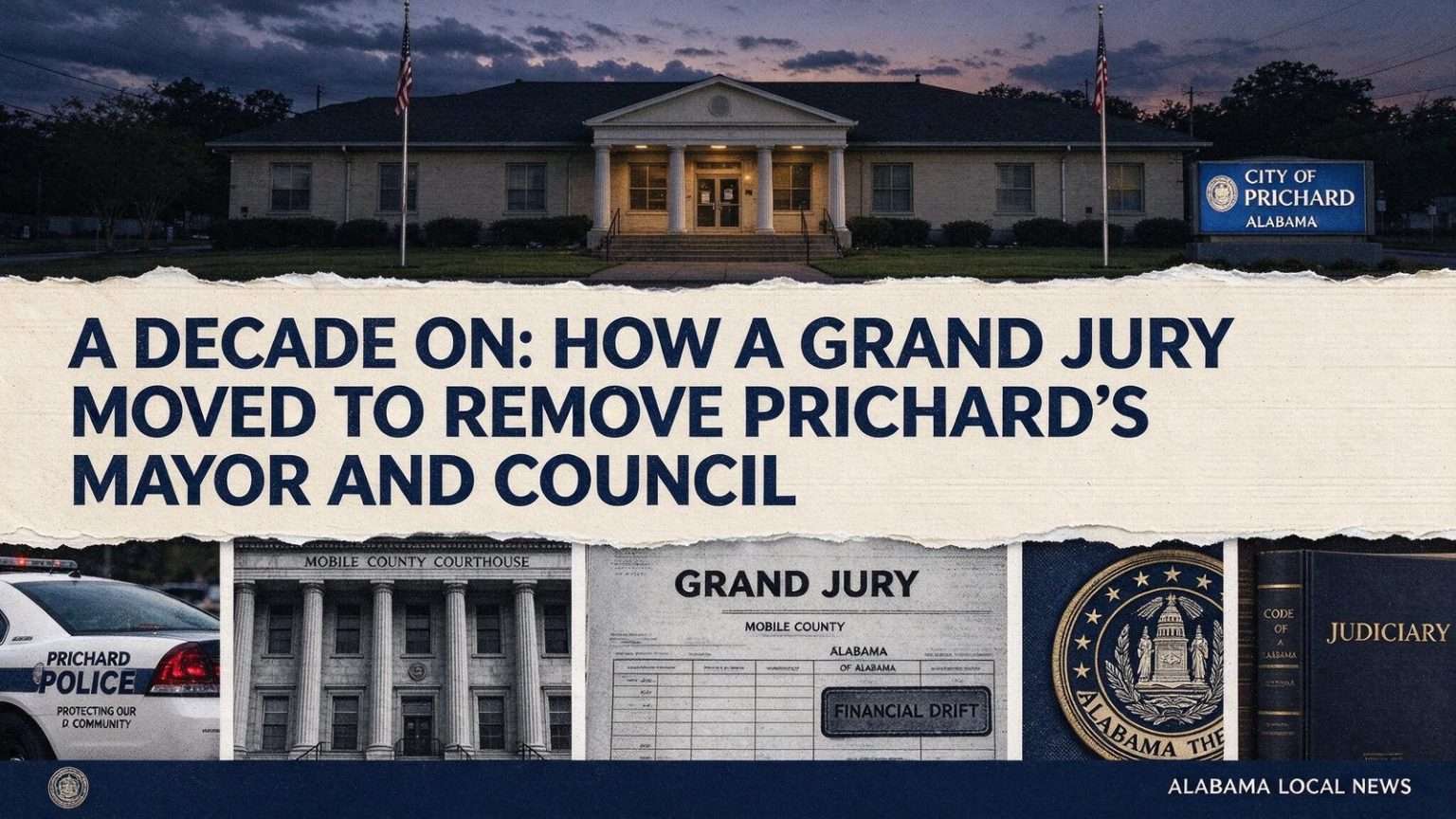
With Mobile’s leaders locked in a public fight over an $18.5 million budget hole, it is worth revisiting an episode from a little more than a decade ago in a neighboring city — one in which a Mobile County grand jury concluded that a municipal government had failed so completely that its elected leadership should be removed from office.
The target was Prichard, and the case grew out of an investigation by Mobile County District Attorney John Tyson Jr., who was then in the early years of a tenure that would stretch across sixteen years. The grand jury called for the dismissal of the mayor, members of the city council and other officials, on charges of willful neglect of duty and incompetence.
A jury trial on the question of removal was scheduled, and Tyson said at the time that his examination of city operations was continuing.
‘Victims of Their Own Government’
“We believe, under the circumstances, the city’s residents have become victims of their own government,” Tyson said as the report was released. “We’re moving as fast as we can to help them.”
The framing set the case apart from ordinary political friction. This was not a dispute over a zoning decision or a personnel hire; it was the county’s chief prosecutor arguing that a city’s residents needed protection from the officials they had elected.
The grand jury did not charge anyone with a crime. What it did instead was arguably more damaging to the officials involved: it accused them of failing to govern with even minimal executive competence.
The distinction mattered legally and politically. Criminal charges require proof of specific unlawful acts; a removal proceeding requires only a showing that those in office could not or would not perform the basic functions of governing. The panel chose the broader path, and in doing so made the entire administration — rather than any single act — the object of the case.
The panel’s findings landed on a city already carrying a run of bad headlines — crime, political infighting, thin revenue and, hovering over all of it, the possibility of bankruptcy. Prichard, a small city wedged between Mobile and Chickasaw, had spent years watching its tax base erode as residents and businesses moved outward, leaving a shrinking population to carry fixed municipal costs that refused to shrink with it.
The Findings
The report laid out a pattern of financial drift:
The mayor, it said, had ignored repeated notices that the city’s monthly operating expenses were exceeding the money available to pay them. The warnings were not secret internal memos; they were recurring statements that told the administration plainly, month after month, that the city was spending money it did not have.
Even so, the city continued to take on additional debt — borrowing that added interest and principal to a ledger already out of balance, deepening the gap the notices kept flagging.
The mayor and council failed to put enough money into the employee pension fund, leaving it underfunded by millions of dollars. For a city of Prichard’s size, a pension shortfall measured in millions was not a rounding error; it was the difference between honoring the retirements promised to police officers, clerks and maintenance workers and defaulting on them.
The city, the report said, carried debt running to many millions more.
In short, the grand jury concluded, the mayor had not tightened the city’s financial belt, and a large share of the blame for the resulting debacle rested with him. Officials, the panel found, had failed to follow prudent business practices — no reserves, no corrective action when warnings arrived, no confrontation with the arithmetic that every month’s spending exceeded every month’s income.
The Defense
The mayor’s attorney pushed back sharply, arguing that his client had spent years trying to solve the city’s finances and had received no cooperation whatsoever from the council.
“We’re looking forward to our day in court,” the lawyer said.
The attorney representing the council declined to comment.
The mayor’s lawyer also offered a bleaker, more fatalistic reading of the city’s condition — one that had less to do with malfeasance than with arithmetic.
Prichard, he said, had lots and lots of expenses, and they kept coming month after month without a break. What it did not have was income. Expenses were plentiful and revenue was scarce, always, and never the other way around. City leaders had kept hoping the relationship would flip. It never did.
“I’d say it’s more a shame than a crime,” he said.
The defense thus split into two arguments: that the mayor had tried and been thwarted, and that the city’s collapse was structural rather than personal — the product of an eroded tax base that no mayor could reverse. The grand jury’s answer was that competence consists precisely of facing such arithmetic honestly, and that the administration had done anything but.
Not every official took the news with resignation. One, unnamed in the report of the proceedings, made clear he had no intention of walking away quietly. He said he was not going to step down, that if he went he would not go easy, and that anyone coming to dislodge him had better bring a lunch and some dynamite.
What Happened Next
What would follow if the officials were in fact removed was, at the time, genuinely unclear. Tyson said that if the impeachment succeeded, he would petition the court to appoint one or more people to run the city’s operations on a temporary basis — a receivership, in effect, with unelected administrators holding the reins while the question of lawful succession played out.
The mechanics were untested. Alabama law provides avenues for removing municipal officers, but running a city without its elected leadership raises a tangle of questions — who signs contracts, who directs the police, how a new council is seated — that no one in the county had occasion to work through in living memory. Tyson’s petition would have made Mobile County the test case for answering them.
The uncertainty itself was part of the pressure. Officials facing removal could not assume that removal meant merely stepping aside; it could have meant watching appointed administrators run their city indefinitely.
The proceedings ultimately led to the impeachment and ouster of Mayor Jessie Norwood and other Prichard officials — an extraordinary intervention by the courts into the affairs of an Alabama municipality, and one of the few times in modern local memory that a grand jury has effectively called for the wholesale replacement of a city’s elected leadership.
The outcome made the case a reference point across the state. Municipal officials elsewhere in Mobile County — and beyond — understood that neglect of basic fiduciary duty was not merely a political liability but, in the extreme, a legal one, with a county grand jury and the district attorney willing to treat fiscal collapse as grounds for removal.
Why It Still Matters
The episode is remembered today mostly as a low point in Prichard’s long struggle with insolvency, particularly the pension fund that the grand jury flagged as dangerously underfunded. That fund would haunt the city for decades. Prichard ultimately entered bankruptcy twice, and the pension obligation — the same shortfall the report identified — remained the central crisis through each of them, outlasting the officials who let it accumulate and reshaping the retirements of the workers who had earned it.
For residents of the Mobile area, the story also reframed the budget fight unfolding in the larger city next door. An $18.5 million hole is, by Prichard’s scale, an enormous sum; by Mobile’s, it was a difficult but survivable gap. The difference between the two cities’ situations was precisely what the grand jury had emphasized in Prichard: whether leadership confronts the shortfall early, with cuts, reserves and honest accounting, or lets it drift until the numbers make the decision on their own.
But the structural warning it contained was never confined to one city. A government that spends more than it takes in, month after month, while borrowing to cover the difference and shorting its retirement obligations, does not solve the problem by hoping the numbers turn around.
Prichard’s grand jury said so in plain language, and the language has aged well. Small municipalities across Alabama continue to face the same forces that hollowed out Prichard’s tax base — population loss, fixed pension obligations, revenue that lags costs — and the city’s impeachment era remains the clearest local demonstration of what happens when the response is denial. The belt, as the report implied, has to be tightened by someone. If the elected leadership will not tighten it, the courts eventually will — or, as Prichard’s later bankruptcies showed, the creditors and the federal bankruptcy judge will do it instead, on terms far less favorable to the city and its employees.