University of South Alabama Mobile
Study Finds Mobile Bay Seawalls Harm Habitat and Raise Long-Term Costs
Researchers at the University of South Alabama found that the vertical seawalls lining much of Mobile Bay's residential shoreline harm natural habitat and cost more to maintain than marsh.
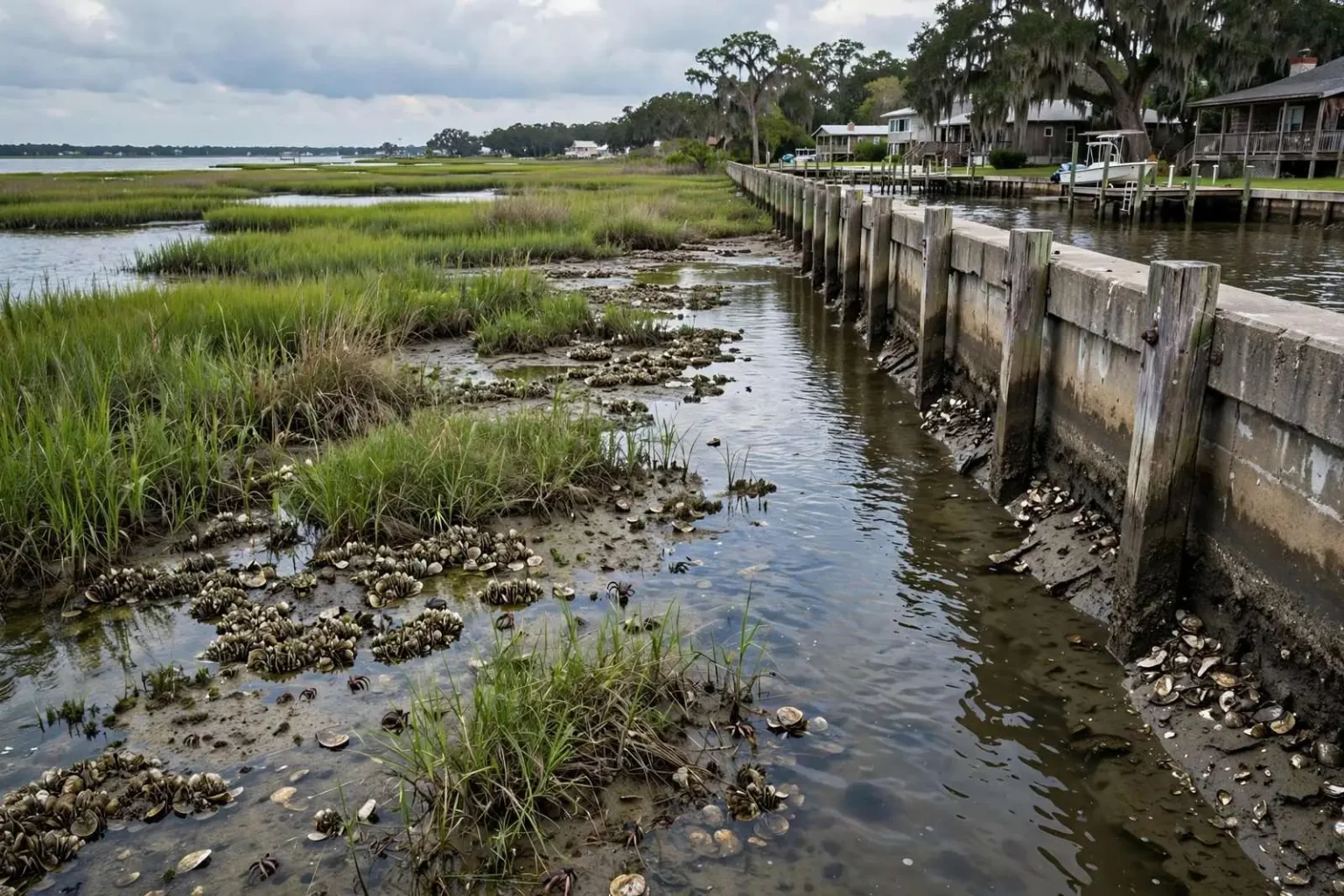
A study by University of South Alabama researchers, released in June 2014, found that the man-made seawalls lining much of the residential shoreline of Mobile Bay could be costly to maintain and damaging to the natural habitat they replaced. The findings challenged a widespread assumption among waterfront property owners that a hardened vertical wall was the surest way to protect land from erosion.
A transformed shoreline
Fifty years earlier, more than 90 percent of Mobile Bay’s shores were lined with salt marshes and other natural habitats, according to the report. To guard against erosion and make it easier to build boat docks, more than 70 percent of surveyed homeowners had since installed vertical walls along the water, dramatically reshaping the bay’s edge.
The transformation described in the study is one of the most complete habitat conversions on the northern Gulf Coast. Mobile Bay’s shallow, low-energy shoreline is precisely the environment where salt marsh thrives — grasses rooted in the intertidal zone, filtering runoff, trapping sediment and sheltering the small organisms at the base of the bay’s food web. Lot by lot, parcel by parcel, that living edge was exchanged for concrete, timber and vinyl walls engineered to do one thing: hold a line.
Researchers found that those seawalls damaged natural habitats and the species that depended on them, including oysters and other mollusks that filter water and serve as a valuable food source. The upkeep of the walls, the report added, cost roughly twice as much as maintaining a natural shoreline.
The oyster connection gave the finding its sharpest edge for the region. Oyster reefs are not merely habitat; they are the bay’s living infrastructure — each oyster filtering gallons of water a day, and the reefs themselves serving as nurseries for the fish and shellfish that support both the ecosystem and the region’s long seafood heritage. A hardened wall eliminates the shallow, vegetated margin where those communities settle, converting a productive edge into a barren one.
A cycle of construction
The study also pointed to a chain-reaction effect along the bay. A survey of 400 homeowners showed that residents were more likely to build a seawall in response to damage caused by a neighbor’s wall, as the hardened structures deflected wave energy onto adjacent, unprotected properties.
That mechanism is the study’s most consequential insight, because it turns an individual property decision into a regional force. A wall does not destroy wave energy; it redirects it. Waves that once spent themselves on a marsh slope bounce off the vertical face and carry their force sideways and downward — scouring the bottom in front of the wall and hammering the neighbor’s unarmored shoreline next door. The neighbor, watching the loss accelerate, responds by building a wall of their own, and the hardened edge marches down the shoreline in a self-propagating chain that no single owner started and none alone can stop.
The survey further revealed significant misinformation about the relative benefits of natural habitat compared with seawalls. Many homeowners, the researchers found, underestimated how effectively marshes and reefs could shield their land.
That perception gap shaped behavior across the bay’s residential frontage. Owners who assumed a marsh was cosmetic — a nice view, but no protection — chose walls in the belief they were making the responsible engineering decision. The research pointed the other way: a healthy marsh absorbs and dissipates wave energy across its width, doing quietly what a wall does brutally, and a reef breaks waves before they ever reach the bank. The property owners’ instinct to armor reflected not evidence but the absence of it.
Alternatives to hardened walls
Rather than simply cataloging the problem, the report offered potential solutions. Salt marshes, the researchers noted, reduce erosion by absorbing wave energy without harming the surrounding ecosystem. Man-made oyster reefs offered another option, dampening waves while restoring habitat for the very shellfish that help keep bay waters clean.
Such approaches, often grouped under the heading of living shorelines, aimed to protect property and habitat at the same time, a contrast to the walls that had come to define so much of the bay’s residential frontage. Where a seawall reflects wave energy and can scour the bottom in front of it, a marsh or reef absorbs that energy, trapping sediment and building rather than losing ground over time.
The living-shoreline concept was already gaining traction in coastal programs around the Gulf when the study was released. A typical project plants native marsh grass along a graded shoreline and, where wave exposure demands it, positions a low sill of oyster shell or manufactured material offshore to take the brunt of the waves. The planted edge then does the long-term work: grass roots bind the sediment, the reef provides substrate for settling oysters, and the whole system grows more protective over time rather than weaker. Restoration groups working on Mobile Bay had used versions of the technique at sites around the bay, demonstrating that the approach functioned in real Gulf Coast conditions rather than only in the literature.
For homeowners, the practical differences were concrete. A living shoreline needs no heavy armoring, accommodates a dock just as a hardened bank does, and improves the fishing and crabbing at the owner’s own waterline. What it asks in return is patience — a marsh establishes over seasons, not days — and an acceptance that the waterline will breathe with the tide rather than sit behind a fixed vertical face.
Costs that add up over time
The report’s emphasis on cost carried particular weight for waterfront owners weighing their options. A seawall is not a one-time expense; it must be repaired and eventually replaced as waves, storms and settling take their toll. By finding that natural shorelines cost about half as much to maintain, the researchers suggested that the cheaper long-term choice was often the one that also did the least harm to the bay.
The arithmetic works against walls for structural reasons. A vertical barrier takes the full force of every wave and storm surge event directly on its face, and any failure — a washed-out section, a settling footer, a hurricane-damaged panel — exposes the land behind it to immediate erosion. Natural shorelines degrade differently: a marsh thins and can be replanted; a reef can be supplemented. The maintenance is gentler, cheaper and less all-or-nothing.
The storm context sharpened the point for Gulf Coast residents. Hurricanes deliver the single most punishing test any shoreline protection faces, and the aftermath of major Gulf storms had repeatedly shown walls failed where shorelines with intact vegetation held their ground. For owners calculating lifetime costs — installation plus decades of repair plus eventual replacement — the study’s conclusion inverted the usual assumption that armor was the economical choice.
What the findings meant for the bay
The study underscored how individual property decisions, repeated hundreds of times around the bay, had reshaped an entire ecosystem. Each homeowner who added a wall in response to a neighbor’s could, without intending to, accelerate erosion next door and chip away at the marshes and oyster beds that once buffered the whole shoreline.
That framing moved the question beyond individual property management to the scale of the bay itself. Mobile Bay is not deep, and its ecology depends on its margins — the shallows, marshes and reefs where the water does its biological work. When the majority of a shoreline is hardened, the loss is not additive but structural: the bay’s capacity to filter its own water, support its fisheries and absorb its own wave energy declines as a system, even if every wall on it was built legally and in good faith.
The findings also carried implications for the agencies and programs that shape shoreline decisions. Permitting authorities, coastal extension agents and conservation groups around the Gulf had been working to put living-shoreline options in front of property owners, and studies like this one supplied the evidence those conversations needed — local data, from local property owners, about what walls actually cost and what they actually do. The survey’s demonstration that misinformation was driving the wall-building cycle gave outreach efforts a specific target: not opposition to protection, but ignorance of the alternatives.
The view from the waterline
For a region whose identity is bound up with Mobile Bay, the study served as a reminder that decisions made lot by lot along the water could add up to broad consequences for habitat, water quality and the long-term cost of living on the shoreline.
The bay is the economic and cultural center of the region that surrounds it — the basis of a seafood tradition that runs back generations, a recreational resource for two counties and the front yard of communities from Spanish Fort to Fairhope to Dauphin Island’s lee. Its shoreline is where the region’s relationship with the water is most literal: the strip where owners decide, one property at a time, whether the bay’s edge remains a living system or becomes a wall.
The University of South Alabama researchers offered those owners a choice the older consensus had obscured. The wall remains an option — sometimes the right one, on high-energy or heavily developed frontage where nothing else will hold. But for the typical low-energy residential lot that rings the bay, the study’s numbers pointed the other way: half the maintenance cost, more habitat, better neighbors downstream and a shoreline that gets stronger as it ages. The June 2014 findings did not order anyone to tear down a wall. They simply made clear, with local data, what the wall had always cost — and what the marsh next door had been doing all along.