Surveys Show Broad Support as Gulf Shores Nears Vote on Hangout Fest Permit
With a June 30 vote approaching on a five-year Hangout Music Fest permit, Gulf Shores officials heard survey results and public testimony showing broad support for the beachfront festival.
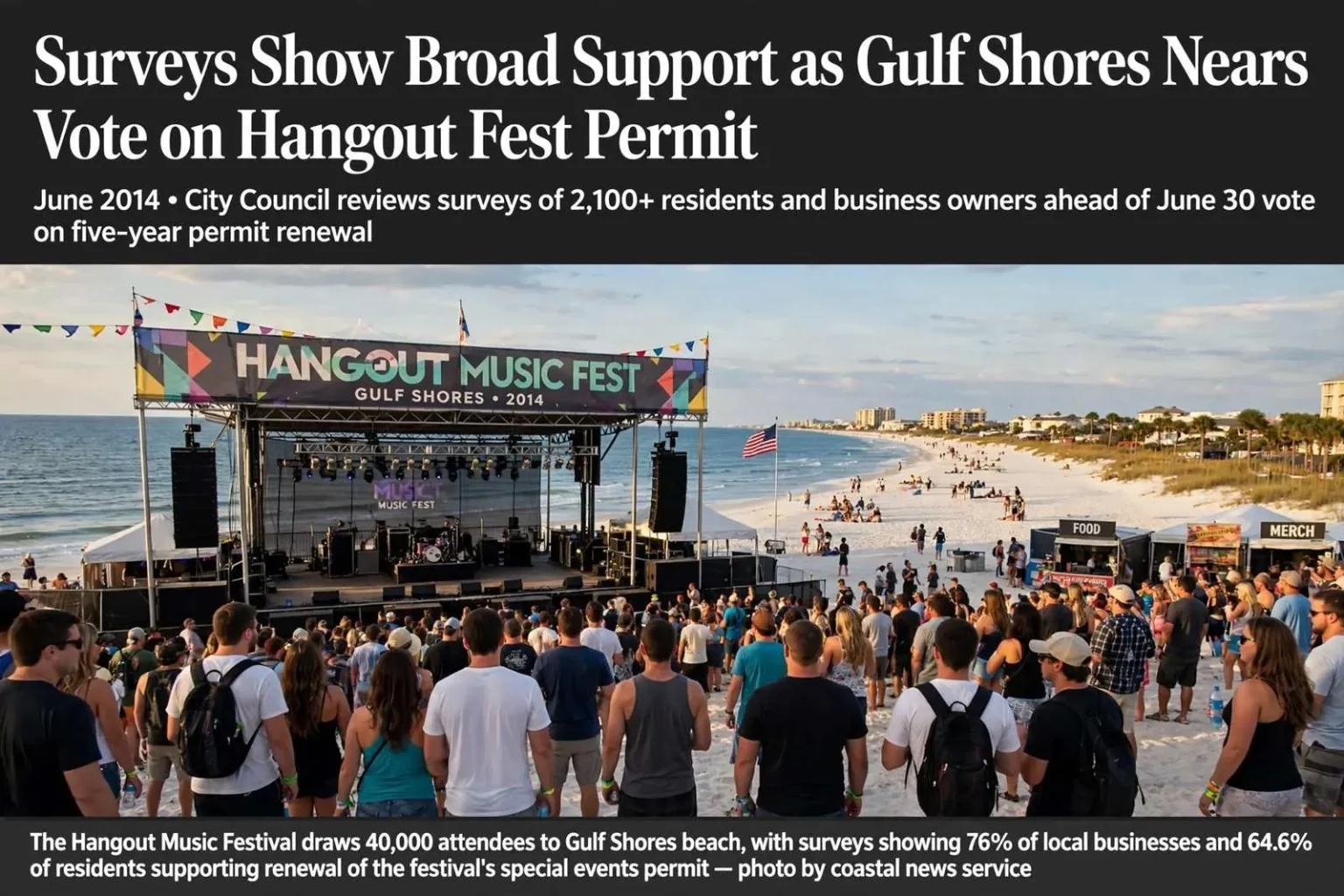
After reviewing survey results from more than 2,100 respondents and listening to more than a dozen speakers, the Gulf Shores City Council was reminded in June 2014 that the Hangout Music Festival had a broad base of support at home and far beyond. City leaders had sought input from the public and the business community ahead of a June 30 vote on whether to extend the festival’s special events permit for another five years. The existing contract was set to end in 2015.
The work session, devoted entirely to the permit question, gave both sides of the issue a full airing before the council committed to a decision that would shape the city’s tourism calendar for the rest of the decade. What emerged from the presentations and the public comment was a portrait of an event that had grown from a gamble into a fixture of the coastal economy.
An Open Door to Public Opinion
“We really are here because we want your comments, your opinions, your input, your requests before we make this very important decision for the future of our community,” Mayor Robert Craft said at the start of the work session. “Come to no conclusion that our mind is made up because I guarantee you it’s not. We’re gaining information.”
The meeting featured presentations on two surveys. A poll of 330 area business owners found that 76 percent believed the festival had a positive economic impact, 64 percent saw a positive community impact and 72 percent supported extending the permit through 2020. An online citizen survey drawing 1,826 respondents showed 64.6 percent in favor of renewal and 78.1 percent crediting the event with a positive economic impact.
The two surveys complemented each other in a way that made the combined picture hard to dismiss. The business poll captured the people whose restaurants, shops and rentals live on the festival weekend directly; the citizen survey captured residents who deal with the traffic, noise and crowds that come with it. When majorities in both groups say an event is worth it, a council has measured public sentiment from the two constituencies most affected.
Public input sessions of this kind are a routine part of municipal life on the Alabama coast, but the scale of this one reflected the stakes. A five-year permit is a long commitment for a city whose beach is its economic engine, and the council’s decision would govern everything from traffic control contracts to beach access during one of the busiest stretches of the visitor season.
The Founder Makes His Case
Festival founder Shaul Zislin then took the podium to review the event’s growth. “I came before this same group five years ago with a crazy idea of let’s do a music festival at the beach here in Gulf Shores,” he said. “And I believe that five years later we delivered.”
Zislin said the fifth annual festival was estimated to have generated a $47.5 million economic impact in and around Gulf Shores, based on 40,000 fans attending, up from an estimated $31 million tied to 27,000 attendees in 2013. He said 80 percent of visitors came from outside Alabama, with tickets sold across all 50 states and in 30 countries.
Those attendance figures put the Hangout in the company of nationally significant destination festivals. An event that draws four in ten attendees from beyond state lines functions less like a local fair and more like an export: out-of-town money flowing into hotels, restaurants, gas stations and shops across Baldwin County during a shoulder-season weekend in May. Economic impact estimates of that kind are built on multipliers that critics can question, but the direction of the flow is not in dispute when the majority of the crowd sleeps and eats somewhere else.
He also pointed to the festival’s reach through social media and broadcasts as far away as Brazil, Chile and Argentina, arguing that such exposure carried long-term value for the community that traditional surveys could not fully capture. Images of Gulf Shores’ white sand broadcast to international audiences are, in effect, tourism advertising the city does not pay for, and coastal promoters have long argued that the reputational dividend compounds over years.
How the Festival Grew From a Gamble
When the Hangout debuted in 2010, a music festival on a public beach was untested ground for Gulf Shores. Cities that host events of that scale take on costs that are easy to see — overtime, cleanup, traffic engineering — against benefits that are diffuse and easy to doubt. The first years answered those doubts by building an audience that returned annually and grew, and by 2014 the event had become the kind of booking that national touring acts scheduled around and that fans planned vacations upon.
The growth curve Zislin presented to the council tracked the broader arc of the coast’s recovery as well. Gulf Shores had spent years rebuilding from the 2010 BP oil spill and the tourism disruption that came with it, and a signature event that put the city’s clean beach on national broadcasts arrived at a moment when the community needed exactly that kind of visibility.
Safety, Students and Local Voices
Zislin credited the city’s police and fire departments with refining best practices over five years to minimize problems, saying the festival had seen no serious violent crime over that span. The safety record was a central element of the case for renewal, since the objection most often raised against large beach events is not the music but the crowd management that comes with tens of thousands of young visitors concentrated on a public beach for three days.
He also highlighted the Hangout Education Foundation’s $25,000 donation to the Gulf Shores High School Career Academy, which gave students mini-internships during the event. Career academy coordinator Susan Nelson urged the council to preserve those opportunities. “We’ve got to keep this,” she said, describing how students worked on audio, video and design projects tied to the festival.
The career academy connection gave the debate a dimension beyond tourism dollars. A festival that doubles as a worksite for high school students interested in production, media and event management offers something a convention center cannot: a large, complex operation staged in the students’ own backyard every spring, with roles real enough to put on a résumé. Programs like the academy are built around exactly those partnerships, and educators in Baldwin County have increasingly tied classroom work to the coast’s hospitality and entertainment industries.
Roughly 15 people addressed the council, with an overwhelming majority in support. Among them was former Orange Beach Mayor Pete Blalock, a longtime island resident and business owner, who called the renewal “an easy decision” and credited the festival with restoring a summer weekend of business to the coast.
Blalock’s endorsement carried particular weight because it came from across the municipal line. A former mayor of Orange Beach vouching for an event staged in Gulf Shores reflected how the festival’s benefits spill over city boundaries — the visitors it draws fill rooms and tables throughout the island communities, and the two beach cities share the same tourism economy even as they compete for developments within it.
What a Five-Year Permit Meant
The permit question was, at bottom, a question about what kind of city Gulf Shores intended to be. Extending the contract through 2020 would lock in a May weekend that transforms the public beach into a concert venue annually, complete with the security costs, road closures and beach closures that entail. Declining to extend would reclaim the weekend but forfeit an event that had grown into one of the region’s most recognizable brands.
Councils along the Alabama coast have faced versions of that trade-off before, weighing the disruption of large events against the spending they bring. What distinguished the Hangout debate was the depth of the documentation: two surveys, a public hearing, a safety record and a business case all assembled before the vote rather than after. Craft’s insistence that no minds were made up gave opponents their opening, but by the end of the session, the opposition had offered no comparable body of evidence.
The deliberations also illustrated the mechanics of special events permitting on the coast. A permit of this scale requires coordination among police, fire, beach maintenance and state agencies, with the city retaining regulatory leverage over sound, hours and security staffing. Those terms are where a city captures much of the value of hosting — and where residents’ complaints, if the surveys had gone the other way, would have found their remedy.
For the residents who packed the work session, the bottom line was straightforward: the festival had put Gulf Shores on national tour schedules, filled the island’s hotels in May and given the high school a working classroom on the beach, and the organized opposition to continuing it amounted to little more than the ordinary friction of hosting tens of thousands of visitors. The council’s June 30 vote would decide whether the “crazy idea” that Zislin had brought five years earlier would keep its place on the calendar through the end of the decade.