Sea Turtle Nesting Reaches Its Annual Peak Along Alabama’s Beaches
Volunteers with Alabama's Share the Beach program have documented 55 sea turtle nests so far this season as nesting activity reaches its June and July peak along the Gulf Shores, Orange Beach and Fort Morgan coastline.
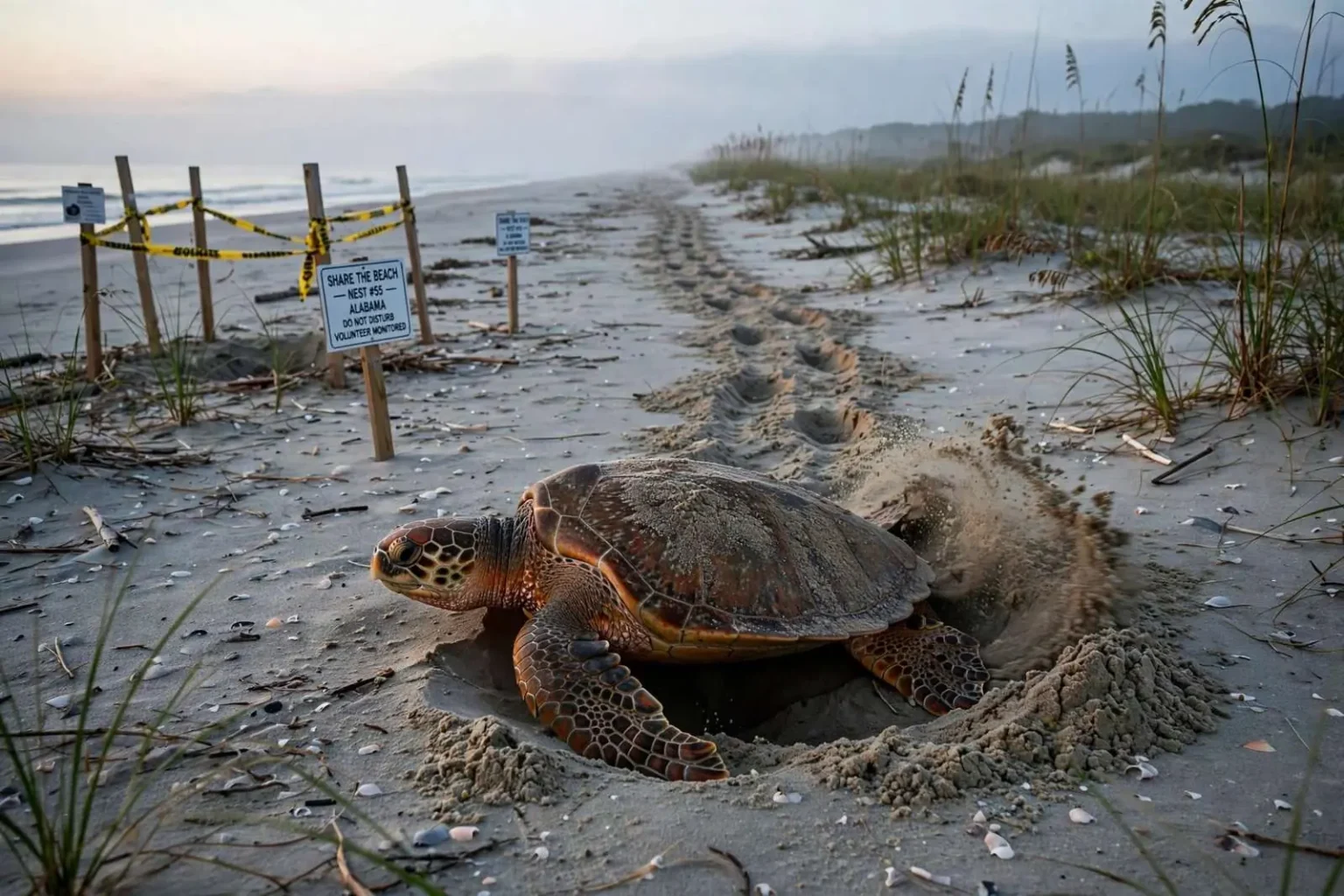
Alabama’s beaches are in the busiest stretch of their sea turtle nesting calendar, and the volunteers who patrol them each morning are asking residents and visitors alike to make a few small changes that carry outsized consequences for one of the Gulf Coast’s most vulnerable species.
As of early July, the Share the Beach program had documented 55 sea turtle nests along the Alabama coastline this season. Nesting officially runs from May 1 through October 31, but the overwhelming majority of activity is concentrated in June and July, with most nesting complete by the end of August. That makes the middle weeks of summer the period when a single careless decision on the sand — a beach chair left overnight, a hole dug and abandoned, a phone flashlight waved at something moving in the dunes — can undo work that dozens of people have invested since spring.
What happens on an Alabama beach at night
Nesting is a slow, exhausting process. A female sea turtle hauls herself out of the surf under cover of darkness, crawls above the high tide line, excavates a chamber in the sand with her rear flippers, deposits her clutch of eggs, covers the nest, and then works her way back to the water. The entire sequence can take well over an hour, and the animal is essentially defenseless the whole time.
Anything that startles or disorients her during that window can cause a false crawl, meaning she returns to the Gulf without laying at all. Bright lights, camera flashes, loud noise and people crowding too close are all common causes. A false crawl is not merely a missed opportunity for that night — an exhausted female may expend energy she needs for future clutches, and the abandoned attempt leaves a track that volunteers must read and document the next morning to distinguish it from a successful nest.
Volunteers with the program walk the beaches at dawn through the nesting season, searching for the distinctive tracks, marking and documenting new nests, and checking on existing ones. Their morning patrol is often the only record of what happened on the sand overnight, and it is how the season’s nest count — now at 55 — is built nest by nest.
Most of the nests laid on Alabama’s beaches belong to loggerhead sea turtles, the species that dominates nesting along the northern Gulf Coast. Loggerheads are protected under the Endangered Species Act, and the nesting population that uses Alabama and the Florida Panhandle is managed as part of the broader Gulf recovery effort. A nest laid in Gulf Shores or on the Fort Morgan peninsula is not a local curiosity — it is a data point in a regional population that biologists track for decades.
The numbers behind the urgency
Roughly one in every 1,000 hatchlings is estimated to survive to adulthood. The rest are lost to predators, exhaustion, disorientation and hazards they encounter before they ever reach open water. That statistic is the single best explanation for why volunteers are so insistent about beach etiquette. Every obstacle removed from a hatchling’s path measurably improves its already slim odds.
Hatchlings emerge from the nest and orient themselves toward the brightest horizon, which in a natural setting is the moonlit and starlit water. Artificial lighting from beachfront properties, parking lots, flashlights and phone screens can reverse that instinct entirely, sending an entire nest of hatchlings away from the Gulf and toward the dunes, the roads and the lighted balconies behind them.
That misdirection is the most lethal hazard humans create on a nesting beach. A group of hatchlings that crawls inland instead of seaward can dehydrate in the morning sun, be crushed by vehicles on beachfront roads, fall into storm drains or be picked off by predators before anyone notices. It is also the hazard most easily prevented, because the fix is behavioral: lighting can be shielded, moved or switched off during the hours when nests are active, and no one needs a phone flash to observe a hatching that is already underway.
How the nests are protected
Once a nest is confirmed, volunteers stake and sign the area so the public knows to keep clear, and the nest is then monitored through incubation, which lasts roughly two months on Gulf Coast sand. The monitor watches for signs of emergence, records how many hatchlings leave the nest, and after hatching excavates the chamber to account for eggs that did not develop and any hatchlings still trapped inside. That final excavation is where the season’s production numbers come from — hatched eggs, unhatched eggs and live hatchlings rescued.
The program operates in cooperation with the Alabama Department of Conservation and Natural Resources, and its volunteers undergo training before they are authorized to work around nests. The rules that govern their work — what they may handle, how a nest may be relocated, when a hatchling may be assisted — exist because sea turtles are federally protected and every intervention has to be documented and justified. Members of the public who find a hatchling in trouble are asked to call the program rather than intervene themselves, since well-meaning handling can do more harm than the problem it is meant to fix.
The nest count is also read in context. Alabama’s coastline is short compared with Florida’s, so every nest documented here matters proportionally more to the regional tally. Season totals fluctuate naturally from year to year — female loggerheads typically do not nest every season, returning on multi-year cycles — which is why volunteers and biologists caution against reading too much into a single summer’s number. The more reliable signal is the trend over decades, and that trend depends on nests laid this month surviving to produce hatchlings.
What beachgoers are asked to do
The requests that volunteers repeat each summer are deliberately simple, because they rely on thousands of casual visitors rather than a handful of specialists. Beach furniture, tents and toys should be removed from the sand each evening rather than left in place, since obstacles can block a nesting female’s crawl and later trap hatchlings. Holes dug in the sand should be filled in before leaving the beach — a hatchling that tumbles into a deep hole cannot climb out on its own.
Visitors are asked to keep beachfront lights shielded or turned off at night during nesting and hatching season, to avoid using flashlights or camera flashes near a turtle or a nest, and to keep their distance from any turtle they encounter after dark. Occupied nests are marked with stakes and signs, and the markers should be left alone even when a photograph would be tempting.
Along much of Alabama’s coast, those practices overlap with local ordinances adopted in recent years in Gulf Shores and Orange Beach — rules that ban leaving tents and umbrellas overnight, require holes to be filled and restrict lighting on the beachfront — measures adopted for general beach management that also serve the turtles directly. Visitors who follow the posted rules are, in practice, already doing most of what the nesting season requires of them.
The weeks ahead
The peak of nesting is also the prelude to hatching season. Nests laid in June and early July will begin producing hatchlings from late July through August and into September, which means the second half of summer is when the lights-out discipline matters most on the beachfront. A nest that survived its two-month incubation can still lose its entire output in a single night if the hatchlings emerge under a beach lined with unshielded lighting.
Volunteers will continue their dawn patrols through the summer, adding to the nest count as late-season females come ashore, and then shift to hatching watches as the first nests approach emergence. The season formally runs through October 31, and stragglers — late nests laid in August or September — may not hatch until the fall, when the beach is cooler and the crowds thinner but the darkness discipline is just as important.
For the species, the arithmetic is unforgiving. The one-in-1,000 survival estimate means that the 55 nests documented so far this season represent a few thousand hatchlings, of which only a handful will ever return to these same beaches as nesting adults years from now. Sea turtle nesting is a long-horizon enterprise: the females that come ashore in Alabama tonight hatched decades ago, and the population’s future is being decided quietly, one clutch at a time, on sand that most people see only as a place to spread a towel.
Why local participation matters
The Share the Beach program is built on volunteers, and its capacity to monitor 55 nests — and the dozens that may follow before the season ends — depends on residents along the coast who give their mornings to the work. Training sessions prepare new volunteers for the season, and the program’s reach along the Fort Morgan peninsula, Gulf Shores, Orange Beach and the other Gulf-front communities is a reflection of how many people have taken part.
But the program cannot patrol a beach at 2 a.m., and it cannot switch off a porch light. The behaviors that decide whether a nesting season succeeds happen in the hours when no volunteer is present: the lights a beachfront renter leaves burning, the tent frame a family leaves in the dunes, the hole a child digs and abandons at the end of a long beach day. Those are the decisions the program asks for, and they cost nothing.
The volunteers’ message as the season reaches its peak is consistent with every summer before it: the turtles have been nesting on these beaches for longer than any of the towns behind them have existed, and the difference between a good year and a poor one is measured not in grand gestures but in the small, repeated courtesies of the people who share the sand. Fifty-five nests are already in the ground. What happens to them over the coming two months is, to a remarkable degree, up to the humans who walk past them.