A Sponsor at Last? Gulf Coast Classic Said to Be Near a $1.5 Million Deal
Reports circulated that the Gulf Coast Classic was nearing a three-year, $1.5 million title sponsorship, badly needed good news for an event that survived a bruising fight over Mobile city money.
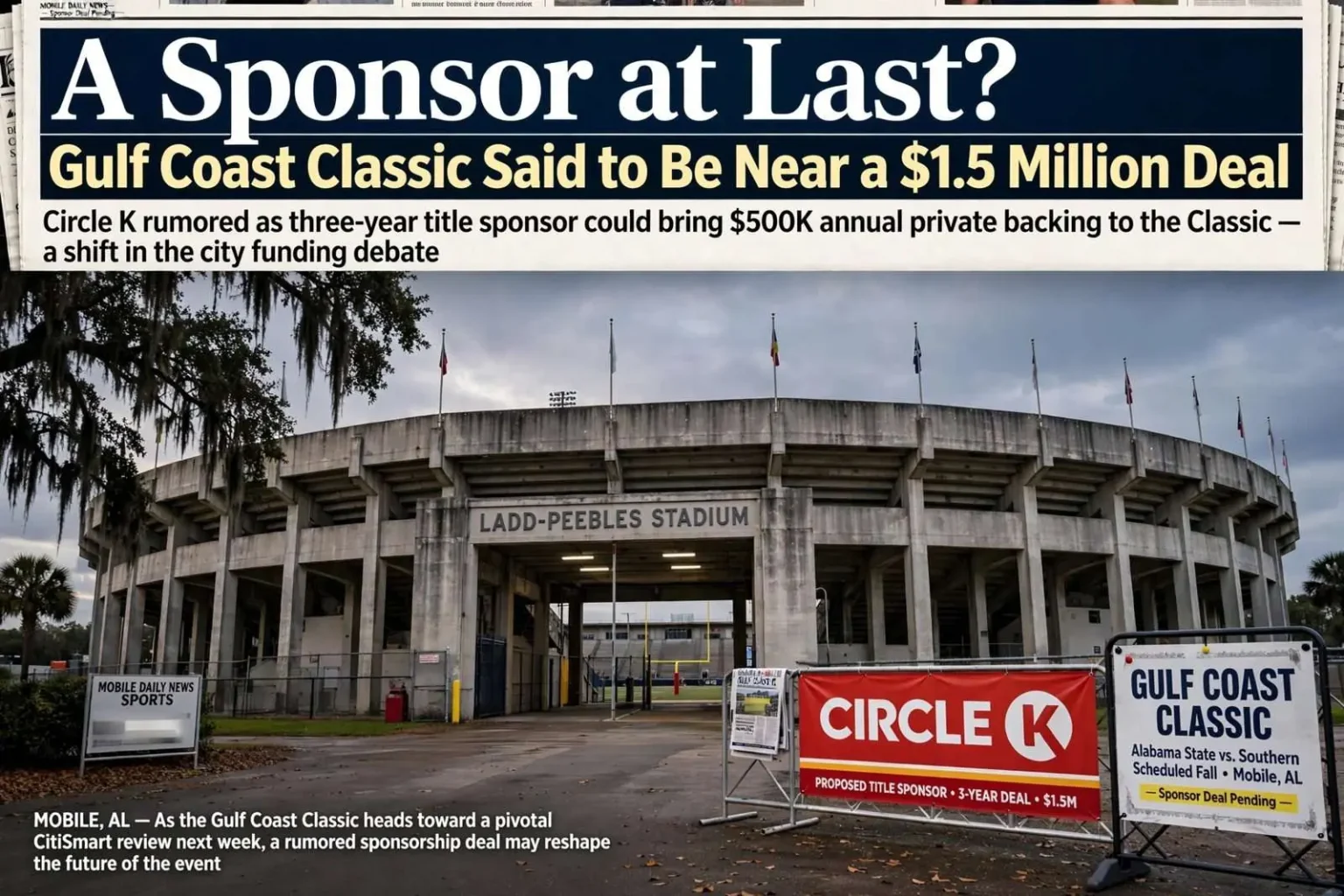
The Gulf Coast Classic, an event that has spent more time defending its city funding than celebrating its football, may finally have something to celebrate. Reports circulating in Mobile suggest the game is nearing terms with a title sponsor — said to be Circle K, in a three-year agreement worth a reported $1.5 million. Several calls to the convenience store chain’s regional marketing director were not returned, so the deal remains a matter of rumor until signatures land.
If the deal closes as described, it would answer the sharpest criticism leveled at the event: that a game requiring six figures of taxpayer support had failed to attract private money of its own. A title sponsor at that scale would put roughly $500,000 a year of private backing behind the Classic — money that changes both the event’s balance sheet and the argument for whether the city should keep writing checks to it.
The Fight That Preceded It
The Classic, played last fall at Ladd-Peebles Stadium between Alabama State and Southern, has been the most scrutinized item in the city’s events budget. Mayor Sam Jones budgeted $450,000 for the 2008 game — a startling jump from the $40,000 appropriated the year before. After sharp debate, the City Council settled on $275,000. The council’s cut was a compromise, but even at that reduced figure the Classic consumed more public money than events with far longer histories in Mobile.
The argument split the council along lines that had less to do with football than with philosophy: whether the city should nurture fledgling events until they can stand on their own, or reserve its money for events that already demonstrate a return. The first camp saw a young game with a historically Black college pairing and real potential — the kind of event a city grows into an asset. The second saw a new event demanding veteran-event money on nothing more than a promise.
The fight had collateral damage. Senior Bowl officials, whose own funding requests had been turned down two years running, watched a brand-new event collect a six-figure check and concluded they were being taken for granted after nearly six decades in Mobile. The Senior Bowl is one of Mobile’s signature institutions — a game that fills hotels and restaurants each January with scouts, coaches, media and fans — and its officials’ frustration gave the Classic debate a sharper edge: the city was funding an event with no track record while shorting one with a fifty-year one.
The Economic Impact Question
Whether the Classic delivers for Mobile remains contested. Leaders in the area hospitality industry — the hoteliers and restaurateurs who would notice a football crowd if there were one — suggested the business generated by the game was minimal. For an event whose justification rests largely on filling hotel rooms and restaurant tables, that assessment lands hard: if the visitors are not coming, or are not staying overnight, the promised economic return is not appearing on the merchants’ side of the ledger.
That assessment cuts to the heart of the city’s performance contract system, under which events must justify public money with measurable results. Performance contracts are the mechanism by which Mobile attaches conditions to event funding — attendance targets, hotel-night commitments, reporting requirements — so that a subsidy is a contract with expectations rather than a gift. Whether the Classic had met the terms of its contract was precisely what the council had been unable to establish to everyone’s satisfaction.
In the current fiscal year, Mobile holds 81 performance contracts worth more than $3.5 million, a figure that excludes events funded through the strategic plan budget, such as BayFest. The size of that portfolio is the context for the Classic debate: event funding is a substantial, recurring line in the city’s budget, and every dollar committed to one event is a dollar not available to another. With 81 contracts outstanding, the council’s philosophical split is effectively a standing argument about how the whole portfolio should be managed.
Next: A CitiSmart Review
The event’s owners, the Gulf Coast Scholar and Sports Foundation, are scheduled to meet next week in a CitiSmart session — the accountability process the Jones administration installed to review events before deciding whether to fund them. The session will assess the Classic, its economic impact and its worthiness for future funding. CitiSmart reviews are the administration’s effort to move event funding decisions from political bargaining toward documented performance, and next week’s session will be the Classic’s first formal test under the new process.
A signed title sponsor would change the tenor of that conversation considerably. An event that can point to $500,000 a year in private backing is asking the city to be a partner. An event that cannot is asking the city to be a patron. The distinction matters in a budget year when Mobile, like every city on the Gulf Coast, is counting dollars carefully. Recession-year budgets have already forced the council to weigh public safety payrolls against discretionary spending, and every appropriation for an event is money not spent somewhere else.
For the Foundation, the arithmetic of the rumored Circle K deal is straightforward: $1.5 million over three years would nearly cover what the city has been asked to contribute in a single season, and it would give the Classic the commercial identity — a named sponsor on the game’s title — that college football events across the country use to sell tickets, broadcast packages and hospitality. For the city, the same arithmetic raises the counter-question: if private sponsors are now willing to pay, how much longer should the public check be needed at all?
What a Title Sponsor Would Mean
College football’s bowl and classic games live or die on sponsorship economics, and the Classic’s rumored deal would bring it in line with the model that sustains similar games elsewhere. A title sponsor buys naming rights, marketing placement and hospitality inventory, and in exchange the event gains a revenue stream that does not depend on the municipal budget cycle. For a game still establishing its identity in a crowded fall calendar — one that competes for attention with high school playoffs, the Senior Bowl season and the region’s college programs — a commercial brand on its title is also a signal to recruits, athletic departments and ticket buyers that the event intends to last.
Circle K, for its part, operates hundreds of stores across the Gulf South, and college football events offer convenience retailers exactly the kind of foot traffic and regional visibility their marketing budgets pursue. The chain’s reported interest would also mark a notable endorsement: a national brand placing a three-year bet on a Mobile event that local critics spent the past year calling a bad investment.
Whether the reported terms hold is another matter. Until the Foundation and the chain confirm the agreement, the $1.5 million figure and the three-year length remain the accounts circulating in the city’s political and business circles — accounts that have a way of shifting before contracts are signed. Several calls to the convenience store chain’s regional marketing director were not returned, and the Foundation’s position will become clearer at next week’s CitiSmart session, where event ownership is expected to present its case for continued city support.
The Stakes for Next Year’s Budget
The timing of the review is not incidental. Mobile’s budget process for the coming year is unfolding against the same recession-driven constraints that reshaped the current one, and the council’s discretionary items — events among them — are the natural targets when payroll and public safety obligations have to be met first. An event that demonstrates private revenue and measurable hotel business enters that conversation with a defense; an event that cannot is negotiating from the weakest possible position.
That is the corner the rumored sponsor deal would turn. With $500,000 a year in private backing, the Classic’s request for city support becomes a co-financing ask — a fraction of the cost of staging the game, matched against a sponsor’s commitment — rather than a full subsidy. Without it, the event faces a CitiSmart review armed only with attendance figures and promises, in a city where 81 performance contracts are already competing for the same discretionary dollars.
The Classic’s organizers have argued all along that the game needs a runway — that no new event becomes self-sustaining in its first two seasons, and that the city’s investment in the Classic is an investment in a future fixture of Mobile’s fall calendar. Its critics have answered that the runway has so far produced neither measurable tourism nor private revenue, and that the city’s obligation is to taxpayers, not to an event’s ambitions. Next week’s session will force that argument into a structured format for the first time, and the answer to the sponsor question — signed or still rumored — will shape how much room the Foundation has left to make its case.