Sheriff Nomination in Doubt Again as Judge Questions Davon Grey’s Filings
Probate Judge Don Davis cited attorney general's opinions suggesting Davon Grey's failure to meet campaign disclosure deadlines could disqualify him as the Democratic nominee for Mobile County sheriff.
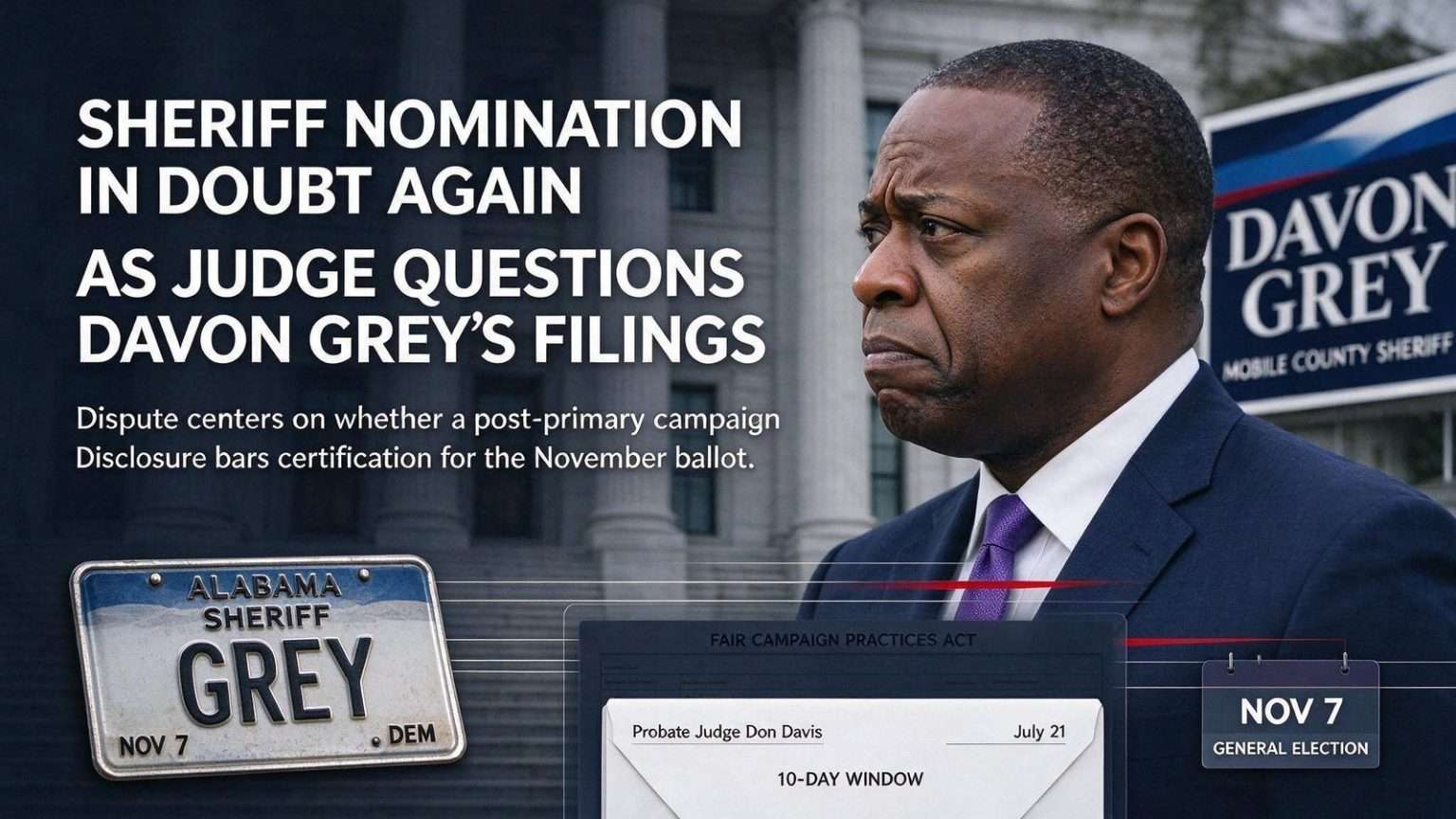
The Democratic nomination for Mobile County sheriff was in doubt once more, as Probate Judge Don Davis raised fresh questions about whether nominee Davon Grey could lawfully appear on the November ballot. In a recent letter to Grey and local Democratic Party officials, Davis cited attorney general’s opinions suggesting that Grey’s failure to comply with the state’s campaign disclosure laws could disqualify him from certification as a candidate.
The letter gave party officials 10 days to resolve the matter before Davis would seek a declaratory judgment in Mobile County Circuit Court the following week. Grey, the magistrate supervisor for the city of Prichard, said Wednesday he had not yet seen the July 21 letter.
The threat of a declaratory judgment is what gave the letter its weight. A probate judge who certifies candidates does not ordinarily decide contested legal questions on his own; by asking a circuit court to declare Grey’s status, Davis was moving the dispute from party rooms and correspondence into the courts, where it would be resolved on the record and on the law rather than on political judgment.
A disclosure law with sharp teeth
Alabama’s Fair Campaign Practices Act requires candidates who raise more than $1,000 to file financial disclosure forms 45 days before a primary or election and again between five and 10 days before the vote. Grey’s 45-day report showed contributions totaling more than $5,000. The statute is unforgiving on the point: “a certificate of election or nomination shall not be issued to any person who shall fail to file any statement or report required by this chapter.”
A 2004 attorney general’s opinion on a similar question reinforced the law, concluding that a primary candidate who failed to file a required report before the election “is disqualified, and a certificate of nomination should not be issued.” Grey filed his 10-to-five-day pre-election disclosure on June 12, nearly a week after the primary.
That timing is the crux of the dispute. The statute’s disqualification language attaches to a candidate who fails to file a required statement before the vote; a filing made after the fact cannot, under the attorney general’s reading, cure the failure. Grey’s camp could argue that the report was eventually filed and that voters had the information before the general election; the judge’s letter rested on the stricter view that the deadline is the law, and that missing it voids the certification regardless of what follows.
The Fair Campaign Practices Act was adopted in 1988 as part of a package of ethics reforms meant to bring Alabama’s campaign finance out of the shadows. Its disclosure deadlines, its penalty provisions and its enforcement history have generated recurring disputes in county races across the state, where candidates without professional campaign staff routinely trip over the filing calendar.
A nomination already contested once
Grey had been briefly removed from the ballot in late June after party leaders upheld a challenge to his primary win. The Mobile County Democratic executive committee then voted to fill the resulting vacancy with Grey himself.
“We have not had a properly filed contest with us,” said Zac McCrary, communications director for the Alabama Democratic Party, adding that the courts, rather than a single attorney general’s opinion, should settle the question. “Whatever the court interprets, we will certainly do that.” The state party’s position put it at odds with the local leadership that had upheld the original challenge, and it framed the dispute as a legal question for a judge rather than a political question for a committee.
Grey had won decisively in a five-candidate Democratic primary on June 6, taking about 11,200 votes, or more than 57 percent, without a runoff. The runner-up, bail bondsman Clint Ulmer, drew roughly 3,500 votes, or just under 18 percent, and then contested the outcome. The executive committee upheld Ulmer’s complaint and declared the slot vacant before turning around and filling it with Grey, a result some members hailed as the people’s will prevailing over technicalities.
That sequence — remove the winner, then reappoint the same man — left the nomination in procedural limbo. Under party rules, a vacancy created by a successful challenge is filled by the executive committee, and the committee’s majority preferred Grey to any of the four runners-up. But the maneuver invited exactly the scrutiny it received: if the primary result could be overturned on technical grounds and its winner restored by vote, what technicalities still bound anyone?
An irony, and precedent
There was irony in the dispute. Ulmer himself had been tardy in filing his campaign’s financial disclosure, though he managed to submit it before the election. Republican incumbent juvenile Judge Pamela Millsaps was likewise late with her pre-election report, filing it the Monday before the Tuesday primary.
Precedent had generally treated such late-but-pre-election filings as a lesser, misdemeanor-level offense subject to a possible fine, rather than grounds for disqualification, the distinction that now hung over Grey’s candidacy. The difference between Ulmer’s and Millsaps’s situations and Grey’s was timing: they filed late but before the vote; he filed after it. Under the attorney general’s 2004 opinion, that gap is everything — the disqualification attaches to a failure that stands at the moment the certificate would issue.
The distinction has real consequences for how the ballot is built. If late-but-timely filers face a fine and post-election filers face disqualification, then a candidate who misses the deadline by days and files late is in a categorically worse position than one who files on the eve of the vote. The courts were being asked to say whether that is what the Legislature intended, or whether the harsher reading should give way to a remedy that lets the voters decide.
Should Grey ultimately be eliminated, local party chairman Bob Beckerle would presumably again convene the executive committee to fill the sheriff’s line on the November ballot. The committee’s options would include any of the other three primary candidates — the race had drawn five Democrats — or a new name altogether, subject to the calendar and whatever the court decided about how the vacancy arose.
The stakes for the sheriff’s race
The eventual Democratic nominee was set to face Republican Sam Cochran, a first-time candidate who won his party’s nomination shortly after retiring as chief of police for the city of Mobile. Cochran’s nomination gave the Republicans a candidate with name recognition across the county and a career’s worth of law enforcement credentials, in a race for an office that has historically leaned Democratic in Mobile County but that an underfunded or disputed Democratic nominee could not count on contesting seriously.
The sheriff’s office is one of the largest law enforcement agencies in Alabama, running the county jail, patrol and investigations across unincorporated Mobile County and providing support to municipal departments. The politics of the office have historically followed the county’s Democratic heritage, but the 2006 contest had been closely fought, and a disjointed Democratic summer — a challenged primary, a contested reappointment, a certification fight — was the kind of backdrop that shapes a general election before either campaign begins.
The general election was scheduled for November 7. The calendar pressed on everyone: the probate judge’s 10-day window, then a potential court fight, then a possible committee meeting to name a replacement, all while ballots had to be printed and absentee voting prepared. Ballot deadlines are unforgiving in the other direction — a county that certifies a candidate later found ineligible faces its own crisis, which is why Davis sought a judicial answer before certifying anything.
What the fight turned on
Stripped to its essentials, the dispute posed a plain legal question with a political ending: does a candidate who files a required campaign disclosure after the deadline lose the nomination automatically, or can the party and the courts remedy the failure? The attorney general’s opinions said yes to the first. The state Democratic Party wanted the second, and said so through its spokesman: let a court interpret the law, and the party will follow.
The episode also illustrated how Alabama’s disclosure rules operate at the county level, where campaigns are staffed by volunteers and the filing calendar is easily missed. The Fair Campaign Practices Act imposes real deadlines with real consequences, and the sheriffs’ races — high-spending, crowded primaries — generate the most violations of it. Candidates who win their primaries by large margins have repeatedly discovered afterward that the paperwork, not the vote count, determines whether their name appears on the November ballot.
Grey, for his part, maintained that he had won the primary and that his eventual filing satisfied the law’s purpose of informing voters. His opponents’ position was that the statute’s language allowed no such cure. Between them stood a probate judge who wanted a court, not a committee room, to make the call — and a general election calendar that gave everyone involved little time to litigate it.
Whatever the circuit court decided, the case was likely to leave its mark on how county candidates in Mobile handle their disclosure filings. The lesson that emerged from the summer — that a primary win does not survive a missed filing deadline, and that an attorney general’s opinion can carry a candidacy off the ballot — would be absorbed quickly by the next field of candidates for sheriff, and by the party officials who certify them.