Vigor High Students to Host Mayoral Candidate Forum in Prichard
A group of teenagers from C.F. Vigor High School planned to host a mayoral candidate forum in Prichard, part of a civic project aimed at improving the city they call home.
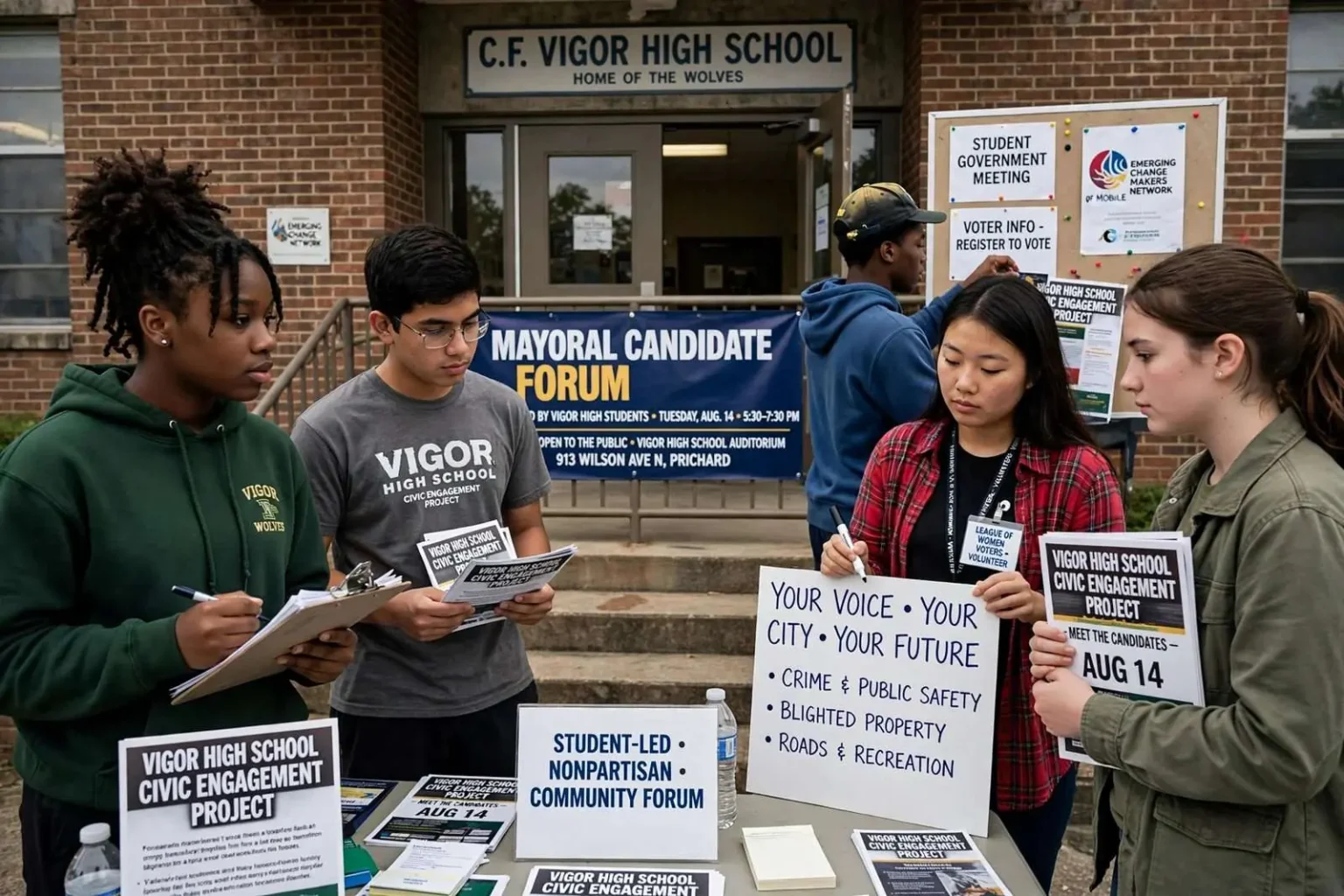
A group of teenagers from C.F. Vigor High School prepared to step into the civic arena this month, planning to host a mayoral candidate forum on Tuesday, Aug. 14, from 5:30 to 7:30 p.m. at the Vigor High School Auditorium at 913 Wilson Ave. N in Prichard. The event was open to the public, and organizers encouraged residents from every neighborhood in the city to come hear directly from the candidates seeking to lead it.
For the students involved, the evening represented far more than another entry on a school calendar. It was the product of weeks of study, planning and rehearsal, and it placed a group of teenagers in the rare position of convening a public conversation about the future of a city that many observers had quietly written off.
A City at a Crossroads
Prichard, which sits just north of Mobile in Mobile County, has had a difficult stretch. The city has struggled financially for years, a period marked by hard budget choices and the familiar companions of urban decline: vacant houses, uneven city services and the steady departure of families in search of safer streets and stronger opportunities elsewhere.
It is against that backdrop that the perception took hold — the one the students found most troubling — that in order to survive Prichard one must get out of Prichard. The teenagers, seniors, juniors and sophomores alike, set out to challenge that idea, not with slogans but with work, aiming to improve their city so that residents would want to stay and raise their families there.
Hosting the forum at the school’s own auditorium on Wilson Avenue carried its own symbolism. The students were not asking the community to come to them; they were inviting the community into a conversation the students themselves had organized, researched and shaped from the ground up.
Students at the Center
About 15 students had been studying local government and preparing for the forum under the direction of the League of Women Voters of Mobile. The league, part of a nonpartisan organization with a long national history of promoting informed and active participation in government, walked the students through how municipal government operates, how elections are decided and how citizens can hold their leaders accountable once the campaigning ends.
The league had partnered with Jessica Norwood of the Emerging ChangeMakers Network, an organization she founded that “pairs emerging leaders with allied supporters committed to making change happen in communities that have been historically disenfranchised.” The partnership gave the students both a framework for their work and a support network as they moved from classroom study to a live public event.
The project’s ambitions ran well beyond a single election-season event. Organizers described the effort as a long-term investment in a generation of young people who too often hear that their city’s problems belong to someone else — or, worse, that the only real solution is to leave and never look back.
Owning the Problem
“We can’t blame the politicians for all of Prichard’s problems,” said Shamaica Lewis, who was entering her junior year at Vigor. “Sooner or later the community has to take responsibility for its part.”
It was a strikingly mature sentiment from a teenager, and it captured the spirit of a project rooted less in complaint than in accountability. Rather than simply cataloging grievances, the students wanted to know what residents themselves could do — and what they should demand of the adults who sought to lead them.
The Vigor High School Civic Engagement Project set out three aims: to inform the community about issues impacting Prichard; to provide an opportunity for citizens to engage in an open forum with mayoral candidates; and to bring teens and adults together to work collectively to build a better Prichard.
Each of the three aims addressed a different gap. Education was meant to counter the sense that city decisions happen out of view. The forum was designed to put candidates on the record in front of the people they hoped to represent. And the intergenerational piece acknowledged a simple truth: no city improves when its teenagers and its adults are working from separate playbooks.
The Issues That Matter to Them
The students identified a clear set of concerns. Among the issues of particular interest were crime rates and police response time, blighted property, bad roads, and a lack of parks and recreational areas.
Public safety sat at the top of the list. For families weighing whether to stay in Prichard, how quickly police answer a call — and whether neighborhoods feel safe enough for children to play outside — can matter as much as any budget line. The students wanted candidates to speak plainly about what a safer Prichard would look like and how quickly it could be delivered.
Blighted property ranked close behind. Abandoned and deteriorating houses do more than make a street look tired; they depress property values, invite vandalism and signal to passersby that no one is watching. Cleaning up or clearing away problem structures is one of the most visible promises a city can keep, and one of the easiest to measure.
Roads and recreation rounded out the inventory. Potholed streets impose real costs on residents who already live with tight budgets, from tire repairs to detours, while the absence of parks and recreational areas leaves young people with few safe places to gather. For a group of students who had grown up in the city, that shortage was not an abstraction.
Taken together, the concerns amounted to a candid inventory of the challenges facing a city that had struggled financially for years — and a wish list from the young people who would inherit whatever came next. The students were not asking for miracles. They were asking for visible, measurable progress on the basics that make a neighborhood livable.
The group, organizers said, dreamed of making Prichard a desirable community where people wanted to live again — a place where families moving through the region would see opportunity rather than a cautionary tale, and where the students now planning its future would one day choose to plant their own roots.
Learning That They Count
For the adults guiding the effort, the value went beyond any single forum.
“I feel excited because these young adults are connecting to their community, to what matters to them, and they are discovering that they can make a difference,” said Mary McGinnis, special projects director for the League of Women Voters of Mobile. “They recognize that voting is one way to have an impact, even though most of them are still too young to vote.”
That distinction is central to the league’s approach. Civic participation does not begin at the ballot box, and it does not end there. By learning how a city budget is built, how a police response time is measured and how a blighted property comes down, the students gained tools they can use long before they cast a first vote — and again at every election afterward.
Training and funding for the project were provided in part by NeighborWorks America, a national nonprofit organization that supports community development work in neighborhoods across the country. The support allowed the students to receive structured training in civic process rather than improvising on their own, and it connected a Prichard classroom to a national network of community-building experience.
As the forum approached, the students found themselves in an unusual position for teenagers — not as spectators to a mayoral race but as its conveners, putting questions to the adults who sought to lead their city and, in the process, staking a claim to its future. Whatever the election brought, the students had already accomplished something rare: they had made the community stop, gather in an auditorium and listen to what its youngest citizens had to say.
The forum also arrived at a practical moment for voters. Municipal races shape the services residents touch every day — police protection, street repairs, code enforcement, parks — yet they often draw a fraction of the attention given to state and national contests. An evening devoted entirely to Prichard’s mayoral candidates gave voters a chance to compare answers side by side, on the record, before casting ballots.
For the candidates, meanwhile, an audience of students carried its own weight. Young people who helped plan the event were learning the mechanics of a campaign season from the inside, and the adults who answered their questions were, in effect, addressing the city’s next generation of homeowners, workers and leaders. The questions the students had chosen — drawn from their study of crime, blight, roads and recreation — reflected what they heard from their own families and neighbors.
Teachers and mentors involved with similar civic projects across Mobile County have long argued that this kind of hands-on work does more to build lifelong voters than any lecture. Students who have stood on a stage and asked a mayoral candidate a direct question tend to remember the experience — and to see themselves as participants in local government rather than bystanders to it.
Whether the forum changes a single vote, its organizers had already changed something arguably more durable: expectations. A community that watches its teenagers convene a mayoral debate has seen proof that the next generation is paying attention, and that the habit of leaving Prichard to its problems is not one this group intends to inherit.