
Group Presses Mobile Schools to Preserve Phoenix Program
Members of the 100 Black Men of Greater Mobile appealed to the county school superintendent to reconsider a plan to bring the district's alternative schooling program in-house, ending the group's 13-year stewardship of the Phoenix Program.
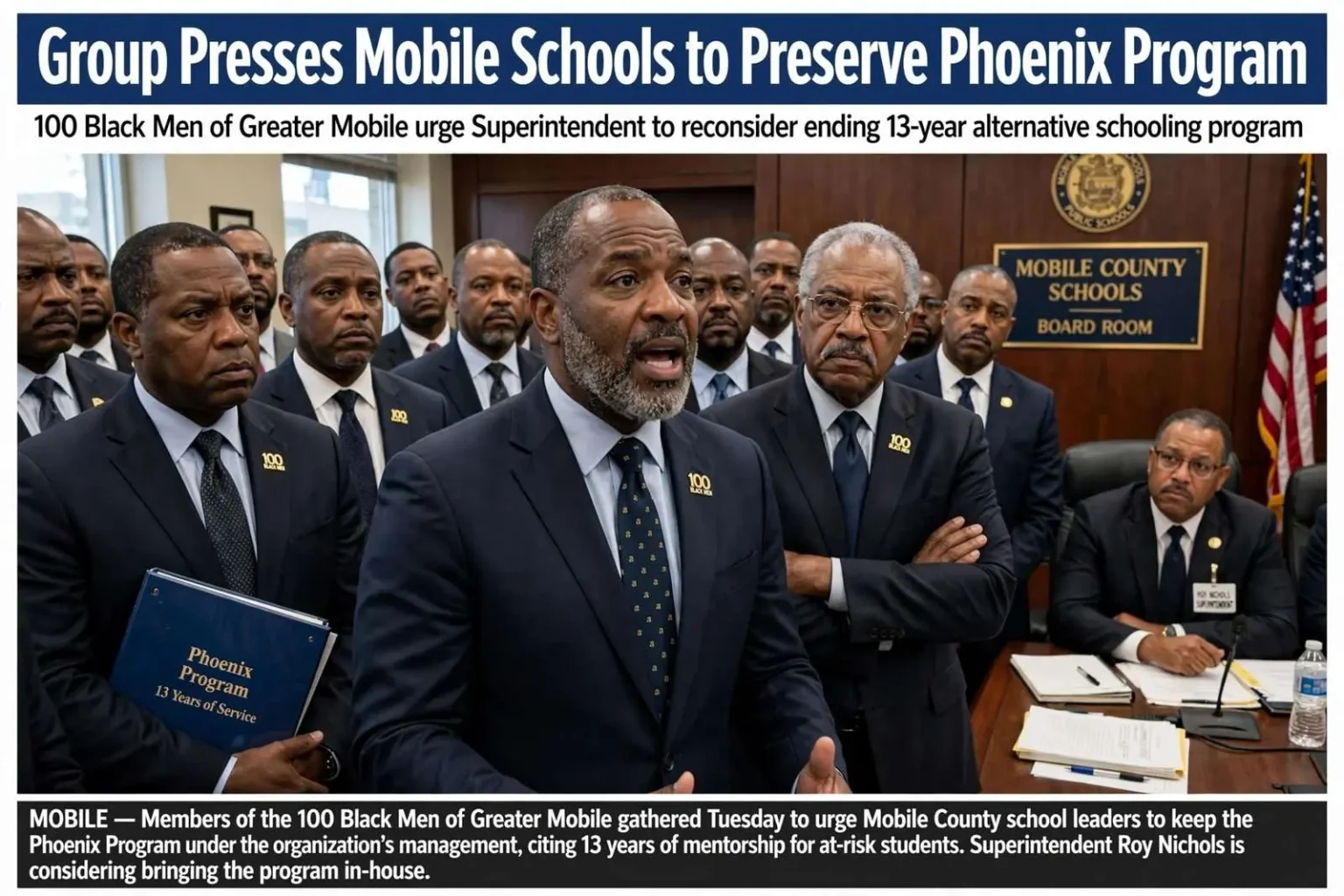
MOBILE – A delegation from the 100 Black Men of Greater Mobile made a public appeal to Mobile County school leaders this week, asking Superintendent Roy Nichols to reconsider a plan that would end the organization’s long stewardship of the district’s alternative schooling program.
An appeal to the superintendent
The contingent, 15 to 20 members strong, addressed Nichols on Tuesday night, urging him to reverse course on his proposal to remove the alternative program from the group’s auspices. The 100 Black Men had operated the Phoenix Program for 13 years, mentoring and counseling students with disciplinary problems, mostly young men who had been suspended for fighting, drugs and similar reasons.
The Phoenix Program occupied a distinctive place in the district’s approach to discipline. Rather than suspending students into the street – where educators and advocates have long warned that unsupervised time tends to compound the problems that led to the suspension – Phoenix kept them enrolled, supervised and mentored while they worked their way back toward regular classrooms. For 13 years, the program had been run not by a contractor but by a civic organization whose members had deep roots in the same communities the students came from.
That history was at the heart of the delegation’s appeal. Members told the superintendent that the organization’s mentors had spent more than a decade building relationships with families, churches and neighborhood leaders across Mobile, and that those relationships were the reason troubled students showed up at all. A new operator, they argued, would inherit the contract but not the trust.
Several bids had been submitted to run the program, but Nichols said an internal management approach would be superior to any of the outside proposals. The superintendent had weighed the competing bids and concluded that the school system could do the job better itself – a judgment that set the dispute in motion and brought the organization before the board to make its case in public.
The numbers behind the dispute
Under the superintendent’s plan, the school system would serve 330 students on a $1.8 million budget, compared with the roughly 200 students handled under Phoenix’s $700,000 program. The comparison formed the backbone of the administration’s argument: more students served, under direct district control, at a scale the civic group had never matched.
The larger figure was not entirely a break with the past. According to a source with knowledge of the details, the $1.8 million for the internal, substitute program included $200,000 for the 100 Black Men so that the organization could continue mentoring the youths. The plan also forgave more than $100,000 that the group still owed the school system for transportation.
Those details complicated the picture on both sides. The district was not proposing to cut the organization out entirely – its mentoring role would continue, funded at a level close to half of what the full Phoenix contract had provided – and the forgiveness of the transportation debt represented a meaningful financial concession at a time when every dollar in the alternative program was under scrutiny.
For the 100 Black Men, though, the difference between running a program and advising one was the whole dispute. Thirteen years of stewardship had made Phoenix the organization’s signature contribution to Mobile’s young people, and the members who stood before the board on Tuesday night described the proposed arrangement as the loss of a mission rather than a change of contractor.
Public support and public scrutiny
The organization had drawn substantial public support over the years. The 100 Black Men of Greater Mobile received more than $4.5 million in public money between 2004 and 2008, according to its latest tax filings, and reported gross receipts of more than $1 million between October 2008 and September 2009.
Those figures cut in two directions. On one hand, they documented years of public investment in the group’s work – money channeled through school system contracts into mentoring, counseling and youth programming across the city. On the other, they invited the scrutiny that follows any organization drawing millions in public funds, and the superintendent’s push to take the program in-house came amid broader questions about how the district’s outside contracts were structured and reviewed.
The debate placed the superintendent and the civic group on opposite sides of a difficult question: whether an established community organization or the school system itself was better positioned to serve some of the district’s most challenging students. Nichols argued that bringing the program in-house would let the district serve more students, while the 100 Black Men contended that their 13 years of mentoring had built relationships and trust that an internal program could not simply replace.
A familiar face in the delegation
Among those in the group appealing to school officials was Herman Thomas, the former circuit judge who had recently fallen short in a bid to unseat state Sen. Vivian Figures. Thomas did not address school officials during the appeal.
Thomas had been tried the previous fall on charges that he coerced young inmates into allowing him to paddle them, allegations tied to accusations of misconduct during his time on the bench. He was acquitted of those charges.
His appearance in the delegation drew attention precisely because of that history. A former judge who had survived a sensational criminal trial and a failed state senate campaign remained active in civic life through the 100 Black Men, and his presence at the board meeting – silent, but visibly among the members – underscored how deeply the organization’s network ran through Mobile’s legal, political and business leadership.
His presence underscored the prominent civic role the 100 Black Men had long played in Mobile, and the organization’s argument that its work with at-risk students was woven into the fabric of the community. The group’s roster drew from the city’s professions and institutions, and its programs had become a fixture of the civic landscape over more than a decade of work with young people whom the schools struggled to reach.
What the students stood to lose
For the students in the Phoenix Program, many of them suspended and at risk of falling further behind, the outcome of the dispute carried real consequences. The young men the program served were among the most difficult to keep in school – students whose suspensions for fighting or drugs put them on a path that educators know ends, too often, in disengagement or dropout.
Alternative programs exist precisely for that population, and their success depends less on curriculum than on the adults who run them. Mentors who know a student’s family, who can appear at a doorstep when a boy stops coming, and who carry standing in a neighborhood are the resource no budget line can replicate. That was the argument the delegation made in person, night after night, as the district weighed its options.
The students’ families, for their part, followed the debate with practical concerns: where their sons would be sent under a new arrangement, who would supervise them, and whether the adults they had come to know would still be part of their school lives.
The larger question of alternative education
The dispute in Mobile reflected a debate playing out in school systems across Alabama and the nation: what to do with students who have been suspended, and who should run the programs designed to catch them. Districts have experimented with in-house alternative schools, contracts with community organizations, and hybrid arrangements, each with trade-offs in cost, accountability and trust.
In-house programs give administrators direct control over staffing and curriculum, and they keep the work inside the system’s own evaluation structure. Community-run programs bring credibility and mentorship networks that a school bureaucracy often cannot build on its own. The superintendent’s proposal represented a bet on the first model; the 100 Black Men’s appeal was a defense of the second.
Cost, capacity and community ties were the three forces pulling at the decision, and each side of the dispute claimed two of the three. The district had the larger budget and the larger enrollment target; the organization had the years of trust and the demonstrated staying power. Neither claim could be fully answered at a board meeting, which was what made the question so difficult.
A decision still ahead
Nichols’ proposal remained on the table as the appeal was made, leaving the future of the program, and of the partnership between the school system and the 100 Black Men, to be decided in the weeks ahead.
The exchange offered residents a window into how the district weighed cost, capacity and community ties in deciding who would guide its most vulnerable pupils. Whatever the board and the superintendent ultimately decided, the public session gave the organization its answer from the community: packed public comment, members willing to appear in the aftermath of personal controversy, and a 13-year partnership argued for as if it were a matter of the city’s own welfare.
For the members of the delegation, the appeal was about more than a contract. It was a statement that the organization’s work with Mobile’s most troubled young men had value that could not be measured in a per-student cost comparison – and that a program called Phoenix, like its namesake, existed to give students a second rise that no other institution in the district could provide.


