Baldwin DA Runoff Turns on Endorsements and Denials
As the Baldwin County district attorney runoff drew near, incumbent Judy Newcomb insisted her endorsement of David Green carried no strings, while candidate Hallie Dixon and a fourth-place finisher sparred over whether her camp had sought his support.
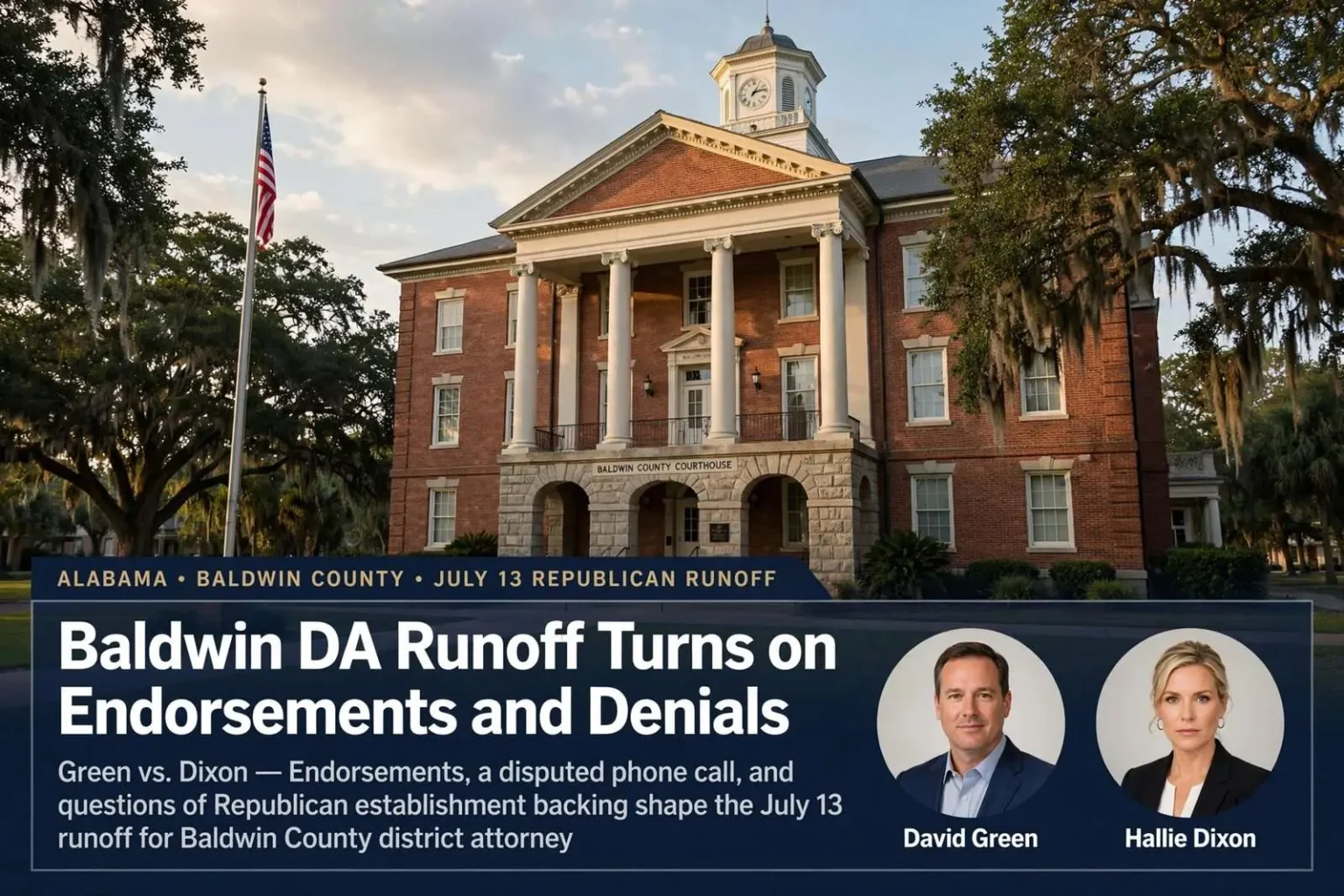
With the July 13 Republican runoff for Baldwin County district attorney approaching, the contest between David Green and Hallie Dixon grew increasingly tangled in questions of endorsements, motives and who had asked whom for support. What might have been a straightforward runoff between two prosecutors — or, in Green’s case, a candidate vying to become one — instead turned into a running argument over who had the backing of the county’s Republican establishment, and whether any of that backing carried invisible strings.
Baldwin County has for years been one of Alabama’s fastest-growing counties, stretching from the tourist economies of Gulf Shores and Orange Beach along the coast to the bedroom communities of the Eastern Shore and the agricultural interior around Bay Minette and Robertsdale. Its district attorney’s office handles one of the heaviest criminal caseloads in the state, and the race to lead it drew an unusual number of serious candidates in the June 1 primary — enough that no candidate cleared the majority threshold required to win the nomination outright, pushing the decision to the July 13 runoff.
Newcomb: No Strings Attached
At the center was incumbent District Attorney Judy Newcomb, who had finished behind both Dixon and Green in the June 1 primary and thus failed to qualify for a full term. In Alabama, a candidate must win a majority of the primary vote to claim a party’s nomination outright; a finish below 50 percent forces the top two finishers into a runoff. Newcomb’s third-place finish meant her own campaign was over, but her endorsement remained a prized commodity — and a contested one.
Newcomb had endorsed Green, and she moved to knock down any suggestion that her backing came with conditions. “The only commitment that David Green has made to the people endorsing him, that I am aware of, is that he will put forth his best efforts to represent all the citizens of Baldwin County,” Newcomb stated. “David’s only promise to me was that upon being elected district attorney and prior to making any decisions on his final plans as to how he will move the District Attorney’s Office forward in the next six years, he will consider and give fair evaluation to all the opinions of law enforcement, judges, prosecutors and citizens, no matter what candidate they supported in the primary election. I did not ask for anything else and I did not offer anything else.”
Newcomb said neither former District Attorney David Whetstone nor current assistants in the office had selfish motivations in supporting Green. The statement was aimed at a suggestion — floated in the closing weeks of the campaign — that Green’s support within the office and among its alumni amounted to a deal to preserve existing arrangements or reward insiders. Newcomb’s six-year term as the county’s chief prosecutor made her endorsement the single most institutionally significant one available in the race, and she was plainly concerned that its value be measured on her terms rather than her rivals’.
Eastern Shore attorney Ken Hitson, who placed fourth in the primary, had also announced his support for Green. His backing gave Green a clean sweep of the two candidates eliminated in the primary whose support was most sought after, and it sharpened the dispute that followed. The statement followed a recent Eastern Shore Republican Women luncheon at which Dixon and Green appeared as guest speakers, and where Dixon distributed a letter that prompted Newcomb’s response. The luncheon was one of the last large joint appearances scheduled before the runoff, and in Baldwin County’s Republican politics, a gathering of the Eastern Shore’s most active primary voters is not a neutral venue — it is the audience both campaigns needed most.
A Dispute Over a Phone Call
The sharpest exchange, however, was between Dixon and Hitson. Dixon declared that her campaign had not sought endorsements and would not. “My campaign has not sought endorsements, nor will we,” she wrote in a post-primary letter. The declaration was central to her campaign’s public identity: Dixon positioned herself as a prosecutor answerable to voters rather than to the county’s Republican network, and soliciting endorsements from the establishment’s figures would have undercut that framing.
Hitson begged to differ. He said he had received a call from the Dixon camp seeking his endorsement after the June 1 primary. “I was contacted by telephone on June 7 at 11:28 a.m. by someone with the Dixon campaign seeking my endorsement,” Hitson said. “I told that person that I would give Ms. Dixon’s request thoughtful consideration. I then notified that same person a week later, on June 14, that I could not express any support for Ms. Dixon, but would instead be supporting David Green.”
Hitson said Dixon’s assertion was “not true and I am flabbergasted that she would say such a thing.” He did not identify the campaign representative. The refusal to name the caller left the dispute at a standoff of competing accounts, but the specificity of Hitson’s recollection — dates and times down to the minute — was calculated to make his version difficult to dismiss. In a runoff fought largely among the same universe of primary voters, a question about truthfulness directed at either candidate carried real weight.
Dixon stood by her account. “To my knowledge, absolutely not,” she said when asked whether a campaign representative had sought Hitson’s support. “I did not authorize a single person in my campaign to ask for his endorsement. I called my campaign manager and to my knowledge nobody in my campaign asked for his endorsement, and I definitely didn’t authorize it.” The exchange effectively consumed the campaign’s closing argument window, replacing discussion of trial experience and office management with a dispute over a single phone call that neither side could prove or disprove publicly.
Qualifications at the Core
Beneath the back-and-forth lay a genuine disagreement over what mattered most in a district attorney. Dixon, a Silverhill native who had served as chief assistant under Newcomb and as a former assistant attorney general, argued that felony prosecution experience was essential and cast herself as the only candidate with the qualifications to serve as the county’s chief prosecutor. Her record inside the office — years of handling felony cases from intake through trial — was the centerpiece of her pitch, and she suggested that the endorsements of Green by figures who had earlier stressed prosecutorial experience contradicted their own stated standards.
Green’s supporters, for their part, emphasized leadership, management and administrative skills. The district attorney’s office in a county of Baldwin’s size is as much an enterprise as a courtroom operation, with a budget, a staff of assistants and investigators, and working relationships with every municipal police department and the county sheriff’s office. Whetstone, who led the office for more than two decades before stepping down in 2006, called Green a man of leadership and integrity who would do an outstanding job. The competing definitions of the job — courtroom prosecutor versus office manager — gave the runoff a substantive frame beneath the personal disputes.
For voters, the choice carried consequences beyond the courtroom. Baldwin County’s population growth had made its criminal justice system one of the fastest-changing in Alabama, with drug cases, domestic violence dockets and coastal-area property crime all straining existing resources. The next district attorney would inherit decisions about staffing, plea practices and courtroom priorities that would shape the office for a full six-year term — the constitutional length of the office in Alabama, and the “next six years” Newcomb herself referenced in her statement.
The runoff also unfolded against the backdrop of Baldwin County’s decisive role in statewide Republican politics. The county regularly posts some of the highest GOP turnout percentages in Alabama, and its party activists — the same circles from which endorsements flow and in which disputes like the Dixon-Hitson exchange play out — form the base of any statewide Republican campaign. A race that ends with lingering bitterness among those activists does not stay contained for long.
With the runoff days away, both candidates pledged to keep working for votes, leaving Baldwin County Republicans to sort through the competing claims before choosing their nominee. Whether the endorsements mattered more than the qualifications dispute — or whether the phone-call fight had changed any minds at all — was the question the July 13 vote alone would answer. What was certain was that the nominee would emerge from a primary season in which the county’s Republican establishment had been asked, repeatedly, to pick sides, and in which both finalists had claimed the same prize: the trust of the county’s voters rather than the favor of its power brokers.
The dispute over endorsements also illustrated how a county-level race can absorb the habits of statewide politics. Campaign letters, dueling statements and exchanges over the precise minute of a phone call are the standard equipment of Alabama’s bigger contests, and their appearance in a district attorney’s runoff reflected the office’s growing prominence in one of the state’s most competitive Republican counties. The candidates themselves had helped raise the stakes: both campaigned across the county’s municipal corridors, from the Eastern Shore to the northern end, in an effort to build coalitions that stretched beyond their home turf.