Three Democrats, Two Tax Bills and a Question of Trust in the District 3 School Board Race
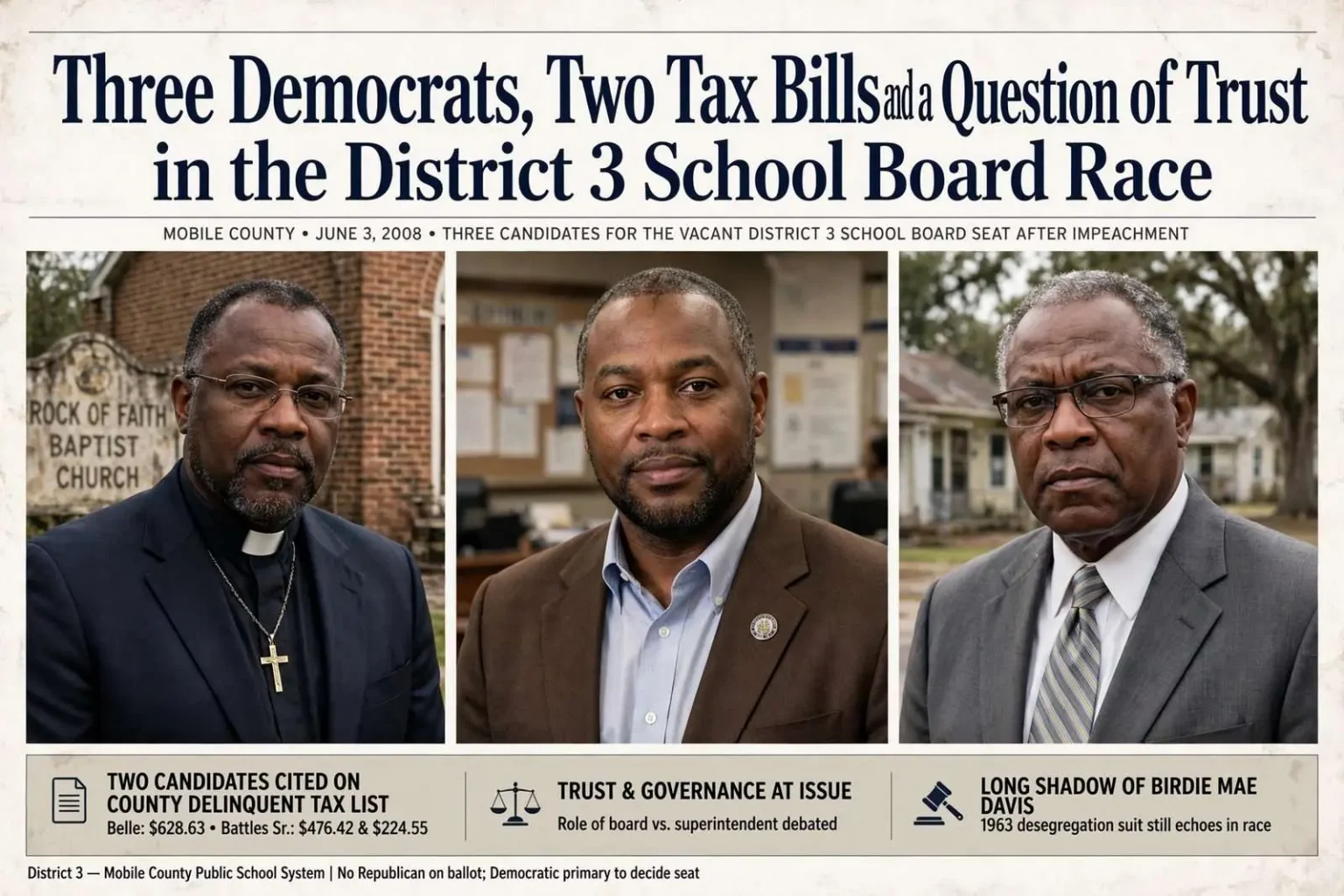
Appointed school commissioner Fleet Belle sought election in his own right in 2008, campaigning on trust between board and superintendent, while he and a rival turned up on the county's delinquent tax list.
The Mobile County school board seat for District 3 came open in 2008 in the least dignified way a seat can come open: its previous occupant, David Thomas, had been impeached. The impeachment — an extraordinary rebuke for a local board member — left the board with a vacancy in a district that takes in some of the city’s oldest and most politically attentive neighborhoods, and the appointed replacement would have to run quickly if he wanted to keep it.
The board appointed the Rev. Fleet Belle, pastor of Rock of Faith Baptist Church, to fill the vacancy. That spring, Belle set out to win by election what he held by appointment. He faced two other Democrats: the Rev. Levon Manzie and Robert E. Battles Sr. All three were seeking the seat in the June 3 primary, and with no Republican fielded for the district, the Democratic primary was, for practical purposes, the whole election.
One thing, in six years
Asked what he would want to accomplish if he could accomplish only one thing in a six-year term, Belle gave an answer about relationships rather than programs. “To be able to help the superintendent to have enough confidence in his board to run the system day-to-day as it should be run,” he said, referring to Superintendent Roy Nichols. “He trusts us; we trust him.”
The answer is more pointed than it may look at this distance. The Mobile County Public School System is the largest in Alabama, and the relationship between an elected board and a professional superintendent had been a persistent source of friction. Boards in the county’s recent history had divided over micromanagement, personnel and the line between policy and administration, and the factional fights that followed had slowed decisions the system could ill afford to delay. Belle’s stated ambition was to establish a working boundary: the board sets direction, the superintendent runs the schools.
That theory of governance carries particular weight in a district like District 3, where constituents have historically expected a board member to fight for their individual schools — a pressure that pulls board members directly into administrative territory. Belle, a pastor whose congregation gave him a ready-made constituency, was arguing instead that the district would be better served by a board member who defended the system’s professional management than by one who forwarded every complaint to the central office.
The impeachment that created the vacancy had itself been the subject of county-wide attention. Board members are subject to removal only in extraordinary circumstances, and the proceedings against Thomas — chronicled in detail by local media — left the District 3 seat burdened with a history its next occupant would have to confront. Whoever held the seat would be asked, at every forum, to explain what the system had learned from the episode and how the board intended to restore the public’s confidence.
The delinquent tax list
Belle also received a piece of free publicity he could have done without. He and his wife, Carolyn, appeared in print among the county’s delinquent taxpayers, listed as owing 628.63 dollars in property taxes — a legal advertisement that newspapers publish annually and that candidates in any race read with dread.
Belle said he had already mailed payment by the time the legal advertisement ran and had received a receipt back. “It’s just one of those things that got overlooked; but it’s been cleared up,” he said. “No excuses.” For a candidate for a board that oversees hundreds of millions of tax dollars, even a small, explained delinquency was an unwelcome headline in the middle of a campaign.
He was not the only candidate on the list. Robert Edward Battles Sr. was also listed as delinquent on two parcels, one for 476.42 dollars and a second for 224.55 dollars. Battles confirmed he had not yet settled the bills but said he would get it squared away that week, describing the period as “a difficult time” for him. Two of the three candidates in the race appearing on the same list gave the campaign an uncomfortable symmetry, and it fell to Manzie — whose name did not appear on the list — to be the beneficiary by omission.
Property tax delinquency lists occupy a peculiar place in local politics. They are published as legal notices — not as news stories — but every candidate and reporter reads them, and in a school board race they carry a particular sting: the board votes on the taxes that fund the system, so a candidate’s own tax record becomes fair ground for conversation. The amounts involved were small, but the symbolism of a school board candidate owing school taxes was not lost on voters in a district where every school’s needs outstrip its budget.
Battles and the long shadow of Birdie Mae Davis
Battles said his candidacy was about starting a conversation regarding the school system’s recent history, and he reached back to the case that defined it. “We’ve receded from where we were in 1971 with the Birdie Mae Davis,” Battles said, referring to the landmark desegregation lawsuit filed in 1963 on behalf of a Mobile student. “We’re more segregated now than we were before Birdie Mae Davis.”
The Birdie Mae Davis case is among the longest-running school desegregation suits in American history. It reached the U.S. Supreme Court, produced decades of court supervision over Mobile County’s schools, and was not formally dismissed until 1997. For thirty-four years, federal judges shaped attendance zones, faculty assignments, magnet programs and capital spending in the county — one of the longest federal oversight regimes any school district in the country has known.
Battles was raising, in a school board primary, the question of whether the decades of litigation had ultimately delivered what they promised. His answer — that the county’s schools had resegregated along neighborhood lines once the court’s supervision ended — resonated well beyond the district lines, because it described a pattern visible across urban school systems in the South: integration achieved on paper during the court-ordered years, then gradually undone by housing patterns, private school migration and the return of local control.
For the candidates who did not share that framing, the argument posed a dilemma. Agreeing meant conceding that the system’s post-desegregation era was a failure; disagreeing meant defending demographic facts that were difficult to defend. The Birdie Mae Davis conversation that Battles sought — thirty years old by then and largely dormant in local campaigns — had a way of making every other school board issue look like a symptom of something larger.
The primary’s calendar compressed everything. With the June 3 vote coming barely months after Belle’s appointment, none of the three candidates had time to build the machinery that normally sustains a countywide campaign; the contest would be decided by church networks, neighborhood associations and whatever attention the tax list generated. In District 3, where school board primaries have historically turned out a small fraction of the electorate, those organized constituencies were not a supplement to the campaign — they were the campaign.
What became of the field
The race is worth remembering for the trajectories that followed. Levon Manzie would go on to a long career in Mobile city government, elected to the Mobile City Council and later serving as council president — a rise that began, in retrospect, with the name recognition this school board campaign provided. The school board seat itself remained one of the more closely watched in a county system serving tens of thousands of students, and its occupant would face years of decisions about construction, consolidation and the superintendent’s office.
Belle’s appointment-to-election arc is a familiar story in Alabama local government. Being appointed confers incumbency but not loyalty; the appointed officeholder must win over voters who had no say in his selection, in a primary where two organized challengers are competing to characterize him as either a caretaker or an insider. Belle’s answer about trust — that a board’s chief task is to support a superintendent it trusts — doubled as a warning to voters about what the opposite looks like: a board at war with its own administration, and a system that serves no one well.
What the campaign showed, in miniature, was the texture of local politics: a candidate explaining his theory of governance, a legal notice in the newspaper embarrassing two of the three contenders, and a challenger using a primary as an occasion to raise a question about segregation that the county had spent forty years litigating and never quite settled. School board races rarely attract the attention they deserve; in District 3 in 2008, the attention the race did attract revealed the whole layered history of Mobile County’s schools — impeachment, appointment, taxes and the long shadow of a lawsuit filed in 1963 by a family whose name most voters had never heard spoken aloud.