Primary Night Redraws the Map in Mobile and Baldwin County Races
Ashley Rich routed Mark Erwin, Vivian Figures turned back Herman Thomas, and Baldwin County's incumbent district attorney failed to make her own runoff, as local observers assessed a night of upheaval.
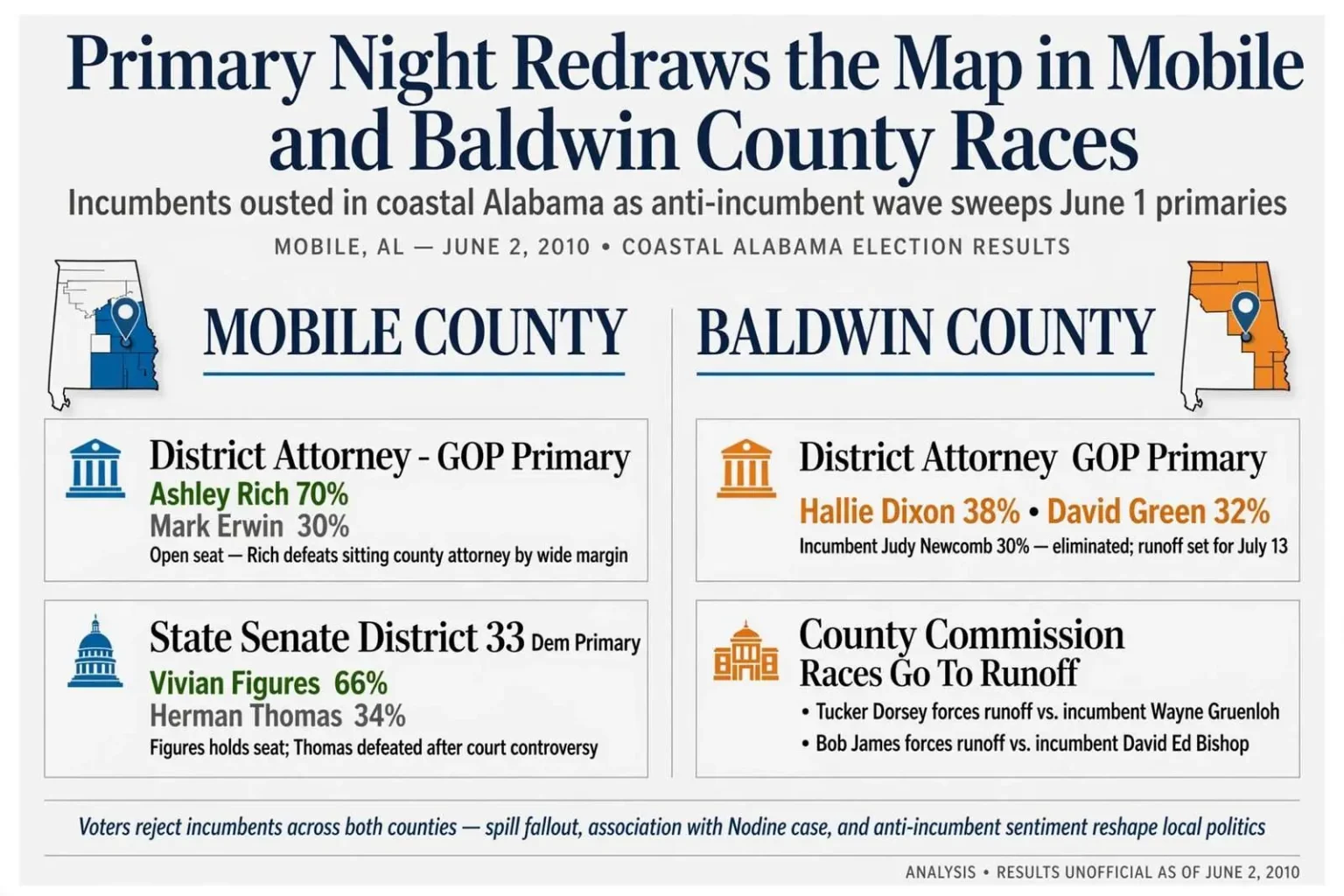
If the statewide results of Alabama’s June 1 primaries surprised the political class, the local returns in Mobile and Baldwin counties rearranged it. An incumbent district attorney missed her own runoff. A former circuit judge was routed by a two-to-one margin. And a first-time candidate for prosecutor won by a landslide that observers struggled to explain by her own strengths alone.
The night was Alabama’s first statewide primary since the onset of the anti-incumbent wave that followed the recession and the Gulf oil spill, and in the two coastal counties the mood translated directly into results. In races from the courthouse to the county commission, experience on the ballot turned out to be a liability rather than an argument.
Rich over Erwin, decisively
In the Republican primary for Mobile County district attorney, Ashley Rich defeated Mark Erwin, the county attorney and chairman of the local party, by roughly 70 percent to 30 percent. The seat was open: longtime District Attorney John Tyson Jr. had chosen not to seek another term, drawing a crowded field of Republican contenders to succeed him.
“Obviously, Ashley Rich is a big winner,” said an attorney identified as BZK. “Seventy-thirty over the GOP chairman is impressive no matter what other factors were at play.”
Nearly every observer traced Erwin’s collapse to a single association: former County Commissioner Stephen Nodine, then facing a murder charge in Baldwin County. Erwin had been reported to have gone to Nodine’s home and removed firearms in the immediate aftermath of the shooting death of Angel Downs, and the image of the county’s top lawyer and party chairman at the scene in the hours after the killing followed him for the rest of the campaign.
“The decision to go to Nodine’s house ‘the morning after’ was his undoing in this race,” said a lawyer writing as CTR, who added that he had expected Erwin to lose but not by that margin.
Several respondents were careful to note that Erwin had not been accused of a crime and was, in the estimation of many who knew him, well qualified for the office. His service as county attorney and his command of the courthouse made him, on paper, the most experienced candidate in the field.
“Mark Erwin would have made a fine District Attorney,” said a Republican official. “The sudden change in his political fortunes will be talked about for a long time.”
Rich advanced to face Democrat Don Foster in November, with the general election to decide who would lead an office that prosecutes everything from capital murder to the county’s sprawling dockets of theft and drug cases.
Rich brought to the race a resume built inside the courthouse — years as a career prosecutor in the Mobile County district attorney’s office, trying cases in the same courtrooms she was running to supervise. That made the Republican primary a choice between two kinds of experience: the insider’s knowledge of a career prosecutor against the institutional knowledge of the county’s chief legal officer. In the end, the voters’ verdict on Nodine outweighed everything else on the scales.
Figures turns back Thomas
In the Democratic primary for state Senate District 33, Sen. Vivian Figures defeated former Circuit Judge Herman Thomas, taking roughly two-thirds of the vote in a contest that had been expected to be far closer.
Thomas had resigned from the bench before facing the Court of the Judiciary, the body that disciplines Alabama judges, and was later acquitted of criminal charges arising from allegations that he paddled inmates. The trial had been one of the most closely followed courtroom stories in Mobile in years, and its aftermath shadowed every step of his campaign.
Panelists read the result as voters delivering a verdict that the courts had not. “I think justice is a big winner,” said an executive identified as SDC. “With clever legal maneuvering, Thomas ducked the legal system. He could not duck the voters.”
The seat itself carries weight in Mobile politics. District 33 has long been anchored in the city’s African-American community, and Figures held it as part of a family legacy in the Senate — a legacy that gave her deep name recognition and an organized base that no challenger could easily crack in a single campaign.
Timing mattered in every one of these races. Alabama’s primaries fell on June 1, late enough that the summer runoffs would be held in the heat of July — July 13 for Baldwin County’s races — with turnout expected to thin to the most motivated voters. Candidates who built enthusiasm in a crowded spring field had to hold it through a six-week lull with no statewide races to pull voters to the polls.
Baldwin County: an incumbent left out
The night’s sharpest local shock came in Baldwin County, where District Attorney Judy Newcomb finished third and failed to reach the runoff. Hallie Dixon, her former chief assistant, led the field, followed by David Green, sending the race to a July 13 runoff.
“For an incumbent DA to draw a crowded field of competitors is a bad sign,” said CTR. “For her to fail to make the run-off speaks volumes.”
Observers differed on what the runoff would look like. Because of the well-known animosity between the Dixon and Newcomb camps, several predicted that Newcomb’s voters would migrate to Green rather than to Dixon — a dynamic that could decide the outcome as much as either campaign’s own effort.
Baldwin County’s district attorney race drew unusual attention that spring because of the Nodine case, which was being prosecuted there and kept the office in headlines across the state. Whoever won the runoff would inherit a prosecutor’s office under extraordinary public scrutiny.
The arithmetic of the runoff was the subject of most of the post-primary discussion. A third-place incumbent’s supporters rarely vote for the rival who ran against her for years; they defect to the alternative. If that pattern held, Green would enter July 13 as the nominal favorite among the two, while Dixon needed to broaden beyond the base that had already backed her — a challenge made harder by the personal history between her and her old boss.
County commission shakeups
In Baldwin County Commission races, newcomer Tucker Dorsey denied incumbent Wayne Gruenloh an outright win and forced a runoff, and Bob James pushed longtime Commissioner David Ed Bishop to a July 13 runoff as well — leaving two of the county’s incumbent commissioners fighting for their political lives in the middle of summer.
“Dorsey simply out worked Gruenloh in the primary election,” said a Republican official identified as NMH.
Several respondents linked the anti-incumbent mood to a trade trip to China that Baldwin commissioners had taken as oil from the Deepwater Horizon disaster approached the coast. The timing of the trip — commissioners abroad while tar balls and oil sheens moved toward the county’s beaches and bays — became a symbol in the campaigns of a commission perceived as detached from the crisis at home.
“Losers: Commissioners Gruenloh, Bishop and Gruber for jetting to China on a junket while biggest disaster to the coastal environment and economy comes ashore,” said a manager writing as PRP.
The spill’s local toll gave the complaint substance. With coastal waters closed to fishing and the beach season collapsing, the county’s economy was absorbing a direct hit at the very moment its elected officials were photographed halfway around the world. Whether or not the trade mission had merit on its own terms, it handed every challenger in the county a ready-made argument about priorities.
Baldwin County, Alabama’s fastest-growing county and one of the fastest-growing in the Southeast, had spent a decade building its commission into an energetic economic development operation. The 2010 primaries suggested that voters wanted that energy focused closer to home, particularly with the county’s tourism and fishing economy reeling from the spill’s shutdown of coastal waters.
An environmental footnote
One environmentally minded respondent flagged a result that drew little notice: Chip Brown, who had taken up the cause of regulating private sewer systems in Baldwin County, lost his bid for the Republican nomination for Public Service Commission.
Brown’s signature issue — the patchwork of privately operated sewer plants serving subdivisions across fast-growing Baldwin — remained unresolved regardless of his race. Whether the Public Service Commission would remain receptive to Baldwin residents’ concerns about private sewer regulation was, the respondent wrote, an open question.
The issue is a persistent one in the county: private utilities serve thousands of homes outside city limits, and rate increases and system failures have repeatedly landed on the commission’s agenda, making sewer regulation one of those quiet county concerns that occasionally decides bigger political fights.
The through line
The observation was itself part of a longer argument in Alabama politics about campaign tone — one that surfaces after nearly every election dominated by attack advertising, and just as reliably fails to change the next cycle. But the 2010 primaries in the two coastal counties offered an unusually clean illustration: in race after race, the decisive moment came not from a policy debate but from a single image or association that no amount of advertising could dislodge.
That verdict captured a primary night in which qualifications and records seemed to matter less than circumstances: an association with a murder case, a paddling scandal, a trip to China, a crowded field. The runoffs that followed — in the Baldwin district attorney’s race and two commission seats — would determine how much of the shakeup endured, but the message from the June 1 electorate in both coastal counties had already been delivered, and no incumbent could afford to ignore it.