
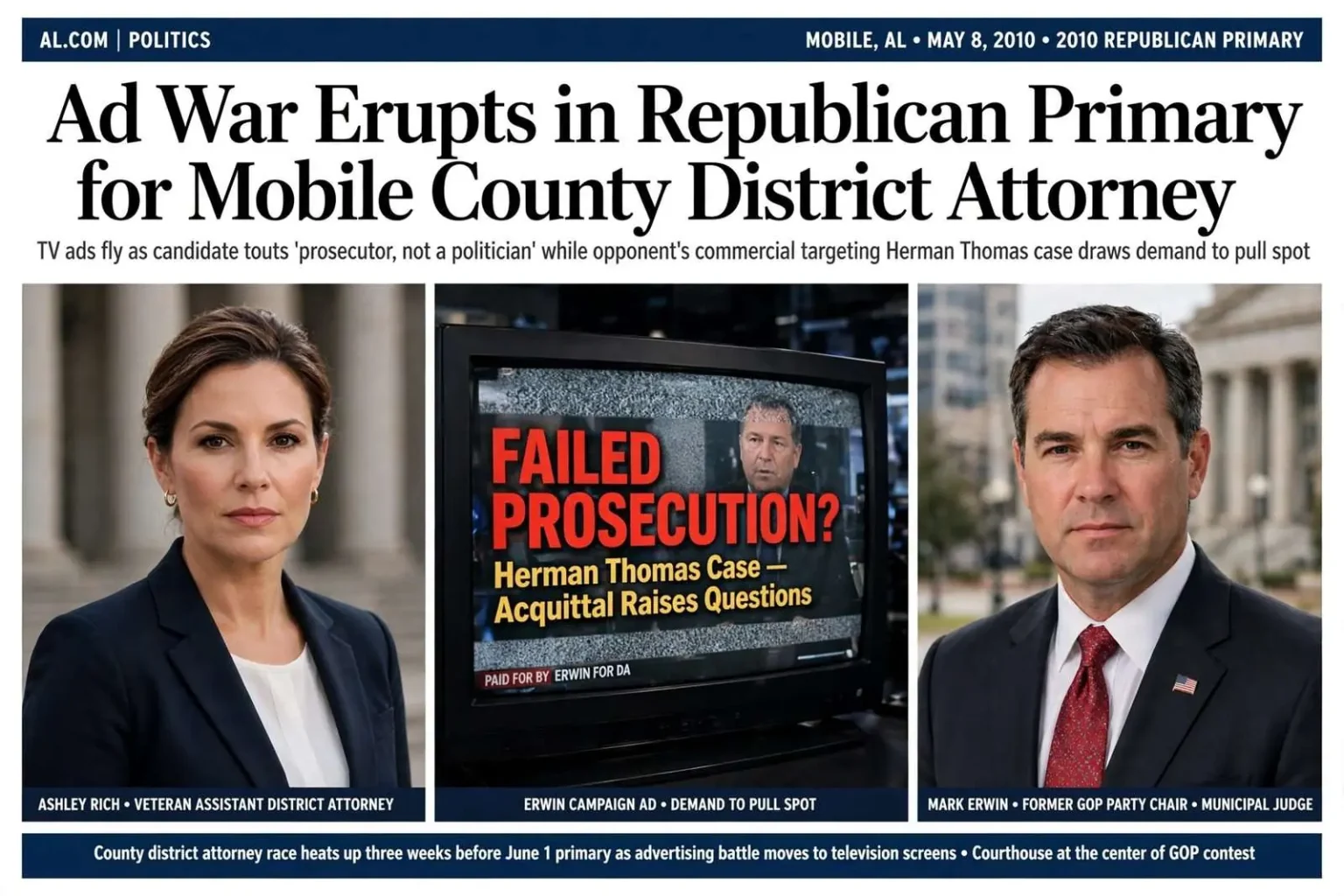
The Republican contest for Mobile County district attorney moved onto television screens this week, with veteran assistant district attorney Ashley Rich rolling out the first in a planned series of commercials and her opponent’s advertising drawing an angry demand that broadcasters pull it off the air.
Rich, a 14-year prosecutor in the Mobile County District Attorney’s Office, built her new spot around a phrase that had become the spine of her candidacy: she was a “prosecutor, not a politician.” The advertisement, which began airing Saturday, May 8, was described by her campaign as the opening installment of a sequence of ads intended to walk voters through her courtroom record ahead of the June 1 party primary.
The framing was aimed directly at the race’s central question. Mobile County’s district attorney runs one of the busiest prosecutor’s offices on the Gulf Coast — responsible for prosecuting every felony and misdemeanor case in the county, from capital murders in Mobile to drug cases across the county’s municipalities — and the office’s top job has historically gone to prosecutors who rose through its ranks. Rich’s campaign argument is that she embodies that tradition: nearly a decade and a half of trying cases, supervising younger lawyers and working with law enforcement, with no political resume beyond the courthouse itself.
A contest over who owns the courthouse
Rich faced Mark Erwin, a former chairman of the Mobile County Republican Party who worked as an assistant county attorney and served as a municipal judge in Saraland. Erwin campaigned on the promise of a fresh start in the prosecutor’s office and pressed the argument that Rich was too closely tied to John Tyson Jr., the Democrat who had run the district attorney’s office for 16 years.
The strategy set up an unusual dynamic for a Republican primary: two GOP candidates arguing less about each other’s politics than about their distance from a Democratic incumbent who was not on the ballot. Tyson’s long tenure made him the race’s invisible third candidate — Rich running as his heir by experience, Erwin running as his repudiation by party and philosophy.
Erwin’s commercial leaned on that theme with a rhetorical style that observers said recalled Ronald Reagan’s famous question to voters in the 1980 presidential campaign and George H.W. Bush’s hard-edged treatment of Massachusetts Gov. Michael Dukakis in 1988.
The echoes were deliberate. Reagan’s 1980 refrain — asking Americans whether they were better off than four years earlier — turned an incumbent’s record into a referendum, and Bush’s 1988 campaign built a similar structure around his opponent’s record and associations. Importing that architecture into a county prosecutor’s race signals a campaign that believes the office’s status quo is its best target, and that the fastest route to a Republican nomination runs through dissatisfaction with the incumbent’s management of the courthouse.
The Herman Thomas ad and the demand it be pulled
Erwin’s spot criticized the Tyson office for its handling of the prosecution of former Circuit Judge Herman Thomas, the case widely known locally for allegations that Thomas had paddled inmates. Thomas was acquitted at trial.
The case had hung over Mobile County politics since the charges were filed: a sitting circuit judge accused of spanking and abusing inmates and detainees he had encountered from his judicial career, tried amid intense local attention, and acquitted by a jury. For Erwin’s campaign, the acquittal was evidence of prosecutorial failure — an argument that the office had mishandled a marquee case and lost it. For the Tyson office and its defenders, an acquittal by a jury was the system working, and blaming prosecutors for a verdict second-guesses the very process prosecutors are sworn to serve.
The advertisement’s use of the case drew an immediate objection: the Herman Thomas campaign demanded broadcasters pull the ad off the air. By the spring of 2010 Thomas was running for the Alabama Senate in District 33, challenging the incumbent, and his camp argued the commercial’s treatment of the case crossed the line into unfair attack — dragging his name into a race he was not part of, for an office he did not hold.
Broadcast stations rarely pull political advertising over such demands. Federal law grants candidates broad protection to have their ads aired, and stations generally decline to referee factual disputes between campaigns, leaving complaints about political spots to be litigated — or, more commonly, argued loudly in the press, which is often precisely the point.
Why the district attorney’s race matters this much
County district attorney races rarely draw this kind of attention, but Mobile County’s office is not a typical prosecutor’s shop. The District Attorney’s Office handles tens of thousands of cases in a metropolitan county of more than 400,000 people, coordinating with every municipal police department from Mobile to Saraland, the Mobile County Sheriff’s Office and state and federal agencies. Its policies on charging, plea bargaining, capital prosecution and diversion programs shape the county’s jail population, its court backlogs and, ultimately, questions of justice that affect thousands of families a year.
Tyson’s 16 years at the head of the office gave the position unusual visibility. A Democratic incumbent in an increasingly Republican county, he held the post across multiple terms and made the office a presence in everything from death-penalty prosecutions to child support enforcement. Whoever succeeded him would inherit a large professional staff and the political question of how much of his administration to keep.
That succession question is precisely what the primary has been about. Rich’s argument — continuity by a career prosecutor — and Erwin’s argument — change by a Republican outsider with his own legal credentials — are the two classic answers to any long-tenured incumbent’s departure, and both campaigns have spent the spring making them in forums, mail and now television.
Television money and the June 1 sprint
The arrival of television advertising in early May marks the point in any local campaign where money and message converge. Broadcast buys in the Mobile-Pensacola market are the largest single expense most countywide candidates undertake, and the timing — three weeks before the June 1 primary — reflects the standard play: saturate the airwaves in the final stretch when voters are finally paying attention.
Rich’s plan to follow her opening spot with a series suggests a campaign confident in its script: introduce the candidate as a prosecutor, enumerate the record, and let the biography do the arguing. Campaigns that structure their television in sequences typically reserve their strongest contrasts for the closing ads, when late-deciding voters tune in.
Erwin’s ad, and the fight over its airing, shows the other side of the arithmetic: a challenger who needs to move numbers in a short window uses contrast advertising to attach the incumbent’s record — or the incumbent’s successor-in-waiting — to his opponent. The complaint from the Thomas campaign, whatever its broadcast consequence, guaranteed the ad’s message received more attention than the buy alone would have purchased.
The Republican side of the courthouse
The contest is also a snapshot of the Republican Party’s consolidation in Mobile County. A generation earlier, the district attorney’s office was a Democratic stronghold in a Democratic county; by 2010, both contenders for the office were Republican, the party chairmanship Erwin once held had become a meaningful launching pad, and the real election in a countywide race increasingly took place in June rather than November.
The result is that GOP primaries now decide prosecutors, sheriffs, judges and county commissioners in Mobile County, and those primaries attract candidates with genuinely different resumes — the career prosecutor versus the party activist, the insider versus the fresh start — rather than candidates separated by party ideology. On the issues of crime, punishment and the administration of justice, both candidates in this race were running as Republicans in a county that now effectively elects its courthouse by primary.
Between the ads, the complaint and the June 1 deadline, the campaign’s final weeks were set to be consumed by the same exchange: Rich’s camp pointing to her courtroom career and asking voters to keep a prosecutor’s office in a prosecutor’s hands; Erwin’s camp pointing to 16 years of one administration and asking voters to try something new. The voters who settle that argument will have watched it unfold, this week at least, on their living room televisions.
The Thomas case’s long shadow
The Herman Thomas prosecution was bound to surface in this campaign no matter how carefully either side managed it. Trials involving former judges are rare anywhere, and the allegations in the case — that a circuit judge had physically abused inmates, some of them men he had sentenced from the bench — made it the most discussed courthouse story in Mobile County in years. The acquittal did not settle the public argument; it only moved the argument from the jury room to the political arena, where questions about charging decisions, witness preparation and case selection are fair game for anyone running to control those very decisions.
That is the uncomfortable intersection this primary illustrates: the tools prosecutors use — discretion, publicity, case prioritization — are the same tools a challenger can critique in a campaign, and there is no referee above the voters. Rich’s campaign must defend an office’s record without owning its losses; Erwin’s campaign must attack that record without disparaging the verdict of a jury. Both walks are narrow, and the Thomas case is where each is being tested.
For the candidates’ overlapping worlds, the race also blurs lines that usually stay distinct. Thomas himself, a former judge turned Senate candidate, is connected to both campaigns’ arguments; broadcasters field complaints from a man featured in an ad for a race he is not in; and a district attorney’s race doubles as a referendum on the courthouse’s recent history. In a county where courthouse politics and electoral politics have always shared a hallway, the 2010 primary simply puts the arrangement on television.